November 2004 — Solar Village
Publisher's Message
Next steps In this issue we explore the first draft of plans for a Solar Village. Here is your chance to become part of something that will change things for the better. Sustainable living is possible for the majority of us and by building a community like this we will all learn how. A shared community will enable us to communicate, demonstrate, educate, and test new and even more holistic ideas for Natural Living. Things are aligning as these words are being written.
This past fall several people informed me that they are ready to purchase a home in the Solar Village project. We've been sharing the idea for several years now and it looks like the level of interest is reaching the point where we can begin to make concrete steps forward. This issue is dedicated to sharing the vision and plans as they are currently drafted. As these ideas and plans are further refined we will continue to share them through the pages of this journal.
We are planning a trip to Europe next spring, to visit several sustainable community developments. This trip will provide input, ideas, proven concepts, and planning tools for further developing and detailing of the Solar Village. We are hoping to purchase land in the spring of 2005.
Land and location of the land pose a major hurdle to the development. Without knowing the specific location, site features, and pricing for the land, all other parameters of the project can only be estimated. As a means of developing the plan and encouraging a collaborative and educational experience, we will be teaming up with local universities in order to do site analysis, development plan ideas, and on-going educational collaboration. These partnerships and ideas will then be leveraged for future projects that will take the Solar Village to a larger scale, which will represent how we can transform both our suburbs and city downtown cores.
Some of the concepts within the plan require further investigation. These concepts include:
Modular construction systems that incorporate sustainable techniques while lowering costs
New models for local shared energy utilities integration
Small-scale sewage waste processing using Living Machines
Diversity of community facilities so that work, food, and transportation is local
Local organic food, clothing, cleaning and goods for both the local and surrounding community
Café and learning centre so that surrounding communities can experience the Solar Village of the future These ideas, however, provide potential for sustained growth as an organization. As we all turn to Solar Villages for ideas, we will develop the methods, knowledge, and experience required to create and transform our communities.
Time to get to work. If you want to be a part of this incredible opportunity, contact me today!
John Wilson, Founder of the Natural Life Network E-Mail: john.wilson@naturallifenetwork.com
Natural Living Journal John D. Wilson - Editor Natural Living Journal Published by World Peace Communications Copyright ã 2004 John D. Wilson Our Web Site: www.NaturalLivingNetwork.comE-Mail: john.wilson@naturallifenetwork.comPhone: (519) 942-3266 ADVERTISING SALES: Leigh Geraghty, Advertising Representative, (519) 942-3266, leigh.geraghty@sympatico.caCONTRIBUTE: We are always looking for new, interesting and inspiring stories, pictures, and poetry, about people who are achieving a natural lifestyle. If you would like to contribute an article or story then please send us a note with your idea. Contact John Wilson by email at john.wilson@naturallifenetwork.comAll contents of this issue of Natural Living Journal are copyrighted by John Wilson, World Peace Communications, 2004. All rights reserved. Printed in Canada.
Join us!
NAME
ADDRESS
CITY/STATE/PROVINCE ZIP/ POSTAL CODE COUNTRY
PHONE
YES! Sign me up for Natural Living Journal. Orders must be prepaid. Here is my check/money order in U.S funds (Canadian orders in Canadian funds). Subscriptions/ membership includes shipping, handling and applicable taxes. $29 - Individual - 1-year subscription and membership, paperless Internet delivery, requires email (12 issues) $59 - Business - 1-year subscription and membership, paperless Internet delivery, requires email, and business directory listing with logo (12 issues) Membership includes answers to three questions (no more than one per month) through email for a year. To order online by credit card go to www.NaturalLifeNetwork.com. Send all subscriptions and renewals to payable to World Peace Communications. Mail to:
World Peace Communications
248108 5th Side Rd., RR# 5 Orangeville, ON L9W 2Z2, Canada
Solar Village
Introduction
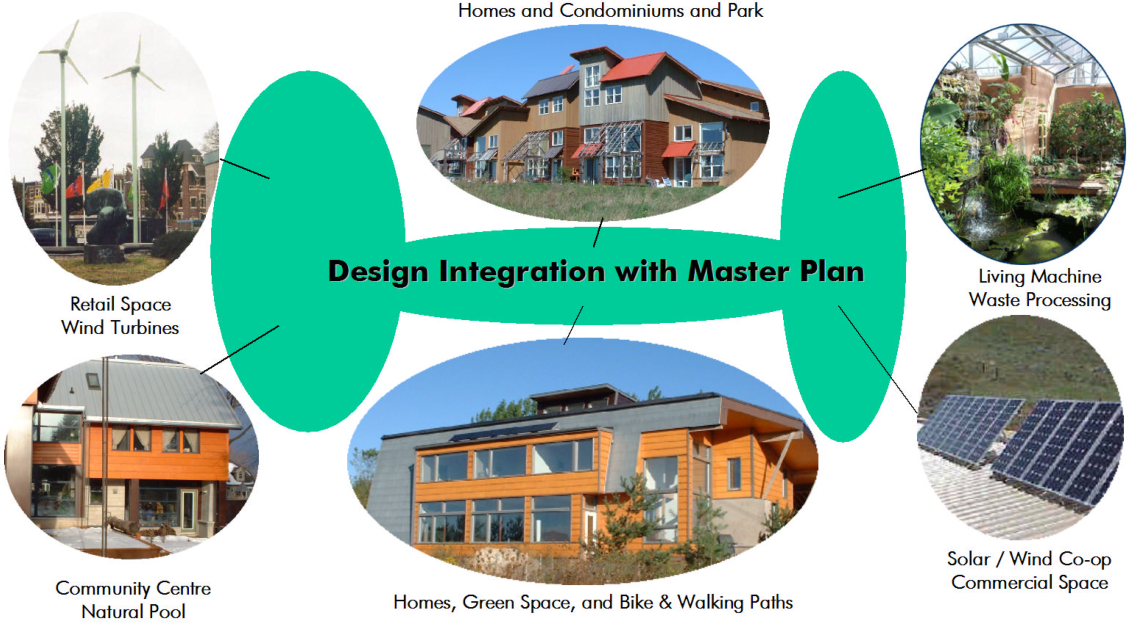
The Solar Village is a sustainable community development organization that combines the services of designers, developers, educators, planners, engineers, and sustainability experts. The organization is driven to meet the needs of community members while generating sufficient profits to grow the organization in support of increasing demand for sustainable community developments. Development projects are undertaken with increasing levels of complexity and size, building greater levels of design integration, efficiencies of scale, and combining holistic approaches that will transform the community in favor of long-term sustainability. The first project will be limited in scale in order to develop the organization, further refine objectives, goals, and future larger scale community development ideas.
Plan
The Solar Village is a community development organization focused on building with sustainable best practices. Services of the organization are designed to provide an integrated approach to sustainable development. With a strong understanding of sustainable design, construction, and community education, the group is in a solid position to design and implement increasingly sophisticated sustainable communities.
Key Initiatives and Objectives
In the short term, the ideas and designs will be explored, detailed and refined, through a small-scale community development. By combining best practices and experience from around the world, a world-class team will create a model sustainable community in the first Solar Village. The remainder of this year will focus on refining the organization and the key participants. If you are interested in being involved, now is the time to join us. In the New Year, we will focus on the following primary objectives:
1. Gather information on specific site development locations including land costs, development restrictions, financing options, partnerships and development charges. 2. Engage a design firm with specialization in sustainable home and commercial building design. 3. Work with a University in order to do site selection analysis and high-level design ideas. 4. Engage a financial institution for development financing. 5. Secure sufficient financing for the purchase of land. 6. Purchase land for the development of the first Solar Village project. 7. Obtain commitment from five to ten future residents. 8. Obtain commitment from one or two future commercial tenants or owners.
9. Complete construction of the sales center and future community center in order to display the plans for the community, and ideas for future communities developed by University students.
Marketing Opportunities
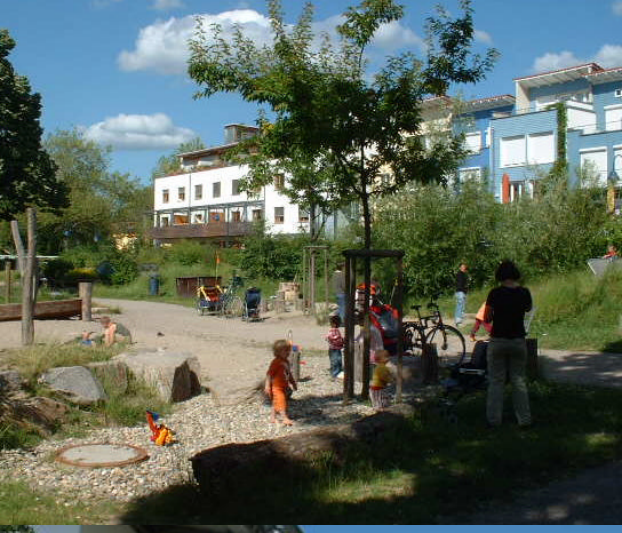
Sustainable community development is still in its early stages of development. While there has been progress in other parts of the world, the Toronto area lags behind. Proving the value and viability of sustainable community development requires significant effort. Many large and medium-size community development companies exist with little or no plans for any kind of sustainable initiatives. As these and other firms begin to see the opportunity, groups such as the Solar Village will be able to leverage a combination of experience, strategy, and unique expertise. As the price of energy rises and binding international commitments force Canadians to address climate change, the unique holistic solutions offered by the Solar Village will mean increased demand - in fact the necessity - to incorporate Solar Village ideas.
Competitive Advantages
Most competitors face significant limitations in that they are tied to existing modes of community development, old methods of construction, and short-term views. The partners and investors at the Solar Village have many years of experience designing and building the most progressive and respected homes in the country. This focus on innovative and holistic sustainable design has resulted in the most highly awarded projects. These awards are combined with a strong understanding of the bottom line and strategic issues required to complete projects. The focus is on developing an organization that is business driven while delivering sound, inspiring sustainable communities, in partnership with the community.
Marketing Strategy
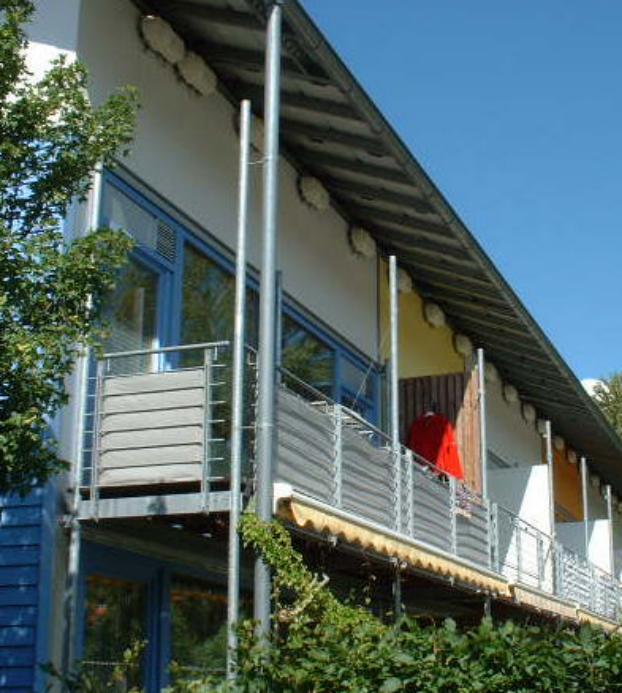
The Solar Village expects to sell through word of mouth, the web site, and public presentations. The marketing strategy will leverage a documentary DVD to promote the concepts to be incorporated into the community so that people can see before they buy (Order the DVD today at www.NaturalLifeNetwork.com/documentary/ ). Once the land has been secured and development plans produced, a large scale media campaign will be undertaken to let the public know that the worlds best, awarding-winning builders and designers are creating the world's most innovative sustainable community in the Toronto area. Public presentations will display these designs, show the documentary, and allow for direct sales to the public.
Healthy by Nature
The Solar Village is an idea whose time has come to your neighborhood. Several critical factors have conspired to make now the time for a transformation of our conception of community. These factors include:
· Rising costs and risks of fossil fuel and nuclear energy, especially as limited reserves of fossil fuels (depletion is expected in the next 40-50 years) increase in demand as supply declines (energy is the largest portion of the world economy).
Increasing awareness and acknowledgement that we must act now to forestall climate change with the devastating effects of exponential growth rates (e.g. population, temperature changes, pollution levels etc.).
People now realize that the cars, SUVs, trucks, electricity, garbage, sewage and industrial pollution they create is directly related to millions of premature deaths every year.
Threats of economic instability, terrorism, and war create a culture of fear that tunes into TV, inaction, and apathy in order to cope, further reinforcing the notion that change is neither possible nor desirable.
Economic security, health, education, and the environment top peoples' concerns politically, culturally and personally as people seek for answers to the many obvious problems. Around the world sustainable communities exist and thrive, proving the viability and benefits of communities that rely solely on renewable energy. Ancient cultures remind us of the time-honored means we have developed to live, like the rest of nature, upon the daily allotment of solar energy. We know how to efficiently and effectively combine new and old techniques to live in balance with natural systems, within limits, and using closed loop natural cycles rather than open ended, unlimited growth models. These are the concepts that will make the Solar Villages of the future into safer, more secure, freer, and healthier communities than any that have previously existed. Solar Villages around the world can address the priority concerns of the majority of people, give hope in the face of so much fear, and deliver the benefits of economic security for the long term, improved health, and a sustainable means of coexisting with the natural world.
Overcoming Myths
Before we begin the next phase, we need to dispense with some of the myths about solar power so that we can build upon firm ground instead:
Myth 1, solar only works in sunny parts of the world.
Sustainable design award winning Wilson Natural Home in Canada uses passive solar design to eliminate the need for a fossil-fuel-based furnace, for the same cost as a conventionally built custom home.
Photovoltaic solar panels actually operate more efficiently at colder temperatures partially making up for reduced levels of sunlight.
Colder climates generate much high intensity and consistent wind (a byproduct of solar energy) during the colder months. Colder wind, being denser than warmer wind, allows wind generators to produce more electricity during the winter. Myth 2, solar energy is too expensive.
If the massive subsidies and hidden costs of fossil fuel and nuclear were incorporated into their costs then they would be more expensive than solar sources.
The Wilson Natural Home that incorporates passive solar design was built at the same cost as a conventionally built custom home.
By increasing economies of scale, the cost of solar and wind power will soon be lower than other
sources, despite the subsidies for other sources of power. Myth 3, solar isn't as reliable as other sources.
Solar hot water heaters have proven so reliable and useful most homes in Cyprus have had one for decades.
Photovoltaic solar panels are a solid state, silicon based system, with no moving parts - making them the most reliable source of energy for military, coast guard, and space travel.
Windmills more than four hundred years old are still working. Myth 4, solar is not practical in urban areas.
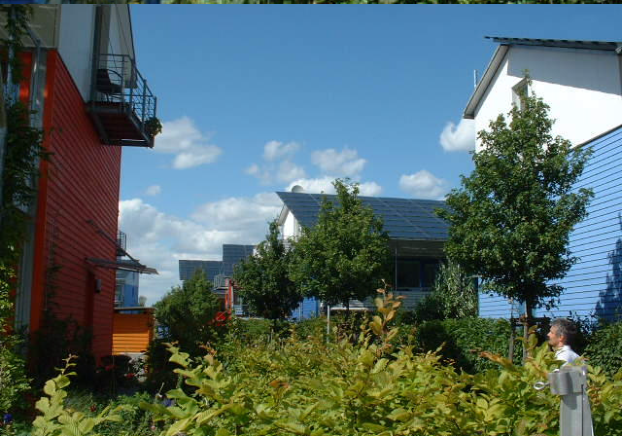
The city of Freiburg, Germany (see last months issue of this Journal), proves this completely wrong with more than 3,000 homes already built with solar energy systems incorporated.
The first large urban wind turbine (powerful enough to provide power to 250 homes) in North America was erected in downtown Toronto, just several meters from one of the busies boulevards in Canada, and now is a powerful symbol of the potential for renewable energy. Solar energy continues to improve. When combined, solar energy in the form of passive solar design, solar hot water heaters, wind turbines, windmills and biomass make it not only possible, but also economically sensible, sustainable for the environment, and a requirement to prevent climate change. The Solar Village community development will be the next level of holistic design integration that finally topples every last myth - decisively.
Opportunity
The sustainable community of the future, the Solar Village, will serve the true needs of the residents first and foremost. Why haven't Solar Villages taken hold yet? Take energy for example. Energy is the largest industry in the world. The energy choices we are offered are the result of large corporate control of sources, complicated expensive technology requirements, corporate influence over government in order to garner massive tax subsidies, and media control that influences consumers to the extent that alternatives aren't even considered. Nuclear power also hides behind the little known fact that tax-payers have subsidized construction, never-ending fixes to lemon reactors to the tune of billions of dollars annually, and continued subsidy through the hidden costs of risk, disposal and future shut-down costs. Nothing but the corruption of profit-loving corporate control can explain this insanity. The Solar Village proves that we can harness all the power we need from the sun, as we have done for more than 95% of our history. It can and must be done if we are to survive.
Solar Villages offer a new decentralized source of energy for communities. Solar energy means local sources of sun, wind and biomass energy, available locally such that we will not be at the mercy of government and corporate energy conglomerates. It means freedom, economic security, clean air, and no more unnatural climate change.
Vision Plan
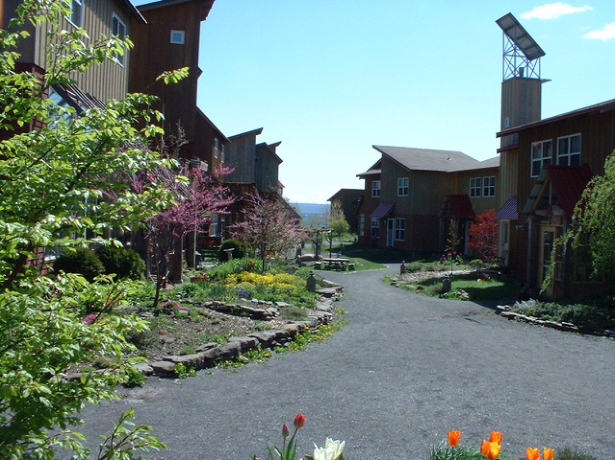
The site plan, layout and construction design should reflect the balance of elements in nature. This place will be a community with nature that clearly shows how sustainable building, energy systems, living, agriculture, and community grow from the earth. The community will embody a feeling of connection, wholeness, and health - so much so that it will spread beyond. Visitors, residents, workers, politicians, business people and media will know that a sustainable future is possible, achievable and desirable. Inspired by nature this community will demonstrate sustainable, symbiotic balance through landscape, agriculture, housing, community, and transportation integration. This richly natural place will inspire people who visit to become the changes they see, hear and feel all around them. Picture an oasis village atmosphere, full of life, natural sounds, and beauty all around, welcoming everyone.
Place
The landscape and buildings must be a direct and simple expression of nature's solar power. Healthy, natural, renewable materials will reflect the local site conditions. Man-made structures and nature should mingle and coexist as though one and the same, and yet fully alive, and full of humanity. The feeling of just being in this place will attract people from all over the world. All of the ideas, creativity, materials, processes, principles, values and concepts required to replicate the essence of the place should be laid bare, easily accessible, and open for all to learn from.
Community Center
The central hub of the community should be an open and inviting community center designed to welcome visitors, bring community members together, and provide an education facility for those interested in learning how to build a Solar Village. Some space will be left to allow for a small-scale bed-and-breakfast for visitors that come from a distance. An educational exhibit, welcome desk, café, and organic food store will share a common outdoor patio and indoor seating area. The central exhibit should revolve around a circular skylight area modeled after the teepee, but incorporating natural cooling and lighting systems, for passive heating and cooling. Construction of the community centre should be straw bale walls. The entire community center should be powered by photo-voltaics, a wind generator, and perhaps a hdyro generating system of some kind. A Living Machine will be a central part of the sustainable living exhibit and process the sewage waste for the entire community. The use of gray water and rainwater will be made visible. All systems will need to have descriptive signage and multi-media explanations available by touch screen. A shared theatre, meeting room and presentation centre will allow for residents and business to present videos, educational material and business presentations. Exhibits on display should also provide details on other solar village type communities, what others have achieved, and people who have been instrumental.
Early in the development the landscape should be naturalized and allowed to create calm, serenity and beauty so that when construction has completed, the surroundings will be well established.
Some of the land will be set aside for local agriculture that can supply the organic food store. Parts of the land may be planted with apple trees, pear trees and other fruit trees to supply the organic food store and community members.
Other features that may be included:
· Natural swimming pool or pond
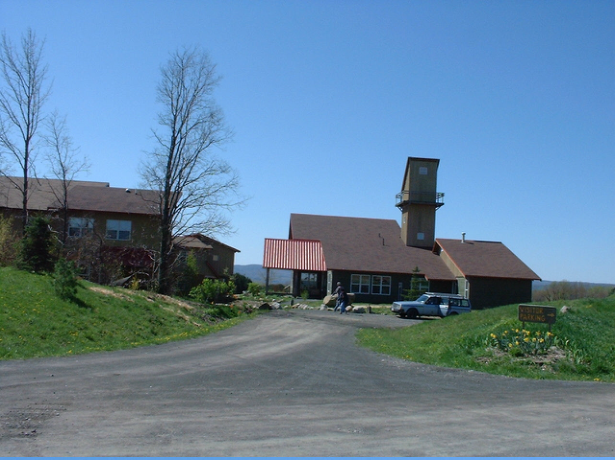
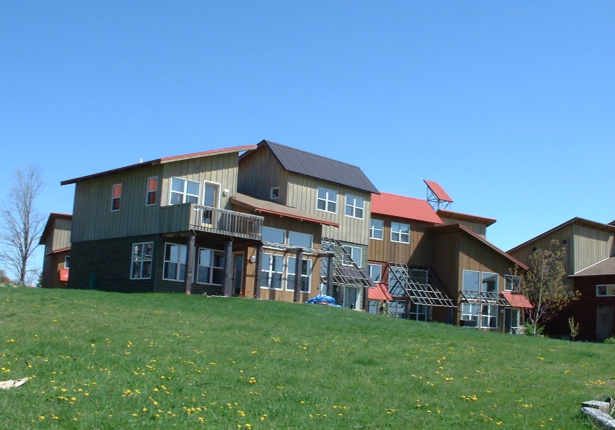
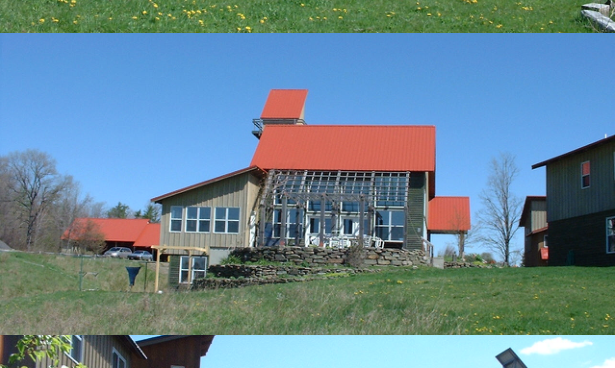
Sculptures that represent sustainable living, indigenous peoples buildings, and community elements
Landscapes that allow the transition of seasons to be celebrated
Walking and biking paths
Outdoor parks where kids and adults can play
Shared hybrid or electric vehicles parking
Electric bus service to transit services
Future Solar Village Projects
Several projects will develop the ideas and concepts, financing larger and more ambitious rejuvenations, leading towards a downtown complex that proves it can be done within our existing city cores. Energy requirements will be met through a variety of solar systems including site orientation, efficiency of design, insulation, passive solar, solar hot water and active solar. Wind power will have a place. Diversity of design will integrate and demonstrate the creativity so abundant in natural environments. The village will include buildings half in the earth, half out, EarthShips, earthen walls, natural building materials, rocks, soil on roofs, and plants growing on buildings. Re-use of materials, non-toxic materials, sustainably harvested materials, and local resources will be used. A state of the art renewable energy system will be tightly integrated with each dwelling as well as a shared utility of the community. Agricultural areas will be shared, integrated with naturalized areas, and organic. A community center, the welcome center, clear signage, easy to understand pathways, exhibits, and commons must welcome as many people as possible. Interactive learning exhibits will offer visitors a chance to learn, hands on, so they will see how it all works, and how they too can do these things to be sustainable.
Waste will be reprocessed back into the earth naturally. Organic composting techniques, living machines, and natural reprocessing techniques will turn "waste" liabilities into assets for the community to use. Rainwater will be collected and used for landscape, agriculture, and toilets. Grey water will be recycled for use in landscape, agriculture and other areas where the nutrients in this resource can provide value. Nature will be the exposed guide to the magic of transformation.
Shared Values
The Solar Village creates a new community within an existing community, near public transit for easy access by residents and visitors. It provides an inspiring place to learn hands-on how the rest of the city and all cities can be transformed to provide a sustainable lifestyle. Three pillars of the community will include:
1. Sustainable Living Science Centre, an experience oriented, hands on public facility for researching, teaching and learning about community sustainability. 2. High-density sustainable housing, and shared community natural spaces. 3. Business retail and office spaces with a focus on sustainability. This provides a world-class premier destination for the public, business and academics to study and learn how they can incorporate sustainable practices in an urban environment. It uses the principle of being the change that is required to create sustainable communities.
Principles
1. Be the changes required to demonstrate true sustainability. 2. Generate all required energy using only renewable sources (no fossil fuel or nuclear power). 3. Process waste so that it becomes an asset. 4. Provide opportunities for residents and visitors to reconnect with nature. 5. Provide a systematic approach that is reproducible at different scales and locations.
Goals
1. Facilitate the sustainable transformation process by welcoming more than 100,000 visitors per year. 2. Be recognized as the world's best centre for the demonstration of sustainable living in an urban setting. 3. Generate all required renewable energy locally. 4. Produce all food organically for community and visitors. 5. Process waste locally using composting and Living Machines. 6. Provide two-way outreach within the local and surrounding community. 7. Provide a saleable model that can be replicated around the world.
Economic Benefits
Annual Savings Estimate (Per 3000 sq.ft. building)
Electricity - $500-1,000
Oil/Gas - $2,000-3,000
Transportation - $500-1000
Food - $500-1000
Themes
Promotes an integrated planning culture - goals and measures of the urban development project are chosen at an early stage, integrating significant sectors from administration, local politics, experts and citizen representatives. On-going monitoring continues through the project. Structures and procedures are transparent.
Use new forms of citizen participation - ensure financing supports this, participation is visible and accessible, independence is important.
Implement sustainable transport and mobility concepts - plan to reduce and avoid traffic, support ecologically sound transportation, promote car-free options and areas.
Promote environmentally sound and healthy building measures - use resource saving building materials, healthy and environmentally friendly building materials and concepts, attractive designs that will stand the test of time; natural cycles must be respected including soil, water and air; biodiversity is protected.
Ecologically sound energy supply and minimal energy consumption - passive solar design, insulation, co-generation and renewable energy, especially solar energy for heating, hot water and power production, modern energy services like least-cost planning, contracting and demand-side management.
Strengthen regional economies - focus on the local economy, increased local democratic management of development, local materials, new jobs, increased participation of women, small and medium-size business, faster to react to change, and turning ideas into marketable products more quickly.
Design socially oriented living spheres - good accessibility to social and cultural facilities, places for education, shopping, public spaces, recreational areas and public transit, mix of living and work space, privacy and communication, provides identification for residents and a diversity of living spaces for different phases of life.
Mix requirements with supporting measures - ambitious minimum requirements for sustainability measures, voluntary measures are promoted through advisory services and financial incentives.
Cultivate good contacts and exchange of experiences - spread good practices; networks are good tools for exchange.
Courage to leave the beaten track - exciting opportunities for initiative are used proactively to follow goals of sustainable development, unconventional solutions can sometimes make a big difference. (Based on themes developed by Forum Vauban for the successfully award-winning sustainable community development in Freiburg-Vauban - www.forum-vauban.de)
Market
The target market for the Solar Village includes people who:
1. Are environmentally conscious 2. Have a desire to live sustainably 3. Interested in being a part of a community of like- minded about the need to provide an educational community for others to learn how to live sustainably 4. Require or see the value of better health that results from non-toxic, natural materials 5. See the long term financial stability provided by efficiency and renewable energy 6. Are interest in participating in community development processes 7. Open to new and innovative ideas, methods, organization and processes 8. Have the flexibility to re-locate to new community 9. Are willing to invest for the long term 10. Are willing to voluntarily participate in some aspects of the design, construction and maintenance Requirements
What follows are some of the starting points for developing the common requirements of a Solar Village. These will be further developed, refined, reviewed, updated, shared, and improved through community collaboration:
1. Easy access to transit systems (walking distance ideally) 2. No fossil fuels required for heating 3. Integrated use of passive solar, solar hot water heating, and active (photo voltaic) solar systems into the structure of buildings 4. Use of non-toxic, natural and renewable building materials 5. Green roofing, required for cooling and heating; easy access to the green roof, to simplify construction and maintenance 6. Community center that incorporates the following uses
Sustainable living science centre, gallery, exhibit and learning, hands-on
Tours - both self-guided and guided
Theatre/auditorium - daily sustainable living topics, evening entertainment use by residents
Meeting rooms
Café
Organic market
Sustainable living products store - clothes
Second hand book store
Sustainable living library
Office spaces
Play area for kids
Patio 7. Living Machine for sewage waste processing 8. Rainwater collection for landscape watering 9. Modular building techniques 10. Lower-cost sustainable homes, at a level affordable to the
majority Summary
The Solar Village is about providing a flexible generalized plan for sustainable community development that may be replicated and scaled from single family home to large-scale city communities. The components of the model system may be re-arranged and scaled to fit different sites and uses. The primary components of the model eco-community will include efficiency measures, building systems, energy, water, waste reprocessing, and landscape. -
Reading
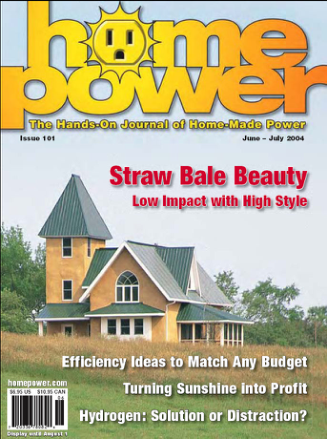
Home Power
For anyone who wants to get into the details of living with renewable energy this is the magazine for you. Each month this hands-on journal has off-the-grid and on-the-grid home owners tell their story in an easy to understand format. If you are interested in the technical details and comparing systems then this is the ultimate source of information. You can download a free copy off their web site each month in PDF format.
Web Site: www.homepower.com
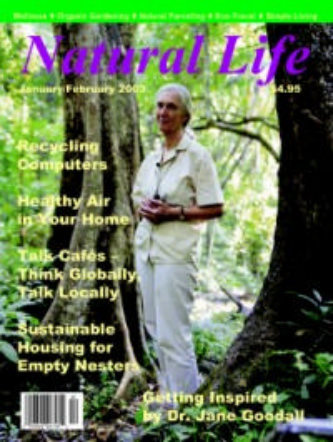
Natural Life
This simple magazine covers a wide range of sustainable living topics. For ideas that we can all start using today this is the place to start. Each issue reaches far and wide for interesting stories with lots of ideas for living a more natural life style.
Web Site: http://www.naturallifemagazine.com/
Natural Home
Each month this magazine features new and renovated homes that are seriously sustainable. Like other popular home and design magazines, you also get coverage of life issues, food, travel and other related topics, all with a "green" twist of course. Other departments include Good to Know, Green Events, New & Noteworthy, Try This, Nuts and Bolts, and Earth Mover Awards. If you want to be inspired by high-end homes with tons of creativity, and features like solar panels, this is a great magazine.
Web Site: www.naturalhomemagazine.com

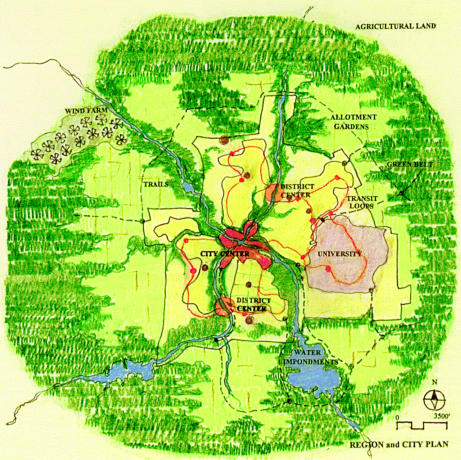
A Comprehensive Urban Regenerative Process
Sustainable programs require a comprehensive and integrated understanding of a community's unique human-environmental resources. They integrate natural systems with human patterns and celebrate continuity, uniqueness and placemaking (Early, 1993).
This proposal is based upon a working definition of sustainability and modeling techniques that provide a method to carefully balance the community's on-site ecological interchanges between human and environmental systems. An integrated set of regenerative design and planning strategies are proposed for this community to place these systems in balance.
Web Site: www.arch.wsu.edu/sustain/home.html
-
Join Us
Become a part of a community of people around the world dedicated to living in harmony with nature. We've created this network so that we can all share our ideas, experiences and knowledge. The changes we envision are revolutionary; however our goals are to make them the norm. The organization is about the practical, inspiring and real application of living gently on the earth so that our children may enjoy a clean, healthy and productive environment.
The simple point is that we all can "do" much more - and that means all of us or it won't work. For example:
§ Choose or create a home/community that is powered by the sun; § Grow and eat organic food; § If you must travel select the most efficient means, walk, bicycle, tele-commute, travel by train, bus, ultra-efficient car, or fly; § If and when possible, work in nature - grow your own
organic food, restore nature around you, put your investments to work for natural living. What will amaze you that everything we need to live this way exists. The cost over the longer term is less. The results are a happier more healthy self and family. Start learning how today. Member benefits:
Monthly Natural Living Journal full electronic edition.
E-Mail Question & Answer (3 per year, no more than 1 per month.)
Directory listing (optional) and Natural Directory.
Discounts on some products and services offered by Natural Life Network. Sign-up for membership at: www.NaturalLifeNetwork.com-
Next Issue
Ecovillages and the future of communities. For weekly updates, special offers, and additional products and services visit our web site: www.NaturalLifeNetwork.comHave a question? Ask us and we'll try and include a response in our next issue of the Natural Living Journal. Have an interesting story to tell that relates to natural living? Contact us any time with your questions, concerns or ideas at: john.wilson@naturallifenetwork.com-Order online now! www.NaturalLifeNetwork.com