February 2005 — Oil Subsidies
Publisher's Message
Magic Bullet? There isn't one. Despite the fact that current world economics are driven by oil, as is most of the global warming problem, the issue is more complicated. Like the addiction it is, the first step is for us to recognize the problem collectively. This isn't easy for the elites who control the government and large global enterprises that depend on oil for profits. Also, if oil prices continue to rise or if they suddenly rise more rapidly, the people that get hurt the most are the poor. We need an alternative vision of how we can transform the current system without destroying lives.
Given the pivotal role of oil, however, it does make it worthwhile to address this problem as a primary priority. This issue of the Journal deals with the large subsidies that oil companies receive. The scale of this handout is well hidden from the public's view most of the time. This hints at the disservice the media perpetrates in this game of keeping us ignorant of the most important facts.
It is pretty easy now to see that oil by itself gets about $300 billion in subsidies from tax payers like you and me all around the world every year. Add in the war the US has fought in Iraq to control their oil and you get another $200 billion. Start including the damage that pollution from oil causes and you get into the range of $1,000 billion actually numbers that are incalculable if you include the millions of people that die every year from pollution. Then there is poverty, the poverty of billions of people who survive on less than $2 per day. How can we justify the billions in profits that these oil companies make through our $300 billion dollar subsidy while billions of poor are doomed to die of starvation, or work in slave labor conditions, and die prematurely because of oil based pollution.
We don't like to think about these problems. It is depressing. We tend to think, what can we do? We can't do much. It is the government or the oil companies or the tyrant's fault. But is it? Aren't our hands bloodied by our taxes that go towards subsidizing these oil companies?
Understanding the truth is where we have to start. We now know that subsidies distort the economic reality of energy costs. When you hear someone say renewable or green energy isn't cost-effective you can clarify that the subsidies - the imbalance - favor oil today. If that distortion were removed it would put renewable energy alternatives into the cost-effective category. When reductions in clean-up costs and reduced smog-related deaths are included, the economic benefits strongly favor renewables. Finally, with global climate change approaching devastating proportions, we must act quickly to avert disaster. Global climate change so completely favors renewables that this entire economic discussion becomes ludicrous. Green energy is economical today, given the horrors created by our continued use of oil, which causes global warming.
John Wilson, Founder of the Natural Life Network E-Mail: john.wilson@naturallifenetwork.com
Natural Living Journal John D. Wilson - Editor and Publisher Natural Living Journal Published by World Peace Communications Copyright ã 2005 John D. Wilson Our Web Site: www.NaturalLivingNetwork.comE-Mail: john.wilson@naturallifenetwork.comPhone: (519) 942-3266 ADVERTISING SALES: Leigh Geraghty, Advertising Representative, (519) 942-3266, leigh.geraghty@sympatico.caCONTRIBUTE: We are always looking for new, interesting and inspiring stories, pictures, and poetry, about people who are achieving a natural lifestyle. If you would like to contribute an article or story then please send us a note with your idea. Contact John Wilson by email at john.wilson@naturallifenetwork.comAll contents of this issue of Natural Living Journal are copyrighted by John Wilson, World Peace Communications, 2005. All rights reserved. Printed in Canada.
SUBSCRIPTION SPECIAL OFFER
NAME
ADDRESS
CITY/STATE/PROVINCE ZIP/ POSTAL CODE COUNTRY
PHONEYES! Sign me up for Natural Living Journal. Orders must be prepaid. Here is my check/money order in U.S funds (Canadian orders in Canadian funds). Subscriptions/ membership includes shipping, handling and applicable taxes. $29 Now only $19 - Individual - 1-year subscription and membership, paperless Internet delivery, requires email (12 issues) $59 Now only $39 - Business - 1-year subscription and membership, paperless Internet delivery, requires email, and business directory listing with logo (12 issues) Membership includes answers to three questions (no more than one per month) through email for a year. To order online by credit card go to www.NaturalLifeNetwork.com. Send all subscriptions and renewals to payable to World Peace Communications. Mail to:
World Peace Communications
248108 5th Side Rd., RR# 5 Orangeville, ON L9W 2Z2, Canada
Oil Subsidies
What would be the benefit of $300+ billion annually to the renewable energy sector?
It is taken as gospel that renewable energy systems in general are "not economical". Sure, a few people have heard that wind turbines are competitive with conventional energy sources. But by-and-large the prevailing view, supported by endless off-hand remarks to this effect - including well-researched articles on the subject - have ingrained in us the idea that solar power, and renewables in general, simply can't compete with oil. End of story.
Lately, articles in local newspapers have tried to answer the question: how is Canada going to meet its commitments to the Kyoto Protocol for reductions in carbon emissions? With just three years to go before the first targets must be met, indications are that we are losing ground and have no real plan to meet these challenges. This isn't quite right. We do have a plan that has targets and goals. However, indicators show that we are losing ground, rather than making progress toward the Kyoto targets. Politicians don't seem to be making any real effort. Come to think of it, neither have Canadians in general. Meanwhile three thousand people die annually in our region of Ontario each year because we continue to fail to actually do something significant!
Local articles have suggested that perhaps the only answer, one that goes against the politicians' election promises, is that we will have to raise taxes in order to pay for the transition away from oil, and towards renewable energy systems. What is shocking is the complete lack of any consideration for the most obvious source of
Photo by Claire Wilson funding for this endeavor. Why don't the politicians do the most logical and powerful thing available? In Canada we the taxpayers - the people - give oil companies, $6 billion annually (including a bit for nuclear). Worldwide subsidies for oil companies exceed $300 billion conservatively. If we include costs related to clean-up, pollution-related deaths, roads built for cars and trucks, military spending required to control the sources of oil in the middle east and around the world, then oil would be far more expensive than renewable energy. On top of that, these oil companies are some of the most profitable corporations in the world, commanding the largest pools of capital, and with horrific human rights abuses, environmental devastation, and scandalous levels of corruption. The scale of the subsidies over the past one hundred years is essentially beyond comprehension, and made so by deception at all levels. I think it is safe to say that trillions of taxpayer money has been used to subsidize the wealthy elites that control oil companies over the past century.
Now it is time to learn from our mistakes. Simply speaking, we need to devise fair and equitable means of transferring the subsidies to clean green renewable energy, rather than oil. This solution actually ends up being doubly effective from an economic standpoint. First, removing the $300+ billion annually from the bottom line of oil companies suddenly forces them to reflect a little better the real cost of this non-renewable resource. Second, applying $300 billion annually to the renewable energy sector would create the necessary economies of scale to further improve the economic advantages of renewable energy. In total, the economic benefits of this shift run far deeper.
The annual balance of subsides would net a $600+ billion and growing advantage in favor of renewable energy. Economies of scale would significantly reduce the cost of renewable energy solutions from solar panels, inverters, storage technology, integration components, wind turbines, wave turbines, water turbines, biogas, biomass, solar water heating, passive solar and geothermal, and others - and new technologies we haven't even imagined. Conservation measures would also benefit in combination with renewable systems. The scale of renewable deployments - and the speed at which the economic engine would drive the change - would be hard to imagine, as the return on investment (ROI) would be so clear to all sectors of society. On top of all this, reduced health costs, reduced effects from climate change, and fewer potential military conflicts, would combine to provide even further support to the economic engine. Taxes added to offset the clean-up and health costs of continued use of oil and nuclear would further increase the economic cost advantages of renewables. In total, within just a few years, this vastly more sensible use of taxpayer subsidy money for energy would essentially provide in excess of $1 trillion annually towards the subsidy of renewable energy. Job losses related to oil would move to the renewable energy sector in proportion (most research indicates that more jobs would be created in a world supplied by renewable energy).
It is well within our rights as the providers of the subsidies to decide that our money is best spent on instantly transferring next year's subsidies entirely to the renewable energy sector. Like an addict, we should realistically consider weaning the oil industry off their current subsidies over a five-year period. Two factors make this aggressive timeline sensible. First, the global climate change impacts, according to some models, may already be approaching the point at which dramatic and perhaps irreversible changes have already occurred. Second, remaining oil reserves may peak during this period causing devastating economic impacts - especially if alternatives are not cost effective (not to mention potentially reducing the likelihood of another military invasion of, say, Iran). Most oil companies are already positioned to take advantage of the renewable energy transition with subsidiaries in the solar, wind, and other renewable energy sectors. With the subsidy shift, it won't take these economic giants long to take advantage. Opportunities will also exists for the creative and entrepreneurial to create the next generation of energy companies. By applying subsides equitably to all sectors of society, local communities, small business, government and large companies will all benefit.
It is early in 2005 as these words are being written. If we commit ourselves to this essential transition of subsidies, we can start the five-year implementation plan in 2006. By 2011, society will be well on the road to a sustainable future - at least from an energy perspective - with oil subsidies transferred completely to renewable energy, in combination with improved regulatory controls on polluters, and increased taxes on polluters (especially the oil industry). Oil rich countries will still have decades to parlay their limited one time inheritance towards a transition in economic focus - one that is sustainable far into the future. Less developed nations must have increased levels of subsidies in the form of aid so that they can skip (or reduce) the development of infrastructure related to the now antiquated oil based centralized models, and move directly to the increasingly economically sensible distributed renewable energy model.
Let us take a small example to see what the potential larger scale impacts might be. Keep in mind that, if worldwide subsidies were transformed, the synergistic increases in economies of scale would be even greater. We will use Canada as a small-scale example of what nations like the United States, European Union, and Asia might do, and what impacts are possible.
Let us review a few facts and cost estimates that we can use to help visualize the transformation. The following are for Canada (in US dollars).
Table 1. Description Estimated Value Current subsidies for oil/nuclear $6 billion/yearCost of a 1 megawatt wind turbine $2 million
Cost to upgrade an average Canadian home to fully solar (insulation, efficiency upgrades, passive solar modifications, solar hot water, solar photovoltaic system) - annual savings $2,000/year in energy cost
$60,000/house
Cost to retrofit industrial, commercial, office and condominiums - 100,000 sq. ft. - annual savings $30,000/year
$1 million/building
Let us assume that the oil subsidies are decreased over four years by 25% each year, and applied to the renewable energy sector. Then in the fifth year let us assume that the subsidy is increased by $1.5 billion per year. Thus, after five years the annual renewable energy subsidy will be $7.5 billion while oils subsidies will be zero thereafter. Canada has about 30 million people. If we assume that the average family has four people, and to keep things simple that each family lives in their own home of some kind, then there are 7.5 million homes (homes being either individual houses or apartments/condominiums). Then let us also say that the number of commercial buildings is about 25% of the number of residential homes - or about 1.8 million buildings.
In the first year of the transformation, 2006 hypothetically, subsidies for oil are reduced by 25% - all of which is applied to renewable energy, providing $1.5 billion. Again, to keep things simple let us divide the subsidies directly into investment in the three areas defined in our table. First, if we apply a third ($500 million) to wind turbines we would get 250 wind turbines producing 250 megawatts of clean renewable wind power. Second, if we a apply another third to retrofitting homes, we'd have 8,333 homes each saving about $2,000 per year while generating approximately 83 megawatts of energy (assuming about 10 kilowatts per home). Third, if we apply another third to retrofitting commercial/industrial or apartment building 500 would be transformed, saving in excess of $15 million per year, while generating/saving approximately 50 megawatts per year (assuming about 100 kilowatts per building). Total renewable energy generating capacity potential for the next twenty to thirty years or more would be 383 megawatts.
Again keeping things simple, we increase the transition amount by 25% each year so that by the fourth year 100% of the subsidies are going towards renewable energy.
Table 2. Renewable Subsidy
Renewable Megawatts
Cumulative Megawatts Year 1 $1.5 billion 383 383 Year 2 $3 billion 766 1, 149 Year 3 $4.5 billion 1, 149 2, 298 Year 4 $6 billion 1, 532 3, 830 Year 5 $7.5 billion 1, 915 5, 746 Of course many variables will affect these models and therefore the numbers in both directions. Increased demand will lower the cost and increase the efficiency of the renewable energy technologies, producing more energy per dollar spent, saving even greater amounts annually on energy bills. Increased demand in the short term on the other hand will increase the price as markets adjust. Availability will limit the level of deployment as will logistical and production limitations. Increased taxes on polluting oil products would improve the situation in favor of renewables. Some oil related job losses would hurt the transformation's economic benefits in the short term. Increases in jobs can be expected from renewable energy economies over the longer term. With these kinds of subsidies applied at these levels the economics suddenly favor renewable to such an extent that demand will prove a difficult and perhaps volatile issue as everyone wants to reap the financial benefits sooner rather than later. Resistance due to fear, lack of knowledge, backlash, or oil company propaganda campaigns may slow the process. If households were given $60,000 and knew they would save $2,000 per year, clearly the demand for the subsidies from this sector would be near universal. In reality, this model is too simplistic. A program that would offer a broader level of support to provide subsidy to homeowners in the range of 50% of the cost of the system, say $30,000, with low/no interest loans for the remaining $30,000 cost amortized over a ten-year period. Zero interest loans with longer terms would also be sensible. These types of programs would necessitate a process of allocation over say a five to ten year period. For commercial, industrial, office, apartment, and condominiums, the demand would be similarly managed, with perhaps even broader and alternative financing schemes.
The idea for a transition strategy has been necessarily simplified. However the principles, even when applied more holistically to a much wider variety of subsidy programs, would likely have similar effects (if not even more significant benefits) and be able to support greater generation of renewable energy as modeled. In fact, generation would likely be much higher as technology improves levels of efficiency and lowers cost.
Other critical areas of transformation would be transportation and food systems. Here again subsidies that support unsustainable practices need to be eliminated through a transition phase. Levels of subsidy for transportation (roads etc.) and food production (farm subsidies) that focus on oil based systems would need to be the focus. Without highways and road systems, oil powered cars would not be economical when compared with trains, subways, walking and bikes. Removal of subsidies for farms that don't use organic or similar sustainable, non-oil based systems would also encourage the transformation of these systems. Farms that produce using organic techniques would suddenly be even more profitable with the subsidies currently enjoyed by other farms.
Clearly, two techniques for transformation to renewables will make things happen. First, as discussed here, shift subsidies from oil to renewable energy sources. Second, the application of higher taxes to oil based products to for cleanup costs and to support the transition phase.
Bottom Line
How does this relate to reality. Currently Canada generates about 600 TWh (terra watt hours) of electricity to meet annual demand. The scenario we have outlined, one that is far to simplistic, and more than likely incredibly conservative, shows that within five years we could generate about 1% of our electricity demand with renewables. Existing "green power" initiatives already underway or announced could provide up to 7% of electricity generation by 2010 (according to Pollution Probe, "A Green Power Vision and Strategy for Canada"). The real impact of transferring all of the oil subsidies is likely much greater. Again, with this type of subsidy strategy in place Pollution Probe, in a review of the potential by experts in the field, estimated that about 340 TWh could be generated using green power by 2025, providing about 50% of the demand.
As I sit in my solar powered home writing these words I know that we can do much more than this. It is about -1 C outside. Despite the cold, even when it is -20 C outside, as long as we get some sunlight the passive solar design of our home keeps me warm. We've had about two weeks of sunny weather. The two weeks before that were bitterly cold and cloudy. Over the four week period, however, our savings in energy has been substantial. Solar photo voltaic panels supply the needed power for this notebook and the washing machine I hear in the background. We've done all this with no subsidies at all! We still have plans for a solar hot water heater that likely will reduce our electricity demand by another 25% an investment that will net us $300 and growing savings over the next several decades. As we add soil to our roof, we can expect reduced heating loads in the winter, and improved natural air conditioning in the summer. If subsidies supported these initiatives today I would have them all done by the end of the year! Everyone I know would do these things if they could be invested in with a low up-front cost and multi-thousand dollar annual savings. The government of Canada could do this by redirecting the subsidies for oil towards the needed financial support that renewable energy sources deserve. If we are serious about our children's future and meeting our commitments to the Kyoto Protocol then we must make these changes today!
Photo by Claire Wilson
"All this sheds new light on the question of the viability of many of the alternative energy options. Imagine if the tens of billions of dollars spent on the fossil fuel sector and the related road transportation sector were spent instead on rail transportation or on developing alternative technologies-technologies that we know are feasible but which are said to be not yet fully cost-effective in a competitive marketplace. As we've seen, the whole notion of a 'competitive' marketplace is a sham. The fossil fuel industry isn't forced to compete at all. On the contrary, it is massively subsidized by governments around the world, while competing technologies are barely supported. But the subsidies for the fossil fuel industry are largely invisible, and rarely acknowledged." -It's the Crude, Dude by Linda McQuaig -
Books About A New World Order
The biggest force slowing the broad based support for the changes required for sustainability are the "corporation" and the governments they control. How did we get to this point in such a brief time and how do we move towards a more equitable and sustainable future? Two books that bring home these important problems and how they can be overcome are The Corporation (also an award-winning documentary), and Alternatives to Economic Globalization. In terms of clarifying the problems and providing workable solutions, these two books provide invaluable information.
The Corporation: The Pathological Pursuit of Profit and Power by Joel Bakan
"My main interest as a legal scholar is in how the law shapes and is shaped by social and economic forces. THE CORPORATION is a project that came out of this interest. In 1997 I published a book, JUST WORDS: CONSTITUTIONAL RIGHTS AND SOCIAL WRONGS, in which I argued that constitutional rights were becoming increasingly ineffective in protecting the ideals they embodied, such as freedom, equality and justice. One reason for this, I suggested, was that constitutions apply only to governments; they do not apply to the key institution of market capitalism-the corporation.
The problem was especially pressing because, with economic globalization in full swing, corporations were emerging as global governing institutions, dominating societies and governments throughout the world. At the same time, most people had, and have, very little understanding of their true institutional nature. So it made sense to ask-what is the nature of this new governing institution? And what are the consequences of its growing hold on society? I developed the idea that the corporation, deemed by the law to be a person, had a psychopathic personality, and that there was something quite bizarre, and dangerous, in such an institution wielding so much power." - Joel Bakan
Quotable
"Since Rachel Carson's Silent Spring began to expose the abuses of the modern industrial system, there has been a growing awareness that profit at the expense of Earth--of individuals, society, and the environment--is unsustainable. Joel Bakan has performed a valuable service to corporations everywhere by holding up a mirror for them to see their destructive selves as others see them. The clarion call for change is here for all who would listen." - Ray Anderson, CEO of Interface, a multi-billion dollar company
Alternatives to Economic Globalization: A Better World is Possible Editors John Cavanagh and Jerry Mander
After years of protest in opposition to corporate globalization, the International Forum on Globalization presents alternatives to corporate domination of the world economy more fully and thoughtfully than has ever been done before. This books includes some of the best of current thinking on alternatives for a sustainable future including:
Ten governing principles for a new social paradigm-one that will lead to truly democratic and sustainable societies that benefit the many rather than the few
Spell out alternatives to the World Bank, the IMF, and the WTO that advance democracy, basic rights, and ecological sustainability
Show how vital goods and services (such as water or genetic material) can be administered for the common good rather than privatized for profit
Offer alternative operating systems for energy, agriculture and food systems, transportation, and manufacturing
Provide examples of successful alternative policies and systems already in use by communities around the world today Written by a premier group of 21 thinkers from around the world, the second edition of Alternatives to Economic Globalization lays out democratic, ecologically sound, socially just alternatives to corporate globalization more fully, specifically, and thoughtfully than has ever been done before. Focusing on constructive, achievable goals, the authors present ten governing principles for establishing truly sustainable societies and describe alternatives to the World Bank, the IMF, and the WTO that would better serve the needs of the planet. They offer detailed proposals for protecting vital goods and services from corporate exploitation, limiting corporate privileges and power, rebuilding economies to make them more responsive to human needs, and more.
The definitive document of the anti-corporate globalization movement - the consensus report of an alliance of leading activists, scholars, economists, researchers, and writers. This book offers a constructive, coherent, positive alternative to globalization-the very thing that the anti-corporate globalization movement is always accused of not putting forward. The International Forum on Globalization consists of the leaders of over 60 organizations in 25 countries - including such prominent organizations as Friends of the Earth, the Third World Network, the Sierra Club, the Institute for Policy Studies, Public Citizen, Rainforest Action Network, and Food First.
Quotable
"Globalization is not inevitable. Fortunately, there are alternatives and presenting them is the achievement of this book. Read it and be motivated: A better world IS possible." - Dennis J. Kucinich, United States Congressman -
Books About Power
Two books that I've read recently have brought home to me how important dealing with our sustainable energy problems will continue to be. In fact, the more I think about it the more that I see how much ideas like population controls, conservation, efficiency, organic farming, permaculture, urban transit systems, and solar power, are so critical to evolving our society. As the oil runs out, and as these books so ably demonstrate, it may be sooner that we expect. It will be to these ideas of sustainability, of Natural Living, that we will be forced to survive. As our ecological footprint shows oil has allowed us to exceed the sustainable capabilities of natural systems. With growing population levels we have already exceed what may be sustainable without oil. If we have any chance of surviving the next fifty to one hundred years it will be because we address these issues. Coming to terms with their reality is critical. So read these books and start taking action today.
War. Big Oil, and the Fight for the Planet: It's the Crude, Dude by Linda McQuaig
Who stands to gain or lose the most from climate change? The oil companies, the largest industry on the planet. When you add up all the subsidies provided ANNUALLY to oil and nuclear energy, you can clearly see how big a lie it is to say that renewable energy systems aren't economical. Subsidies to oil and nuclear including the car and airline industry, amounts to significantly more than $200 billion per year and growing especially if you include the wars fought to protect these resources.
Let us say then that the subsidies to these industries reaches about $1 trillion over the last ten years, contributing massively, if not exclusively to climate change. Now, take away this $1 trillion in subsidies from the oil, nuclear, and transportation industries. Give the $1 trillion in subsidies to the conservation, efficiency, and sustainable renewable energy sector over the next ten years. Suddenly oil and nuclear look uneconomic, and the alternatives make perfect sense.
Quotable
"we've used up the earth's oil so rapidly and recklessly that we have not only jeopardized the viability of the planet (part one of the energy dilemma), but we have at the same time squandered much of this incredibly valuable on-time inheritance. This may sound like a contradiction. If oil is so bad for the earth's ecosystem, maybe we shouldn't care that it's running out. The problem is that we've built the modern world around it, relying on oil for transportation, industry, agriculture and just about every other thing we do, eat, wear, type, watch and move around in." - pg. 29, War, Big Oil and the Fight for the Planet: It's the Crude, Dude.
" annual subsidies to the industry amounted to $14 billion in the U.S., $5.9 billion in Canada and a total of $59 billion in all the industrialized nations that make up the OECD." "nuclear industry, received $12 billion in annual subsidies in OECD countries." "The fossil fuel industry is also aided greatly by massive subsidies to the car and airline sectors plus $135 billion a year in the U.S.-on the construction and maintenance of roads." - pg 299, War, Big Oil and the Fight for the Planet: It's the Crude, Dude.
Power Down: Options and Actions for a Post-Carbon World by Richard Heinberg
Rather than retaining any level of false optimism this book and the author take deadly aim at the priority issues we face and their terrible consequences.
Powerdown provides a visionary response to the coming energy famine, a clarion call to cooperative solutions based on the conviction that realism must trump self-delusion in matters of cultural survival. Ultimately there is hope if we are willing to look truth in the eye. If we have the strength to admit our problems we will find the solutions. Quotable
"Most of the wars of the twentieth century were fought over resources - in many cases, oil." Pg 21.
"The elites - corporate owners and managers, government officials, and military commanders - are people who have been selected for certain qualities: loyalty to the system, competitiveness, and hunger for power. Often they are literally bred for their roles. Like George W. Bush, they are people born to wealth and power, and raised to assume that privilege is their birthright. These are people who identify with the system and the status quo; they are constitutionally incapable of questioning assumptions.
Moreover, the elites are guided day-to-day by a set of incentives that are built into the system itself. Managers who pursue immediate gain get ahead, while those who make short-term sacrifices in order to preserve long-term stability are often at a disadvantage. Likewise, managers are rewarded who keep up appearances, who generate good news, and who exude confidence. Confessing errors accrues no benefit; instead, managers are encouraged to deny short-comings and to blame competitors and subordinates." Pg. 168.-
Reading
Home Power
For anyone who wants to get into the details of living with renewable energy this is the magazine for you. Each month this hands-on journal has off-the-grid and on-the-grid home owners tell their story in an easy to understand format. If you are interested in the technical details and comparing systems then this is the ultimate source of information. You can download a free copy off their web site each month in PDF format.
Web Site: www.homepower.com

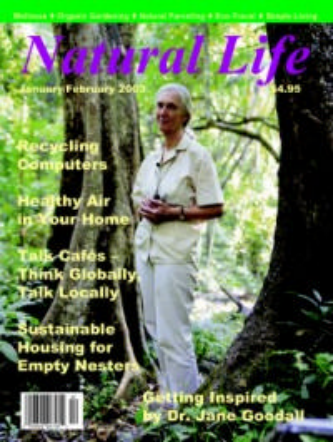
Natural Life
This simple magazine covers a wide range of sustainable living topics. For ideas that we can all start using today this is the place to start. Each issue reaches far and wide for interesting stories with lots of ideas for living a more natural life style.
Web Site: www.naturallifemagazine.com
Natural Home
Each month this magazine features new and renovated homes that are seriously sustainable. Like other popular home and design magazines, you also get coverage of life issues, food, travel and other related topics, all with a "green" twist of course. Other departments include Good to Know, Green Events, New & Noteworthy, Try This, Nuts and Bolts, and Earth Mover Awards. If you want to be inspired by high-end homes with tons of creativity, and features like solar panels, this is a great magazine.
Web Site: www.naturalhomemagazine.com

Dwell: At Home in the Modern World
Small Change is what it takes over a period of time to make the big changes. Dwell magazine may just be about affecting big change in the mainstream. This slick magazine has a real ecological design supported focus while also insisting on homes that look good. " Dwell has become proactive in its mission. The magazine isn't just writing about and showing photographs of the design of houses, she suggested, but is actually influencing the ways in which they are designed and built." The current issue takes aim at ideas such as smaller homes, prefab alternatives, and Dwell Home II, a sustainable house to be built in LA. Check out the amazing four-page pullout spread. The winning home includes passive solar, solar panels, and a green roof.
Web Site: www.dwellmag.com-
Join Us
Become a part of a community of people around the world dedicated to living in harmony with nature. We've created this network so that we can all share our ideas, experiences and knowledge. The changes we envision are revolutionary; however our goals are to make them the norm. The organization is about the practical, inspiring and real application of living gently on the earth so that our children may enjoy a clean, healthy and productive environment.
The simple point is that we all can "do" much more - and that means all of us or it won't work. For example:
§ Choose or create a home/community that is powered by the sun; § Grow and eat organic food; § If you must travel select the most efficient means, walk, bicycle, tele-commute, travel by train, bus, ultra-efficient car, or fly; § If and when possible, work in nature - grow your own
organic food, restore nature around you, put your investments to work for natural living. What will amaze you that everything we need to live this way exists. The cost over the longer term is less. The results are a happier more healthy self and family. Start learning how today. Member benefits:
Monthly Natural Living Journal full electronic edition.
E-Mail Question & Answer (3 per year, no more than 1 per month.)
Directory listing (optional) and Natural Directory.
Discounts on some products and services offered by Natural Life Network. Sign-up for membership at: www.NaturalLifeNetwork.com-
Next Issue
Ecovillages and the future of communities. For weekly updates, special offers, and additional products and services visit our web site: www.NaturalLifeNetwork.comHave a question? Ask us and we'll try and include a response in our next issue of the Natural Living Journal. Have an interesting story to tell that relates to natural living? Contact us any time with your questions, concerns or ideas at: john.wilson@naturallifenetwork.com-Order the Journal now! www.NaturalLifeNetwork.com