July 2004 — Straw Bale Construction
Publisher's Message
Do It Yourself The idea that you can build your own home may seem daunting at first. Even doing renovations for most of us is too much. I have enough trouble trying to figure out how to put together furniture from Ikea. How in the world am I supposed to build actual walls? Well, having worked on several projects now, I have become convinced that straw bale construction is something any of us can do. Not only that, but by doing so we can change the world.
Getting a group of people together to build your home or create an addition on your existing home is a wonderful experience. There is a feeling of accomplishment for some kind of greater good, when you help a friend build their home. Even when the friends are new, as is often the case when you volunteer to help build with straw bales, there is a bond, a feeling that helping a neighbor build shelter is primeval. It is in our very essence to want to ensure our fellow community members have a good, solid, comfortable home. To help them achieve this, to know that you've helped secure a basic need, forever bonds you to them. This feeling lasts for lifetimes. It is one of the many connections our modern life has removed - and straw bale construction provides an answer.
The materials used in the construction of bale walls are a renewable material. They require very little energy to prepare and use. The material is biodegradable so that when the home eventually must be renovated or demolished the majority of the insulation material can be composted. Despite this the straw bales have proven capable of lasting more than one hundred years.
Even though the idea of using straw to build is quite ancient, the technique does what other modern walls can't. They breathe! That means, quite naturally, these straw bale walls act like a human lung. They allow for the clean fresh exchange of air through the stucco and bales as well as transpiring any moisture or harmful air pollutants out of the home. Despite their basic appearance and simple construction technique, straw bales may be the most advanced, sophisticated wall system yet devised. No other building system I am aware of does so much with so little energy.
Living in a straw bale home is the proof that all of these concepts really do work. The home is warmer, cozier, and the air fresher. The look and feel of the sturdy walls with rounded corners, and natural undulations is comforting. With three wonderful years protected by the bales I am more of a believer in their benefits than ever. In hindsight I believe we should have used straw bales for all of our walls. As well, I've proven to myself, by building a prototype shed, that straw bales can be used for insulation in the roof. This adds substantially to improving insulation levels in this most critical area of heat loss. Also, the improved airflows further improve the indoor air quality.
Can you afford it? Yes. It is no more costly than conventional construction, and may be much less if you do it yourself. Over the long term, the additional insulation and improved indoor air quality will provide both monetary and health benefits that will pay unquantifiable returns, not to mention the impact on others who visit and learn about this revolutionary system.
John Wilson, Founder of the Natural Life Network
Natural Living Journal John D. Wilson - Editor Natural Living Journal Published by World Peace Communications Copyright ã 2004 John D. Wilson Our Web Site: www.NaturalLivingNetwork.comE-Mail: john.wilson@naturallifenetwork.comPhone: (519) 942-3266 ADVERTISING SALES: Leigh Geraghty, Advertising Representative, (519) 942-3266, leigh.geraghty@sympatico.caCONTRIBUTE: We are always looking for new, interesting and inspiring stories, pictures, and poetry, about people who are achieving a natural lifestyle. If you would like to contribute an article or story then please send us a note with your idea. Contact John Wilson by email at john.wilson@naturallifenetwork.comAll contents of this issue of Natural Living Journal are copyrighted by John Wilson, World Peace Communications, 2004. All rights reserved. Printed in Canada.
Join us!
NAME
ADDRESS
CITY/STATE/PROVINCE ZIP/ POSTAL CODE COUNTRY
PHONE
YES! Sign me up for Natural Living Journal. Orders must be prepaid. Here is my check/money order in U.S funds (Canadian orders in Canadian funds). Subscriptions/ membership includes shipping, handling and applicable taxes. $29 - Individual - 1-year subscription and membership, paperless Internet delivery, requires email (12 issues) $59 - Business - 1-year subscription and membership, paperless internet delivery, requires email, and business directory listing with logo (12 issues) Membership includes answers to three questions (no more than one per month) through email for a year. To order online by credit card go to www.NaturalLifeNetwork.com. Send all subscriptions and renewals to payable to World Peace Communications. Mail to:
World Peace Communications
248108 5th Side Rd., RR# 5 Orangeville, ON L9W 2Z2, Canada
Straw Bale Construction
Building with straw bale changes everything. This natural renewable insulation material is superior to conventional insulation. If you are thinking of building, renovating or doing an addition on your home then make sure you include some straw bale. If you are like me, it will sound strange at first, but once you read more, work with straw and begin to realize how much sense it makes, you will be forever transformed.
Before you begin any work read this entire article. Some of the tasks require substantial preparation. Other tasks should be practiced or experimented with in advance of the actual construction days. These instructions are best supplemented with hands on workshop experience or volunteering for a straw bale home building project, and books on the topic. For more information see the Products and Services section at the end of this article.
Concerns
First of all, you need to get comfortable with the idea of building with straw. I know when I first heard about the concept I was exceptionally skeptical despite a strong desire to build sustainably. My gut instinct told me that perhaps it would rot or catch on fire too easily. I have a family, and despite my strong desire to create a sustainable future for my children, it would not be worth taking additional risks. So I began to read every book I could find on the subject.
Surely the three little pigs taught us that straw was not the right material to use. It would just blow away, rot or burn wouldn't it?
Is straw bale strong enough? Yes, in fact it's stronger than most other building techniques since it has some "give". Rather than crumbling in an earthquake, for instance, the system, like a tree, is able to dampen the shock, bend, while not being rigid and crumbling. It won't blow away because the simple construction system sews the bales into place, weaving natural fibers together with steel wire fencing, and rock solid posts and beams. In fact these homes have proven capable of lasting almost a hundred years even in difficult climates like Nebraska. Even in the humid southern state of Alabama, a large straw bale mansion has withstood the test of time since the fifties.
Everdale hands-on straw bale workshop cottage.
Also keep in mind that straw bale and straw/mud homes are still built and used all over the world. They are a sensible design that has evolved over thousands of years of trial and error. Although we may be less familiar with the comfort, safety and longevity of these wonderful homes, people all over the world are building with straw bales, relearning ancient techniques and combining them with modern tools, materials and designs. As my wife Leigh says, keep an open mind.
So what is so great about straw bale? Where to start? There are so many things about building with straw bale that I've learned and that have convinced me that it is one of the most sensible, cost effective and sustainable systems ever to have evolved. The benefits also exist at all levels from design flexibility, ease of construction, health, safety and sustainability.
First of all, straw is in general an inexpensive, renewable building/insulation material available in pretty much all parts of the world in one form or another. Being a local and renewable building material that is inexpensive makes it worth a good hard look. There are different types of straw such as wheat-based or rice-based. Similar to straw is hemp, another potential renewable building/ insulation material. Cob is another farm product that can be used to build in a similar way. The beauty of these materials is that they grow back each year so we aren't cutting down old growth forests or using up large amounts of fossil fuel based energy supplies to create conventional insulation materials like fiber glass or "Roxul" (volcanic rock with steel slag). Also, the cost of straw insulation is less than commercial insulation materials while the insulation values are better.
The other critical benefit of straw bale walls is their ability the "breathe". This ability, despite superior insulation levels, provides improved air quality. You've no doubt heard about "sick building" syndrome. You're probably aware of the molds, mildews and fungus growing in homes. Well, incorporating breathing walls can prevent all of this. Breathing walls also react to changes in climate much better than modern methods of sealing a home and then trying to mechanically ventilate it, not to mention the additional energy costs to do so.
Just imagine our modern homes, R2000, or conventional housing development homes built to Canadian "standards". These home are essentially sealed up in plastic and then a heat recovery ventilator (HRV) tries to mechanically refresh the air from the outdoors at a specific rate.
Unfortunately these systems don't work that well. In most such sealed homes there is a very real and common problem of molds, mildews and fungus growing in your walls. This is most frequently caused by the condensation of water on the inside of the vapor barriers, mandated by R2000 or general building codes. So the sealed home works well in the winter by insulating and preventing air from blowing into the home. However, this design does not react well to warm humid summers. Instead, in the summer especially, these conventional homes will be susceptible to condensation. Combined with air conditioning and forced air type heating systems, these homes are like sealed bottles of toxic chemicals.
Problems?
Okay then, but doesn't it cost more? Actually no. Straw bale construction probably costs about the same as conventional construction techniques, although it could cost a fair bit less if you did the work entirely yourself or with volunteers. Over the long run, however, the superior insulation levels provided by straw bale will save you money in reduced heating/cooling costs. Depending on the source of your straw, the cost may be significantly less that conventional insulation. As the cost of energy goes up, so will the cost of conventional insulation, which requires relatively large amounts of energy to produce.
Some of the other major concerns people have include:
· Fire - Tests have proven that the straw bales don't burn; instead they may smolder a little but make actual flames unlikely, and certainly less likely to burn than convention 2x4 framed stud walls. The three layers of stucco, and the borax sprayed on the bales before the stucco is applied, all work to prevent even the possibility of fires. Also, the lack of spaces for air makes the spread of fire less likely. During construction is the only time that fire should be a major concern. Since the straw bales will be divided, trimmed, slice and diced, the loose straw that blows around the construction site becomes a fire hazard if not cleaned up regularly. Take special care to make sure people aren't smoking or burning anywhere near the work site. Also, it is critical that you maintain a work site clear of loose straw to minimize this danger.
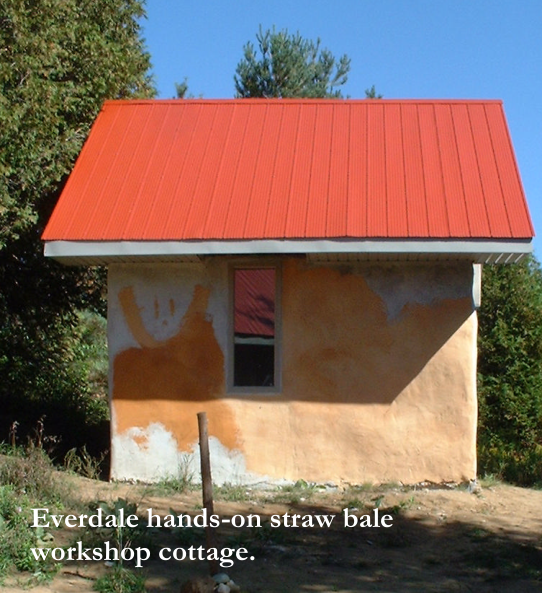
Everdale hands-on straw bale workshop cottage.
Pests - Again the compressed nature of straw bales, lack of anything worth eating, and lack of moisture makes poor homes for pests. In general, the vast majority of experience with straw bale has proven it to be less susceptible to rodents, bugs or other pests, partly because of the three layers of stucco, tight sealing and again the compact nature of the straw bales.
Building Codes - Most countries actually support straw bale construction in some form or another. The United States, and certain states in particular, have support including fire code testing. In Canada, the six thousand square foot straw bale home we worked on in the city of Mississauga (near Toronto), went to the building code committee for review. This review took about a year but has resulted in a very clear ruling in support of straw bales. The ruling required that the architects and engineers involved in the project back up claims that this natural fiber insulating material met the building codes principles for quality construction standards, including susceptibility to fire, strength and other building criteria. Keep in mind that you still may need to relate to your local building inspectors these cases and even some of the technical back ground of this system in order to get them on board. The other thing you learn about straw bale is that two design types are possible. Actually there are perhaps hundreds of different ways or variations on these techniques, but in general, there are two popular techniques. First, you can build using post and beam construction techniques familiar to many builders and very common all over the world. In this configuration the straw bales are primarily for insulation although the walls themselves are substantially stronger than conventional walls. The second design technique is a "load bearing" straw bale design. This system does
use the incredible strength of the straw, compressed, to actually bear the weight of the roof.
Most building codes now support post and beam based (non load bearing) straw bale construction. Some areas also support load bearing straw bale (for instance in Quebec, Canada). Always make sure to check with local building codes before getting too far down the path with straw bale.
You might be thinking, won't that straw just rot when it gets wet? Sure, if you leave it soaking in water it will eventually. However, a key part of straw bale design is allowing the straw to stay dry. A roof with extensive overhangs to prevent water from reaching the walls accomplishes this.
This article focuses on the basics of a post and beam technique for straw bale construction. For details on post and beam or load bearing straw bale construction consult one of the many excellent books on the subject, for example, Straw Bale Building by Chris Magwood and Peter Mack.
Planning and Design
The general layout of your structure can essentially follow conventional rules for post and beam construction. For simple structures it is easy to draw up plans yourself. Drawings should include the site layout so that you can determine placement of windows, posts, bales, doors, stairs and other important features of your structure. Knowing in advance where everything is going and where you are going to place everything is critical. Without this you will no doubt build things that need to get reworked because you forgot to consider requirements of this feature. If you are planning a larger, more complex structure, home, workshop, community center or multi-story building you should work with an experienced architect. There are not many architects who are familiar with straw bale construction. One of the best in the world is Martin Liefhebber, who designed our home. For large, complex structures, it is essential to get an expert at eco-design. For a simple home, or once you've consulted with an architect, you may be able to manage the final design and construction yourself.
The basic design technique follows the principles of post and beam design. The straw bales essentially act as an insulation material and the stucco provides a flexible, strong, and "breathing" wall. Some key design elements to make sure you include for straw bale insulation include:
· Plates (or curb on top of the foundation): Approximately 18" (this is completely dependent
Everdale hands-on straw bale workshop cottage.
upon the straw bales you get so find out your source for these and make sure you know their average dimensions) top and bottom plates on which to place and secure the straw bale. Bottom Plate (or curb): Use 2x4's nailed or glued to the floor. Fill in the area between each side of the 2x4 platform with about 2" thick insulating Styrofoam that matches the thickness of the 2x4. This ensures that the high insulation levels are maintained at the bottom of the bale walls. The 2x4's curb provides a base on which the bales can be placed and a surface for stapling the chicken wire to each side of the wall at the bottom. Top Plate: Cut a .5" to .75" plywood to provide a top plate towards which the bales will be stacked. This top plate should butt up against the ceiling/roof structure. It should be the same width as the base plate.
Keep in mind that the walls will vary in thickness and have typically rounded corners.
Wall thickness can be varied by placing the bales on end, rather than flat, so that the thickness of the walls can be reduced by approximately 3" to 6". Of course the insulation levels will be reduced as well but for a shed or other structure that does not require as much insulation this may give you the additional inside floor space you want.
The additional layers of chicken wire and two to three layers of stucco on both sides will add to the final thickness of the walls. Plan for an additional inch or two on each side. In other words about twenty inch wide walls rather than seven or eight for conventional walls. Keep in mind that your walls will insulate at levels of R30-50 as compared to around R11 for conventionally insulated walls, so this extra thickness really pays off.
Ordering Materials
With designs completed you will need to get a building permit for anything larger than a shed. Check your local building code for permit requirements. Certainly on a larger structure like a barn, workshop, cottage, home or condo you'll need to ensure that your design is acceptable to the building department. In most places in the world, straw bale home construction has been approved, so this step should not be difficult. If concerns are raised there are many sources of information that you can provide to support your request to build with straw bales. In the case of a home in a suburb of Toronto, near where I live, the owners had to go to the building committee with engineers in order to get permission to build with straw bales. Their successful review puts their case in the building codebooks as a precedent. By referring to precedents like this - where engineers backed up claims that straw bale does provide a good building/insulation material, meets fire codes, provides proven levels of insulation, supports structure code requirements and will stand the test of time - you are treading on solid ground. It is possible that in your area you may need to be the ones to break down barriers. However, that process is becoming easier as more and more cases such as this are won.
Now that your building plans have been approved and you are comfortable with all the details having been determined, you are ready to place your orders for materials. With the dimensions of your floor space and walls determined, you will be able to calculate your required quantities of materials. Keep in mind that with straw bale you should order 10-20% more bales than you think are required to ensure that you don't run out during construction. You will likely want to order the foundation, framework and roofing materials first, and complete that work before taking delivery of the straw bales. Once you have completed this stage you can take delivery of the bales and store them in the covered structure or under a waterproof tarp. It is important to keep the bales as dry as possible throughout the construction process and until they are covered with stucco.
Materials List (Straw Bale Walls)
Chicken wire fencing rolls
Wire mesh for window/door corners
Stucco paper for around windows/doors
Portland cement bags
Vapor barrier
Tar paper (to isolate straw bales from foundation)
Lime bags
Wire of similar type and gauge as chicken wire
Straw bales
Staples
Nails
Some Tools: Trowels, baling twine, wire, wire twist ties, and a twist tool.
Tools Required
Stapler (ideally air powered)
Hammers
Large wooden mallet
Trowels
Buckets
Wheelbarrows
Cement mixer
Sewing needles (straw bale)
Wire cutters
Power tools (drill, circular saw etc.)
Chain saw (to trim the bails)
Before you organize a group of volunteers to do the straw bale walls make sure you complete the preparation of all plates around the perimeter of the structure, top and bottom. For both our home and shed we used 2x4's to frame the based, with 2" blue Styrofoam insulation cut to size between the 2x4's. This creates a perfect platform on which to stack the bales and tack the chicken wire to each side of the wall. The top plate can be cut from plywood to size and tacked securely to the upper beams supporting the roof or between the posts. This top plate needs to be secure as the forces to be placed on it by the wall and adjustments with a wooden mallet will be significant. As well, the long-term viability of the wall may be compromised if it is not well secured.
Construction
Once you have your materials, you need to complete all of the foundation, framing, posts and beams. In most cases it is best to also complete the roof so that you have a covered area to store the bales and so that the bales will be covered once the walls are completed. Keeping bales dry is important to ensuring their long-term viability. If they get wet without drying properly they will eventually begin to rot. Straw bales should have less than 20% humidity. Devices are available to measure levels of humidity within the bales. In general, as long as you and the farmer have kept the bales from getting soaked by rain the bale should be sufficiently dry for use in your project.
Straw bales stacked under the roof to be kept dry once delivered.
Each door and window should be framed with 2x6 or 2x8 lumber "bucks" for placement within the bale wall at the right levels. The doorframe can be secured before bale stacking begins. Once all of the framework, posts, beams and frames are ready, and all materials for construction of the bale walls ready, the construction of the walls can begin.
Bottom plates curb prepared.
It may be easier to staple the chicken wire fencing (usual supplied in rolls) to the outside plates before starting the bale stacking (see photo right). Cut the chicken wire with wire cutters so that it can be attached to the top, then bottom plate. Staple the top and then the bottom of the chicken wire strips.
Top Plate Details with a steel rod cross bar for extra strength on high walls.
Leave openings in the chicken wire for doors and windows allowing sufficient wire to wrap around to the frames. As each strip of chicken wire is added, overlap with the previous section by about an inch. Then sew the two strips together with steel wire.
Attach the outer chicken wire before starting to stack the bales.
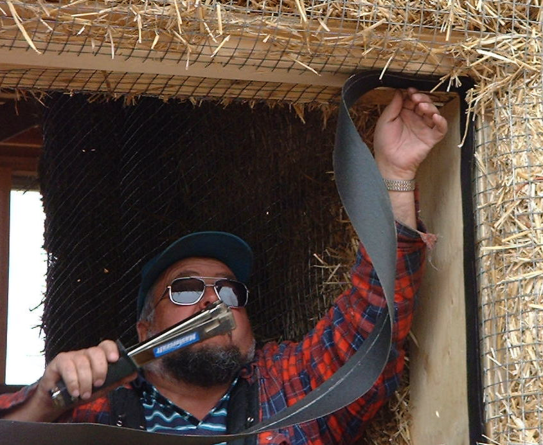
Corners and edges that are exposed to the outside side of the walls should be lined with a plastic membrane (vapor barrier). These should never be used throughout - only where the stucco will eventually make contact with the posts, beams, windows and doors. This will deter moisture from leaking through the walls and into the home at these edges. It is important that any moisture that does penetrate the wall eventually be able to evaporate and flow away from the wall. Make sure these small areas of vapour
Vapor barrierfor corners and edges.
barrier do not have any cups that might trap water.
Laying the Straw Bale Wall
Now that you are ready to stack the bales it is important to have prepared some odd sized bales for corners and ends. Have a group of people prepare one third and two third bales by cutting the baling twine and re-tying the two parts. This turns whole bales into pairs of one-third and two-thirds bales. Make as many of these as you think may be required for the number of ends and corners in your structure (see pictures below).
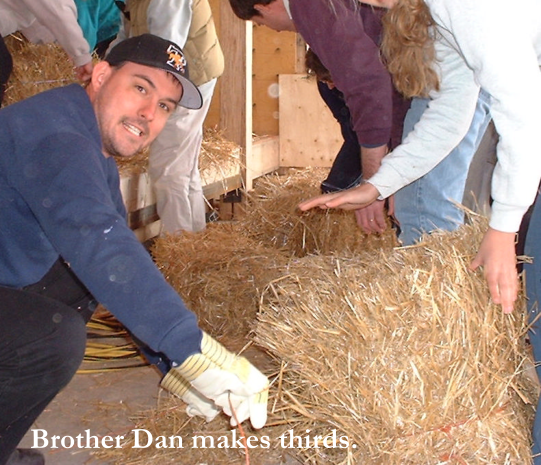
Brother Dan makes thirds.
Lay the straw bales one layer at a time. Complete the first layer, stuff any unusual gaps with loose straw against the chicken wire to ensure no gaps exist. This is critical to ensuring a consistent level of insulation throughout the entire wall. Any gaps or air pockets will severely affect the insulation capacity of the walls. Don't leave any gaps between the bales. Once each row is properly filled you can begin the next row. Offset the next row by half a bale, just as a bricklayer would offset the bricks with each row. This ensures a stronger wall. With each row, ensure no gaps or cracks exist. Fill these with loose straw before continuing to the next level.
As you stack bales around doors, windows and corner it may be necessary to insert one-third and two-thirds bales to ensure a good tight fit. Watch for bulges or bales stacked the wrong way as these will create areas of weakness, less insulation levels and unusual shapes. Keep in mind that it is possible to create and place artwork, shelves, tables and larger than normal window sills, stools, storage spaces and much more. Use your imagination with care though, as some ideas may not be what you want for the long term and changing things can be difficult.
Mike and Christa tie a two thirds bale tight.
While stacking the first layer, the electrical outlet
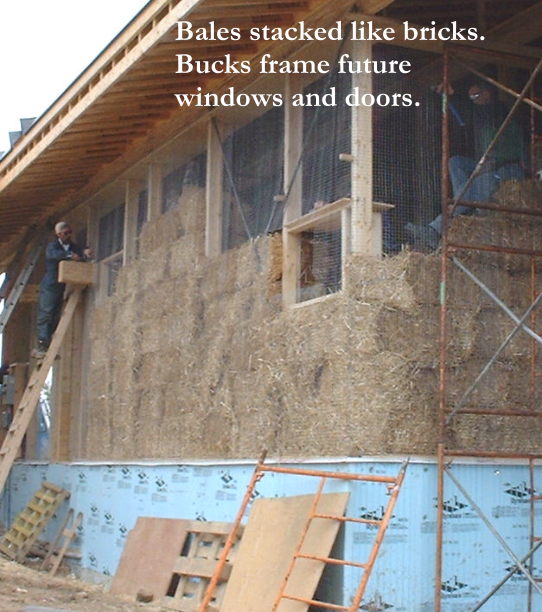
Bales stacked like bricks. Bucks frame future windows and doors.
boxes should be attached to a piece of 2x8 lumber and laid on the bales before stacking the next layer. All electrical and plumbing work should have been planned well in advance and prepared so that it can go in, around or under the bales effectively.
Chicken Wire
Once all of the rows of bales are stacked, cracks filled and corners checked for gaps, it is time to staple the chicken wire fencing to the other side of the bales. Once again, cut the chicken wire fencing to fit the space from the top to the bottom of the wall. Cut to size with wire cutters, staple to the top plate, and then staple securely and tightly to the bottom plate. As each strip of chicken wire is added, overlap with the previous section by about an inch. Then sew the two strips together with steel wire. Special wire twists that can be used to secure the two pieces together quickly with a special hook tool are also available.
If there are any wire bulges, you may want to create some wire "staples". Cut about twelve inches of wire and bend in the shape of a "U" or "V". These can then be inserted into the bales to secure the chicken wire to the bales.
For windows ledges, sills, and doors, attach a finer steel mesh to create curved or sharp corners from the buck frame to the main wall. This additional steel mesh adds strength to these areas that will be impacted by people and objects as these areas are used frequently. Tar paper can also be inserted around and below the chicken wire/wire mesh in corners.
Sewing
While the corners are being finished the walls can be sewn together from each side. Baling twine spools and some straw bale sewing needles will be required. We made our own sewing needles using some steel rods about a quarter inch thick and two feel long, purchased from our local hardware store. On one end of each rod, we created a pointed end by sawing off the corners at a forty-five degree angle. Finally we drilled a hole big enough for the baling twine to fit through (about a quarter inch or half a centimeter). Be very careful with these tools around children, and make everyone aware of the danger of poking someone during the sewing or preparation process.
Straw bale sewing needle prepared with baling twine to be pushed through the bale and then tied.
With tools prepared the sewing can begin. Sewing requires pairs of people to work on each side of the straw bale walls, after the bales have been stacked and the chicken wire secured on both sides as well as top and bottom. The sewing process starts by measuring about ten meters of twine and threading it through the nose of the sewing needle hole. The other end of the twine is then tied to the chicken wire at the bottom of the wall. The sewing needle is then pushed carefully through the bale so that the person on the other side can pull it through completely (being careful not to impale anyone!). The second person "zigs" over about eight to twelve inches and up two to four inches, and pushes the needle back through from the other side. After pushing the needle back through, pull the remaining twine through, ensuring that each stitch is pulled taught. This continues until the top of the wall is reached or until the twine runs out at which point it is tied off on the chicken wire.
Make sure that all of the chicken wire is pulled tight to the straw bales so that no gaps are left. The entire wall should stiffen up as more and more of the wall is stitched. Shifting over a foot or so, repeat the same process for the entire section of wall. Many pairs can work in parallel during this process in order to complete the job quickly - like a quilting bee! Make sure that holes and gaps are filled with straw around doors, windows and corners before sewing tight.
Preparing for Stucco
Use a large wooden mallet, like the hand-made model pictured below, to flatten and straighten the walls as desired. Make sure no gaps or weak spots exist. Trim all loose straw sticking out of the chicken wire with a "weed whacker". Spray a borax/water solution on the bale walls as a fire retardant. Check to make sure that all corners are well prepared with additional stucco mesh formed to the desired shape. Remember that entranceways, windowsills, and corners need to be able to resist many impacts without cracking or breaking.
Pete makes sure the surface is flat before the stucco process is started.
Depending upon the number of volunteers helping and the number and complexity of straw bale walls, this phase may take a full weekend to accomplish. In my own experience the two main phases, assuming a good number of volunteers (between ten and twenty people), the straw bale wall raising can be done through a single weekend. The stucco process usually then takes another weekend or two depending on weather and other factors.
Tina prepares the stucco mixture.Leigh pushes needlethrough the bale.
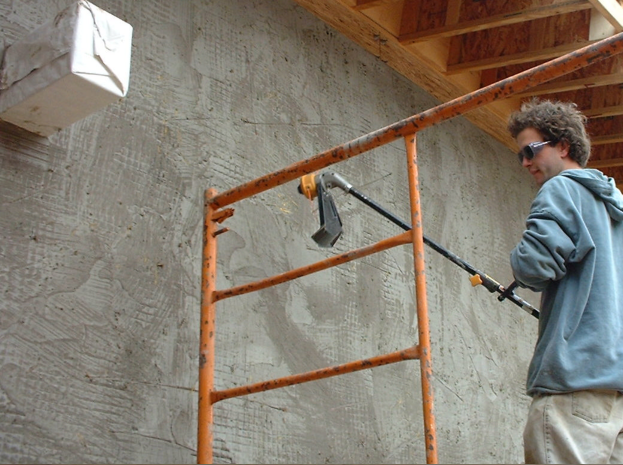
Stucco Plastering
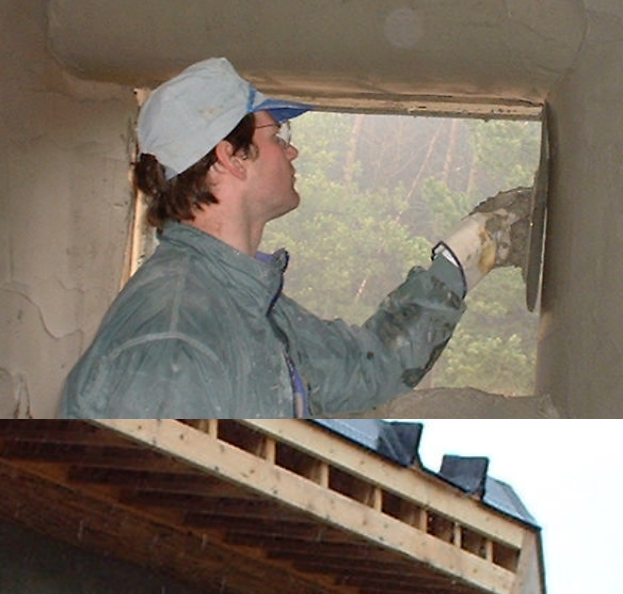
For larger jobs the major tasks in this phase of the construction should be specialized for different groups. One group should manage the plaster mixing while another does the stucco application to the walls. Each group needs to work in a coordinated manner so that as the stucco plaster is prepared it can be immediately applied to the walls. The first coat must dry to some extent before the next layer is applied. Also, the first rough coat may need substantially more stucco as this layer needs to fill all cracks and create an even surface. The first layer should also be scored with a rake before it dries. This scoring provides an important bonding surface for the next layer. Typically three layers are applied. The first layer should cover the entire surface of all
Sponging with a wet sponge creates a wonderfully textured final surface..
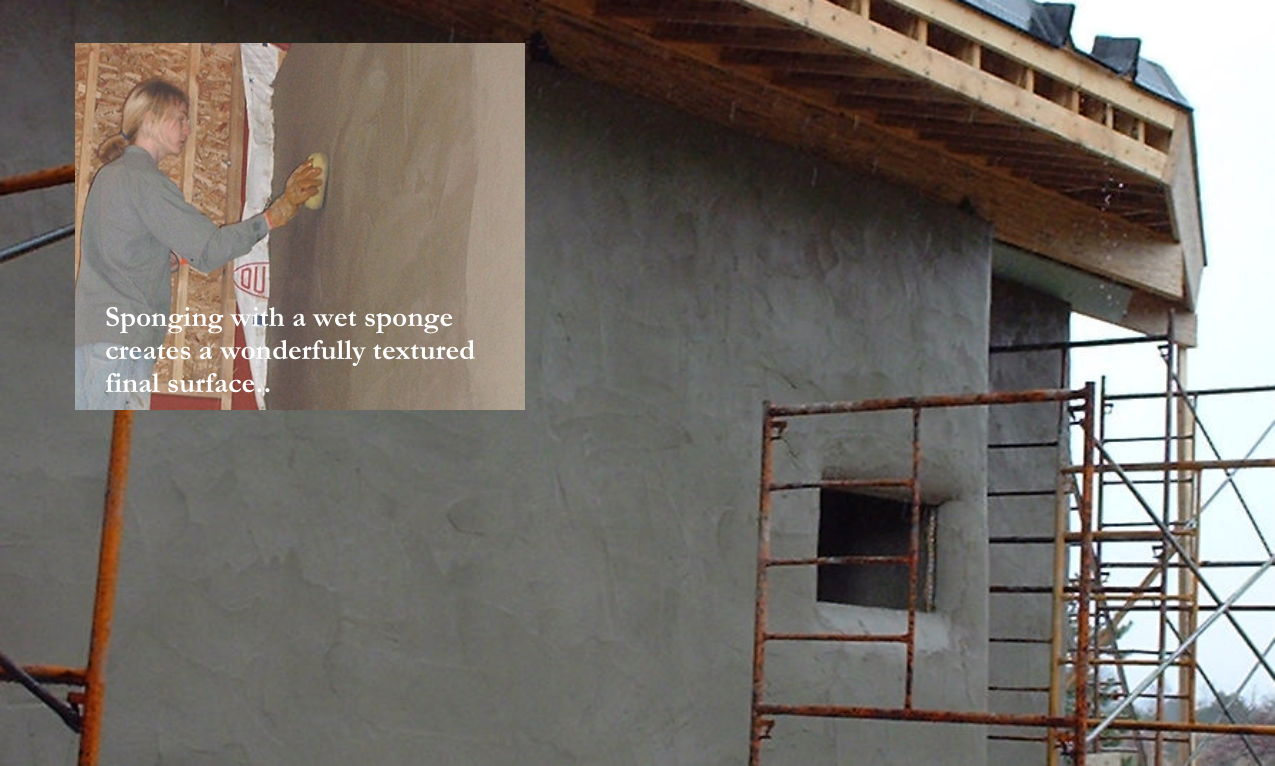
walls and fill gaps. As it dries it should be scored with a rake. Any straw that sticks out should be clipped off at the first layer. Once the first layer dries a lighter layer should be applied to smooth out the entire surface. This may be used as the final surface. To make it a nice texture the second layer can be sponged with a wet sponge. This brings out the sand in the mixture created a smooth texture and minimizes lines created by trowelling.
A final third layer may be applied in order to pigment the final wall. This allows color to be added.
In order to prepare large amounts of cement-based stucco, a cement mixer will be required. For the small shed that I built, I simply mixed the ingredients in my wheelbarrow. For larger homes, walls and buildings you will need a proper construction mixer. Building our home, we rented one for a weekend.
The plaster mix we used was one part Portland cement, one part lime and five parts sand. Mix in water until the consistency changes to a thick mud. You'll know it is right once you try to apply it to the straw bale walls. In should stick and spread, maintaining its position and shape. Don't add too much water too fast. If you do though, you can add the ingredients in the same proportion to thicken things up again.
Although other mixtures are possible, one part Portland cement, one part lime, and five parts sand provides a well-proven stucco mix. The parts can be mixed using a shovel or other tool as long as it is consistent in terms of the ratio of ingredients. If your particular ingredients don't produce the desired results, then experiment with adjustments to the ratios until you get one the produces the results you want.
Each layer should be applied completely before starting the next layer or breaking for the day, in order to ensure consistency.
The stucco is typically applied using a stucco platter to hold the mix. Then the stucco can be spread evenly with smooth consistent strokes using a trowel. Corners can be rounded or forced to a square edge. You may need to spray some water on each layer of stucco as it dries, in order to prevent cracking. This spray should be very fine so that the water does not run down the stucco. After each layer has been applied, review the work to make sure it meets your requirements. Once the stucco dries it is quite difficult to correct any problems.
More Things We Learned
More than fifty straw bale homes have been built in Ontario.
The Ontario Building Code supports straw bale home construction that is non-load bearing.
Quebec and other provinces have permitted load bearing straw bale homes. Products and Services
Straw bale construction company: Camel's Back Construction, Chris Magwood, Peter Mack and Tina Therien, www.strawhomes.ca.
Post and beam home construction: Colin Richards, Builder - e-mail gregory.richards@sympatico.ca.
Martin Liefhebber, Architect, www.martinliefhebber.com .
Fresh, holistic approach to community design with straw bale, Cheryl Bradbee, www.pov-design.com .
Hands-on straw bale workshops: Everdale (see the workshop schedule in this issue of the Journal), Hockley Ecology Retreat Centre. -
Straw Bale Books Straw Bale Building: How to Plan, Design and Build with Straw
By Chris Magwood and Peter Mack published by New Society Publishers, ISBN 0-86571-403-7 280pp, illustrated, 8x9, $29.95 Can./$24.95 US Home Improvement & Construction / Ecological Design Straw Bale Building speaks to a part of us that insists that we should be able to build our own homes with our own hands. We look at pictures of a bale wall being raised and immediately think: I could do that! Straw bale houses can be easy and affordable to build, super energy efficient, environmentally friendly, attractive, and can be designed to match the builder's personal space needs,
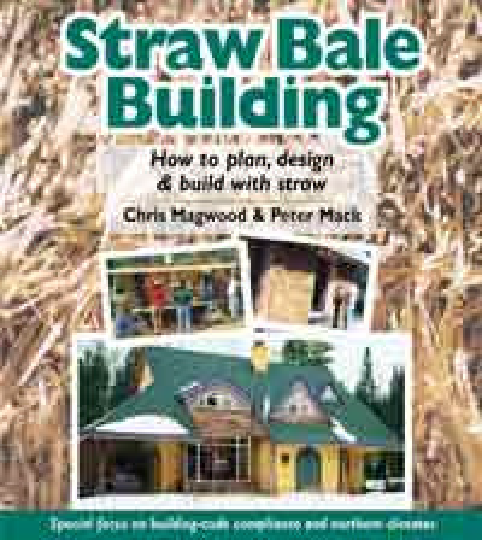
aesthetics and budget. It's no wonder that straw bale houses are growing in popularity.
Now, with Straw Bale Building, this construction technique is explained in the fullest depth yet, enabling everyone who wants to build with bales to do so with confidence, safety and flair and to do so in compliance with local building codes.
Straw Bale Building guides the reader through every stage of the design and building process and is heavily illustrated with both architectural quality drawings and photographs of on-the-job action. With its extensive listing of further resources, it provides all you need to plan and then create the building of your dreams!
Straw Bale Details: A Manual for Designers and Builders
By Chris Magwood and Chris Walker $47.95 US Straw Bale Details is the perfect companion for those who are serious about building with straw. It focuses entirely on the specific design theories and practices that result in well-built, long-lasting bale structures, and extends the range of books like Straw Bale Building through large, easy-to-read architectural drawings rendered for a wide variety of building options, including load-bearing and post-and-beam designs. A range of foundation, wall, door and window, and roof-plate scenarios are presented, along with
explanatory notes and possible modifications. Also included is testing data from the most recent rounds of bale wall exploration, and interpretations of the data are given to help base designer and builder decisions on sound science.
For more information or to order:
NEW SOCIETY PUBLISHERS Books to Build a New Society PO Box 189, Gabriola Island, BC Canada V0R 1X0 Tel: 250-247-9737 Fax: 250-247-7471 On the web: www.newsociety.com-
Workshops
Everdale Hands-on Learning
Straw Bale Construction: FEE: $300 Includes vegetarian meals and camping. June 11-13: 6 p.m. on Friday 4:30 p.m. on Sunday with Ben Polley of Harvest Homes Straw bales can be used to build homes and other types of buildings that are extremely durable, beautiful, energy efficient, low cost and well suited to our four-season climate. Lots of theory and practical experience building a straw bale cabin. (this will not include mudding and plastering. We recommend you take the plastering and finishing workshops set in July) NIA Dance Solstice Celebration FEE: $20 June 18: 7-9pm with Judith Thompson a certified NIA and Kripalu yoga instructor. NIA is a creative, barefoot, expressive fitness and awareness program, blending modern and ethnic dance, martial arts and yoga. Welcome the arrival of the summer season with an evening of dance, ritual and celebration. Please dress in loose comfortable clothing and bring a blanket. Wind Power Generation I (Intro to Wind Power Systems) FEE: $85 June 26: with John Hogg of Free Breeze Energy Systems This is the first part of a two part workshop. Mostly theory with a bit of hands-on. Explore the basics of wind technologies, the products available and their application potential Solar Power II: photo voltaic installation. FEE: $85 June 27: with David Nixon of Arise Technologies. This is the second part of a two part workshop. Hands-on with a bit of theory. We will walk you through the process of installing and maintaining your own solar p.v. system. Home Alive! In Depth FEE: $50 July 4: Lead by one of Home Alive's knowledgeable builders. Learn in detail how this house "Thinks, Drinks and Breathes" while seeing how energy and heat are produced and trying the alternative wastewater, solid waste and drinking water systems for yourself. Elements of the permaculture ecological landscape, house design, construction materials, energy production, appliance selection and more will be discussed with a descriptive tour, active demonstrations and lots of opportunity for your questions. Plastering and Finishes for Straw Bale Homes (Cement-lime) : FEE $85 July 10: with Ben Polley of Harvest Homes Plastering is an art unto itself. Learn skilled techniques to become proficient at mixing and troweling traditional cement-lime plaster to provide elegant and professional finishes. Colour tinting, stucco spraying, interior finishes, reliefs, inlays and mosaics will also be discussed with some hands-on opportunities. Plastering and Finishes for Straw Bale Homes (Earthen Plasters) FEE $85 July 11: with Chris Magwood of Camel's Back Construction Earthen plasters are a healthy, non-toxic, and inexpensive way to create plastered finishes that are ideal for natural building or renovations. Learn how to use local soils and fibres to create beautiful and durable earthen plasters for straw bale walls, or for any other plastered interior or exterior surface. Learn how to sample soils, create test patches, and mix for base, second and finish coats. Wind Power Generation II (Wind Turbine Installation) FEE: $85 July 17: with John Hogg of Free Breeze Energy Systems This is the second part of a two part workshop. Mostly hands on with a bit of theory. See a turbine in action and learn all about the nuts and bolts involved in installing a wind turbine. Solar Hot Water Systems FEE: $85 July 18: with Michael Holm of SOLARCO
Learn to select and install a system, which will heat your water with the suns rays. Hands-on and educational. Home Alive! In Depth. FEE: $50 August 8: Lead by one of Home Alive's knowledgeable builders. Learn in detail how this house "Thinks, Drinks and Breathes" while seeing how energy and heat are produced and trying the alternative wastewater, solid waste and drinking water systems for yourself. Elements of the permaculture ecological landscape, house design, construction materials, energy production, appliance selection and more will be discussed with a descriptive tour, active demonstrations and lots of opportunity for your questions. Everdale Music FESTIVAL August 14: On Saturday, August 14, from noon till midnight, we're hosting a day of music and entertainment at Everdale for you and your family. As well as music on the main stage (mainly folk and blues), we'll have live entertainment for the kids and events that will bring out the kid in all of us. Meals will be provided at a reasonable price - delicious organic food from Everdale and other organic farms in our co-op network. Tickets will be available by the end of April. Stay tuned for developing details on our website: Tuning into Plant vibrations. FEE: $50 August 15: With Janice Canning a registered herbalist with the Ontario Herbalists Association. Exploring the vibrational energy of the plant world. By connecting with the sprit and essence of medicinal plants we can find our balance. Safe and Simple Canning Techniques FEE: $50 August 28: with Cathy Hansen and Ginny Pearce These prize winning canners will walk you through some safe and simple techniques to preserve the summers harvest for winter enjoyment. Tomatoes, pickles, pesto and moreÉ Home Alive! In Depth. FEE: $50 September 5: See August 8 description.
Autumn Harvest Picnic September 11: 1pm-6pm. Take a tour of the organic farm, try your luck at the harvest games, and check out the solar and wind power systems. Fun for the whole family. Bring a picnic dinner we'll supply the corn roast. No need to register in advance. Just come out and enjoy the day. Intro to Sustainable Living. FEE: $85 John Wilson presents the essentials of sustainable living. Organic Gardening: Seed Saving FEE: $50 September 25: with Bob Wildfong president of Seeds of Diversity Canada. Learn how to collect and save your own veggie seeds to plant next year. Grey Water Systems FEE: $85 October 2: with Doug Joy is a professor of water resource engineering at the University of Guelph and the general manager of the Ontario Rural Wastewater Centre. Details on the various types in use; what works, what doesn't and the laws governing these systems. Medicinal Herbs, Identification and Preparation FEE: $50 October 17: see May 30th workshop for details Building Design-getting your ideas on paper FEE $85 October 23: with Larry Benville, 25 year design professional with a background in sustainable construction. Working through design sketches, we will get real about budgets, design realities, and most aspects of the construction process. For more information on attending: Web Site: www.everdale.orgPhone: 519-855-4859 E-Mail: info@everdale.org-
Events
August 28, 2004: SunFest 2004 Tour a working solar/wind powered home. See the awarding winning Wilson Natural Home. John Wilson will be giving tours. Learn about the amazing green roof, straw bale walls, and passive solar design features. Talk to the experts to find out how you too could be running your meter backwards.
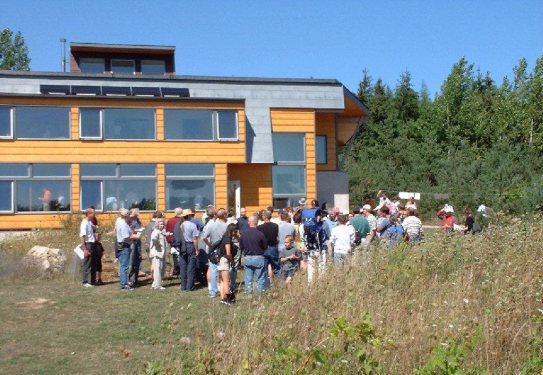
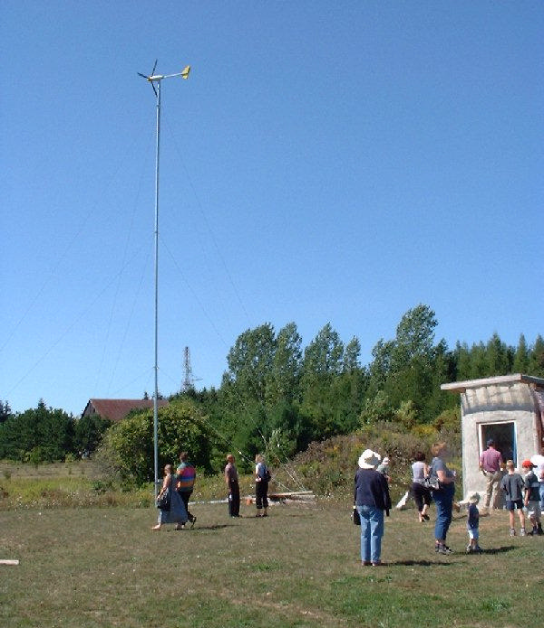
For more information on attending or exhibiting: Web Site: www.NaturalLifeNetwork.com/sunfest2004/Phone: 519-942-3266 E-Mail: john.wilson@naturallifenetwork.com-
Join Us
Become a part of a community of people around the world dedicated to living in harmony with nature. We've created this network so that we can all share our ideas, experiences and knowledge. The changes we envision are revolutionary; however our goals are to make them the norm. The organization is about the practical, inspiring and real application of living gently on the earth so that our children may enjoy a clean, healthy and productive environment.
The simple point is that we all can "do" much more - and that means all of us or it won't work. For example:
§ Choose or create a home/community that is powered by the sun; § Grow and eat organic food; § If you must travel select the most efficient means, walk, bicycle, tele-commute, travel by train, bus, ultra-efficient car, or fly; § If and when possible, work in nature - grow your own
organic food, restore nature around you, put your investments to work for natural living. What will amaze you that everything we need to live this way exists. The cost over the longer term is less. The results are a happier more healthy self and family. Start learning how today. Member benefits:
Monthly Natural Living Journal full electronic edition.
E-Mail Question & Answer (3 per year, no more than 1 per month.)
Directory listing (optional) and Natural Directory.
Discounts on some products and services offered by Natural Life Network. Sign-up for membership at: www.NaturalLifeNetwork.com-
Next Issue
Freedom Off-the-grid For weekly updates, special offers, and additional products and services visit our web site: www.NaturalLifeNetwork.comHave a question? Ask us and we'll try and include a response in our next issue of the Natural Living Journal. Have an interesting story to tell that relates to natural living? Contact us any time with your questions, concerns or ideas at: john.wilson@naturallifenetwork.com-