April 2005 — Solar Village for Survival
Publisher's Message
Responsibility Who bears the moral responsibility for the lack of action towards a solution to the most pressing problems of our time? We all do to some extent. That extent has been brought home to me by my families recent visit to Freiburg Germany. Reading the literature available on web sites, and from the information provided by friends who have visited, I had the impression that this city was the solar capital of Europe by the design of the cities leadership. To be sure, the current leadership does support this vision. However, a review of the history of the city revealed something we can all learn from.
Like so many difficult challenges that we must face, this one started with the need to say NO! Who in our society must step forward to say that this is not acceptable, we can do better, and here is how we can do it? In the case Freiburg it was left to the farmers, students, and a few scientists. These brave souls took on the powers of "progress" to protest a nuclear plant that was to be built near their city. Despite the massive forces arrayed against them, these few risked everything so that we might see the light. For their foresight they were treated as criminals. The police fought these visionaries with water canons as they occupied the planned site of the nuclear reactor. It was like civil war!
This responsibility to say no, however, came with another even more critical responsibility. That is in saying no, to have an alternative solution to the problem that can be proven workable. Armed with the basic idea that the sun provides plentiful energy, and rudimentary plumbing and mechanical skills, these protesters suggested that solar, thermal solar, active solar, passive solar, and efficiency could replace the nuclear reactor. Wildly creative, this issue of the Journal proves that they were right!
We have this same responsibility. We know that we face many daunting problems such as resource depletion, population growth, starvation, pollution, war and brain washing. Our challenge is to protest these problems and provide working solutions. This responsibility is ours because of our children, especially those yet born. It would be easier to hope our leadership might show the way. That is not the way of history, nor is it the way that things really change. It is when the people, people like me and you, work together to change things that the process is kicked into motion on a larger scale. Leaders may arise to communicate the message, take credit, or lead the charge. However, it is up to us to make these changes happen.
John Wilson, Founder of the Natural Life Network E-Mail: john.wilson@naturallifenetwork.com
Natural Living Journal John D. Wilson - Editor and Publisher Natural Living Journal Published by World Peace Communications Copyright ã 2005 John D. Wilson Our Web Site: www.NaturalLivingNetwork.comE-Mail: john.wilson@naturallifenetwork.comPhone: (519) 942-3266 ADVERTISING SALES: Leigh Geraghty, Advertising Representative, (519) 942-3266, leigh.geraghty@sympatico.caCONTRIBUTE: We are always looking for new, interesting and inspiring stories, pictures, and poetry, about people who are achieving a natural lifestyle. If you would like to contribute an article or story then please send us a note with your idea. Contact John Wilson by email at john.wilson@naturallifenetwork.comAll contents of this issue of Natural Living Journal are copyrighted by John Wilson, World Peace Communications, 2005. All rights reserved. Printed in Canada.
SUBSCRIPTION SPECIAL OFFER
NAME
ADDRESS
CITY/STATE/PROVINCE ZIP/ POSTAL CODE COUNTRY
PHONEYES! Sign me up for Natural Living Journal. Orders must be prepaid. Here is my check/money order in U.S funds (Canadian orders in Canadian funds). Subscriptions/ membership includes shipping, handling and applicable taxes. $29 Now only $19 - Individual - 1-year subscription and membership, paperless Internet delivery, requires email (12 issues) $59 Now only $39 - Business - 1-year subscription and membership, paperless Internet delivery, requires email, and business directory listing with logo (12 issues) Membership includes answers to three questions (no more than one per month) through email for a year. To order online by credit card go to www.NaturalLifeNetwork.com. Send all subscriptions and renewals to payable to World Peace Communications. Mail to:
World Peace Communications
248108 5th Side Rd., RR# 5 Orangeville, ON L9W 2Z2, Canada
Solar Village for Survival
"We return thanks to our mother, the earth, which sustains us to the wind, which, moving the air, has banished diseases to our grand father He-no, that has protected his grand children and has given to us his rain to the sun that has looked upon the earth with a beneficent eye."- Iroquois prayer of thanksgiving
We all know there are problems. Soon we will be sharing this planet, the global village, with more than eight billion. This planet simply can't sustain us all if we follow the path of North Americans. Sixty Americans will die today, and every day this year, from pollution. One out of two men will die from cancer. Sixty thousand children will die of starvation. War haunts us at every turn with the potential for thermonuclear destruction. Our survival rests upon finding a sustainable way to live together.
Background
The universe we live in formed more than 15 billion years ago. Earth coalesced into this beautiful blue marble of a planet, the third planet from our sun, about six billion years ago. Life emerged five billion years ago. Out of the water and solar energy rained down upon the earth, life appeared. Despite this simple formula we know of no other planet that has sustained life either in our solar system or any others that we've observed.
About one hundred thousand years ago the evolving humanoid life forms gave birth to the mother of all people alive on earth today. Through scientific analysis of the history of our genetically encoded mitochondria scientists have been able to confirm that we are all the descendents of a common mother. We are all one common family diversified and transported around the globe over thousands of generations. Before that we share a common genetic heritage right back to the first breath of life five billion years ago. All of life on this planet is our brother and sister.
The idea of a global village may be recent. In fact, our ancestors for thousands of years have been building civilizations with trade connections. Our villages have always been connected. Long ago in the mists of time we learned to harness the magical powers of the sun. Using wood for fire the first humans discovered how to harness the energy in universe as a tool. For thousands of years, African, Mediterranean, Asian, and other cultures have used the sun to dry clothes and animal skins, preserve meat, dry crops, and evaporate seawater to produce salt. Where this knowledge came from is not known. We can only assume that trial and error, experimentation, and many millennia of observation combined to provide communities and groups with an oral tradition full of these ideas. Cultures often build these into the myths, songs and stories they tell from generation to generation. In essence we've had a global village that was solar powered, the solar village, from the very beginning of time. We need only apply our creative abilities to new technologies in combination with ancient ideas that have always been in our survival arsenal.
Harnessing the power of the sun to grow crops by farming, using irrigation to ensure that water flows onto the fields as required to ensure optimal growth, and building towns and villages around these farms goes back long before even the Sumerian civilization thousands of years ago. Out of these civilizations we've created systems to manage the commons, wealth, property, food, housing, trade and much more. Our ideas for organizing systems of community have also lead to concepts such as hierarchy, competition, politics, control, law and power.
Much of human history, especially in the last several thousand years, can be seen as an age of competition for resources, land, wealth, and ultimately power. This competitive spirit has driven the powerful among us to conquer and impose systems of empire that best suits their interests.
Perhaps this is the last time the solar village will be forestalled by a false sense of abundance of non-renewable energy supplies. There are no other long-term energy alternatives except for the nuclear reactions kindled artificially by nuclear power plants or the natural energy flows driven by nuclear fusion sited at the appropriate distance of 93 million miles into the center of our galaxy where you will find our Sun.
The Greeks cut down most of their forests for fuel and building materials 2,500 years ago creating a shortage of wood for fuel. By the fifth century BC much of Greece was totally stripped of trees. This led to the earliest examples of solar architecture based on the changing seasonal position of the sun. The Greeks knew that in winter, the sun travels in a low arc across the southern sky while in summer it passes high overhead. They built their homes so the winter sunlight could easily enter the house deep into a south facing portico. Overhanging roofs and eaves shaded the house from the high hot summer sun. Socrates said, "In houses that look toward the south, the sun penetrates the portico in winter, while in summer the path of the sun is right over our heads, and above the roof, so that there is shade." The Greeks planned cities so that each house had good southern exposure. Socrates and Aristotle advised city planners to position buildings so that sunlight entered them in winter but not in summer. Heavy building materials stored the solar energy let in during the day. Window shutters were closed at night to retain the heat inside. Buildings were also clustered together to provide shelter from cold winds.
Six hundred years later, the Romans added to the design of solar buildings. They faced transparent mica windows towards the Sun, and used heavy, dark-colored floors to absorb and store heat for release at night. The Romans were also the first civilization to use greenhouses to grow vegetables and other plants. These structures made use of windows made from the earliest glazing
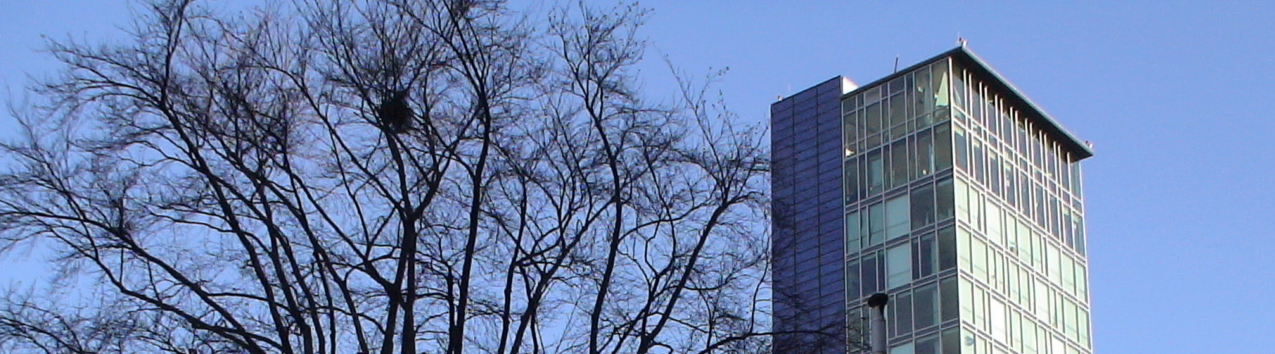
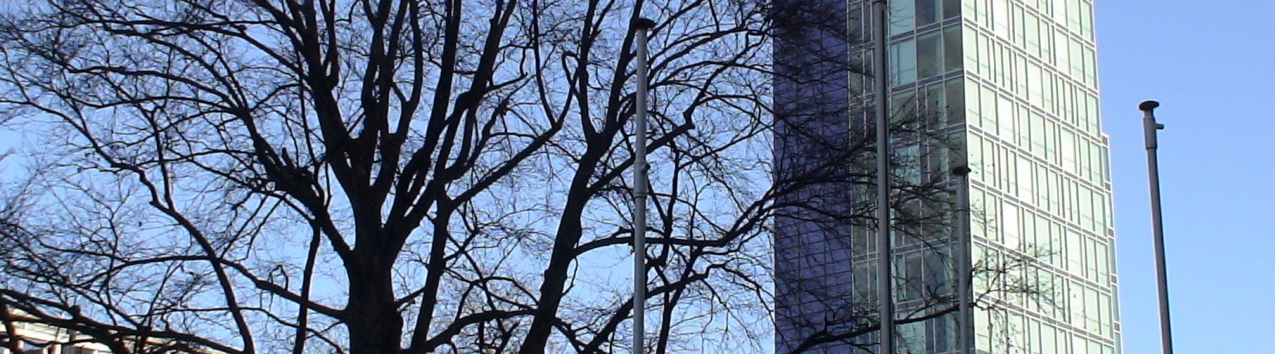
Main train station in Freiburg which hasa large solar array on the main tower.
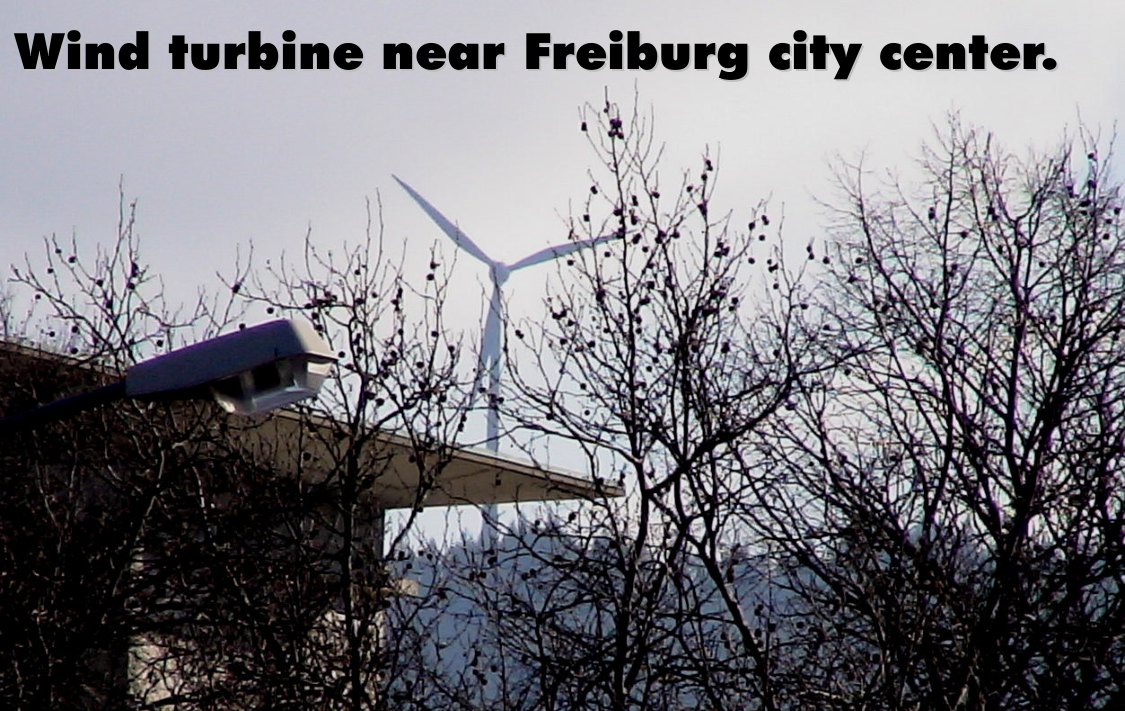
Wind turbine near Freiburg city center.
materials including thinly split stone, such as mica or selenite. In the first century AD Romans developed solar rights laws for this important natural resource.
Harnessing the power of the water wheel allowed the Romans to support much larger communities. Extensive terraced water wheel systems developed providing more than fifty horsepower per wheel. Water supply and sanitary waste removal systems required extensive construction of lengthy aqueducts for the major centers conquered by the Roman legions. The Greeks and Romans had no choice but to innovate and use these renewable energy sources, as the other available resources became depleted. Does this sound familiar?
Solar Village Today
In order to find a working model for some ideas on how to build solar villages, we have visited Freiburg Germany, the solar capital of Europe. The follow information is based on interviews with a resident, a city planner and municipal project manager in the city of Freiburg. Thomas Dresel, Project Executive for the Solar Region Freiburg Project, working with the Environmental Protection Authority of Freiburg.
In the mid-1970's there were plans to setup a nuclear plant about 30 kilometers from Freiburg. There was wide spread demonstrations against them. It was almost like a civil war. Out of the mud pits left by the water canons emerged the ideas for creating a solar community. On the nuclear plant building site, while the water canons fired, they started to think about what other sources of energy could be used. Somebody had heard that you might be able to get solar hot water with copper pipes soldered together on a black surface. At first the visionaries, including leading scientists, activists, farmers and students were ridiculed. The confrontations were difficult for the community. Police who supported the protestors had to struggle with the conflict of enforcing the peace. In some cases the police supported the protesters. The result of these protests was the prevention of this nuclear station from being built. These actions were a large part of the nucleus of the green party that has become such a significant force in European politics. In the end this has lead most of Europe to commit to the shut down of all nuclear reactors. Some people also realized that despite solar being an expensive niche, there was still an opportunity to develop this new and emerging high technology industry.
Grassroots or bottom-up direct action is what drove the majority of initial changes. In the early days it was a small group of visionaries, activists, the mayor and so on that did a great deal to attract industry and groups to the city. At first these initiatives were ridiculed. The first few experts and know-how were attracted by a small group of very committed individuals. The success story of the solar transformation eventually created pride in
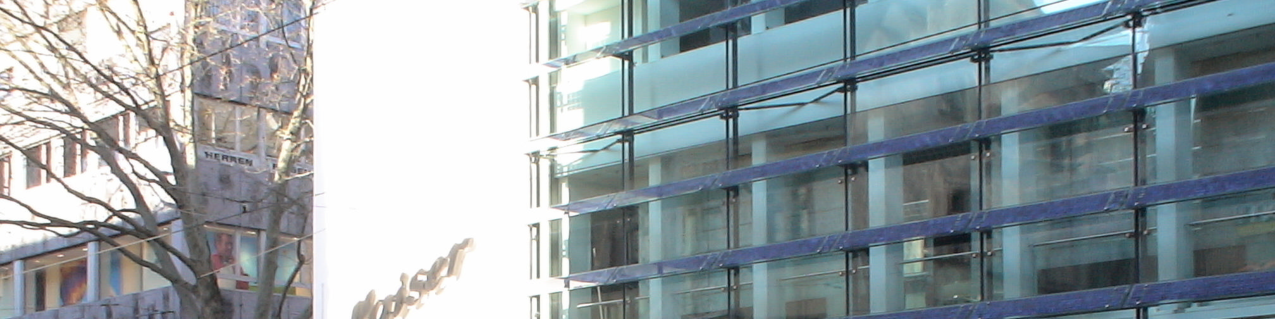
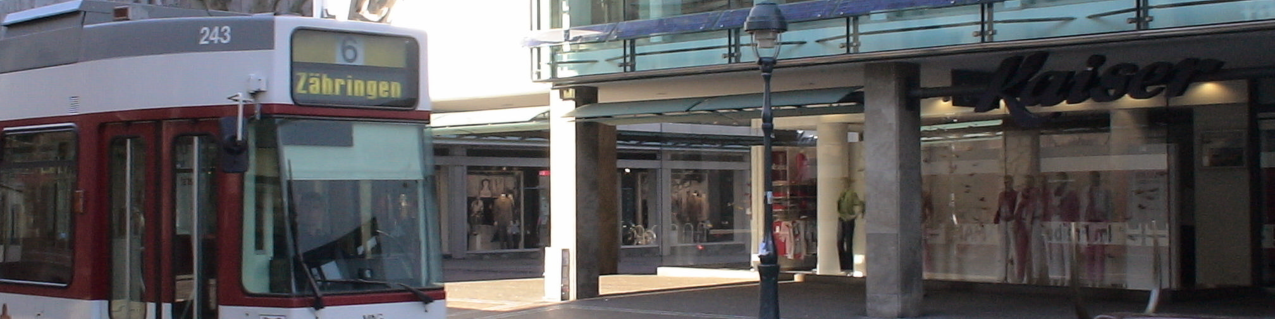
Tramway transit system in the downtown core where no cars are allowed. Buildings have solar panels.
the city for all citizens.
Freiburg is essentially the birth place of the green party which originated in 1992. Recently Freiburg was given number one rating for environmental leadership in solar. This gets noticed by the broader public. Now there is broad based support in the media for a competition for this title of being the solar capital of Germany. The competition to be the number one solar community in Germany is big news. The media covers it much like the football competition. Out of this success a nucleus of identity was created, something people could feel special about, and here is the thing, you can connect your own identity to this solar thing. Being number one in solar is now something that the entire community takes pride in. The competition is called the Solar Bundesleague like the football league.
The most difficult part is always money! Not only in Freiburg, but everywhere, money is a major factor. Solar energy is obviously one of the most expensive forms of energy. You must raise funds for solar projects, and in fact more than with conventional systems of energy generation. This is where the enthusiasm, idealism, and activism plays a big part. Putting solar panels on the cities soccer stadium became a rallying point, and a symbolic first step. The solar panels on the soccer pitch were financed by individual citizens who could buy shares in the installation. This allowed all of the citizens to become small scale electricity producers. It was important that this was visible in the most public place, the soccer stadium. The incentive was a share in the production of electricity but also a season ticket to the soccer games. The joint ownership scheme has now been replicated around Germany. This new financing model has been used extensively to finance wind turbines. Canada has used a similar scheme to finance the now famous wind turbine installed at the Exhibition grounds by WindShare with support from OSEA (Ontario Sustainable Energy Assocation).
The government does not play a role in the financing. The financing model works by having a group of people who want to do something. They form an association to do these projects. The associations may then get connected with Solar Fabrik or other manufacturers for solar panels, wind turbine manufacturers, or solar thermal systems providers in a partnership. The fact that Solar Fabrik, a local solar manufacturer supplied the panels for the soccer stadium, allowed Freiburg to say their panels where home made since Solar Fabrik manufactures in Freiburg. The secret was, passing on the ball like in soccer. Connections were formed between groups and stake holders including for example the sports club, energy production industry (Badanova is the regional energy supplier), and the public. Money comes from citizens who can buy shares in this new setup. It always depends on people who put their money in partly for idealism, but they also want to see a return. It is not a way to get rich, but you don't lose money either.
Two new solar village developments were designed and planned by the city from a site perspective. Vauban, one of the solar developments, now houses more than 5,500 residents. There was a balance in the development. Low energy building standard was required. As a private group you simply had to comply with this low energy standard. Building lots are still available but much of the land has been developed. The sustainable practices have been particularly successful in Vauban. A critical component with this community was a decision by the citizens to make this a traffic free area. In order to do this plans included two large centralized solar garages. Each parking garage has a big solar installation that can generate thousands of kilowatts. This allows for a car free zone around the housing.
Solar projects are supported by subsidies at the national level. In Freiburg the local utility Badonova also offers an additional subsidy system. The local system relies on people who voluntarily choose a standard or raised rate to support solar/wind generation. These tariffs then go specifically to finance renewables. Wind turbines don't need extra support economically. They are cost competitive with other non-renewable forms of energy already.
What are the parts of the system that make it work? In soccer you pass the ball to your team mates. In the field of solar, technology, thermal or PV, Freiburg is not unique but what is unique is the wide range of different applications in different fields. These diverse areas are brought together in Freiburg so that the exchange of information, ideas, and money can be more fluid. The key areas of focus include:
-Economy -Tourism -Education/training -Financing/marketing -Building/housing -Technology development -People Various links and networks between these areas of focus have developed technology is Fronhoffer Institute of Solar Energy Systems with more than 400 experts. This centre of competence has several main focus areas including building technology, solar, systems, integration of various forms of energy, and saving energy. With this wide set of focus areas you get many forms of motivation supported. Economics is about the money motivation, driven by industry and business, as well as the municipal and federal government. People, is about lifestyle and bottom up driven change including community member driven initiatives, as well as health concerns. Technology is the scientific side of things. So from these different forms of motivation the combination creates momentum with solar energy just a starting point or catalyst, but it is the critical driver for gaining momentum that is developing for the future. The other critical element is to make visible the benefits of solar energy for the different areas of society.
What is the scale of what Freiburg has done? If you look at the contribution of CO2 reduction, the biggest sector is in existing buildings. Improving older houses, those built up to the 1970s, this is the biggest possible contribution. Traffic is another area where the community can drive some changes. However, there is only so much you can do at the municipal level. Freiburg does encourage alternatives transportation options with bicycle lanes, public transit facilities, and car sharing to reduce car traffic.
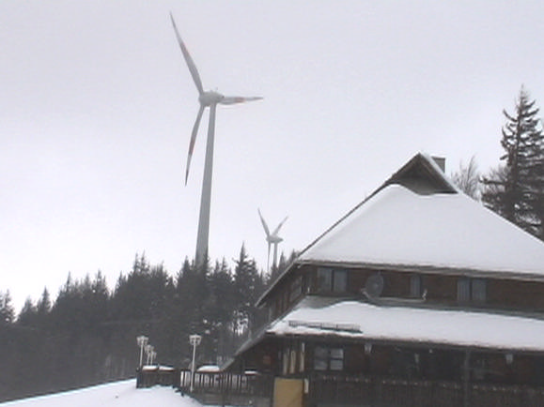
Currently Freiburg boasts a colossal (compared to other cities in the world) 4.3 MW of solar photo voltaic (PV) electricity generation into the grid and 9,200 square meters of solar thermal. Electricity generation from solar PV has reached about 0.4% contribution to the overall supply. Wind power is a major contributor with six large gearless wind turbines generating 9 MW of power. These wind turbines are located within about 20 minutes of the city on the mountain tops of the black forest. As with 95% of all wind power projects this one was financed by citizens and private enterprise.
We are talking about sustainable development and the contribution of the solar focus. In a sense the lead role played by photo voltaic solar panels that generate electricity from sunlight, has lead people to realize you need to work on insulation for instance. Using PV starts with being efficient. Initiated by the use of PV, which is considered a sexy technology that generates electricity, that is attractive. This provides a trigger for other measures (passive solar, solar thermal, insulation and high quality windows for instance). PV started the wind turbines. Wind is debated due to concerns about their impact on the environment and their visual impact. You can't just put them anywhere. From the conviction of renewables being the future of our energy supply, PV already shows the direction. Now it is only a necessary that you must include wind, biomass and other elements that make the best use of the more expensive PV. To this end PV plays a critical and significant trigger function.
It is not politics that is the prime mover. Joint effort is the key. It is the examples set by single initiatives, such as best practices that puts pressure on other areas. Freiburg does not presume to tell others how to do things. Rather with communication, exchanges of information, and shared experiences, the ideas are spreading, evolving and being adjusted to different conditions in different places. Connections with Alsace and the twin city in Ukraine, is a part of how to spread these ideas. Nobody anywhere is isolated anymore. We are all connected in the global community.
Higher energy prices in Europe are largely because of extra taxes. Each kilowatt of electricity in Germany, which is usually 6 cents, has one cent added as a source of revenue for subsidizing higher rates for wind and solar power. The revenue is used for subsidies, for example into PV that are used to feed into the grid. Anybody, big or small, industry or home owner, can sell the electricity they generate. You get a highly subsidized price for clean green solar. This is financed by the tax on all energy. There is a kind of a parallel tax program from national to the local level. This plays a major role. If you want to bring people out of their cars, you can impose restrictions or increase the price of gas. Freiburg prefers another approach, which is to provide attractive alternatives. For instance provide a very good public transit system that provides a better alternative than cars.
It has always been important that energy development including efficiency, heat/power, and renewables and that it be drive from the bottom up. Municipal government should support this. It is equally important to get as many actors or individuals, companies, and groups on board including trainers, educators, and associations in order to create a dynamic network. This is much more effective than just a prescriptive approach.
How do you educate/motivate? You don't have to because with the bottom up approach and networks that form they are participating already.
Necessary preconditions for ensuring the ideas of a solar village are palatable must also consider the following important elements:
-Cost - people are willing to pay a little more, up to 10% more -Comfort - must fit lifestyles, must be simple, easy -Control - people want control of effects -Consensus - not everybody, but you must have wide discourse with everyone, being number one with PV is now a major news story -Cooperation - can't rely on just one institution There are no building regulations imposed by the city. These are left to the national regulatory framework. However, Freiburg does have a low energy building standard that applies for buildings on land bought from the city. The interesting thing is that it is a civil law, a sales contract issue, that legally binds the owner to conform with low energy standards. This works better than regulation. The difficulty is that if you prescribe in regulation you get into expensive law suits regarding compliance. This effect is not worth the hassle and cost.
Some areas have district heating. The connection can be compulsory. This is legally debated. For example if you have a passive solar house, then your ecobalance might suggest you shouldn't have to conform. Legal frameworks in general are not optimal. Freiburg relies on national codes and eagerly seeks rules that make solar equipment compulsory. Make the bottom line reflect the true costs so that solar and renewables become the natural choice.
Compost is centrally processed to produce a gas that is used for producing electricity while the heat is captured for district heating. Keep in mind that large central systems particularly in North America throw away 70% (50% lost as heat and 20% lost in distribution) of the energy through heat as waste and distribution losses. Europeans have figured out that this waste heat can be captured. By building combined heat / energy plants in local communities the majority of this 70% is captured. The heat is then used in the local community conserving this precious resource. Distribution loses are then minimized by having more, smaller plants, right in the local community. This is called community cogeneration and is quite common in Europe. North America for the most part ignores this massive opportunity to stop wasting in excess of 70% of the energy we currently generate. This waste is in many senses a crime.
Solar Factory
Zero emissions factories are now possible. One of the first is the solar panel factory constructed by Solar Fabrik in Freiburg.
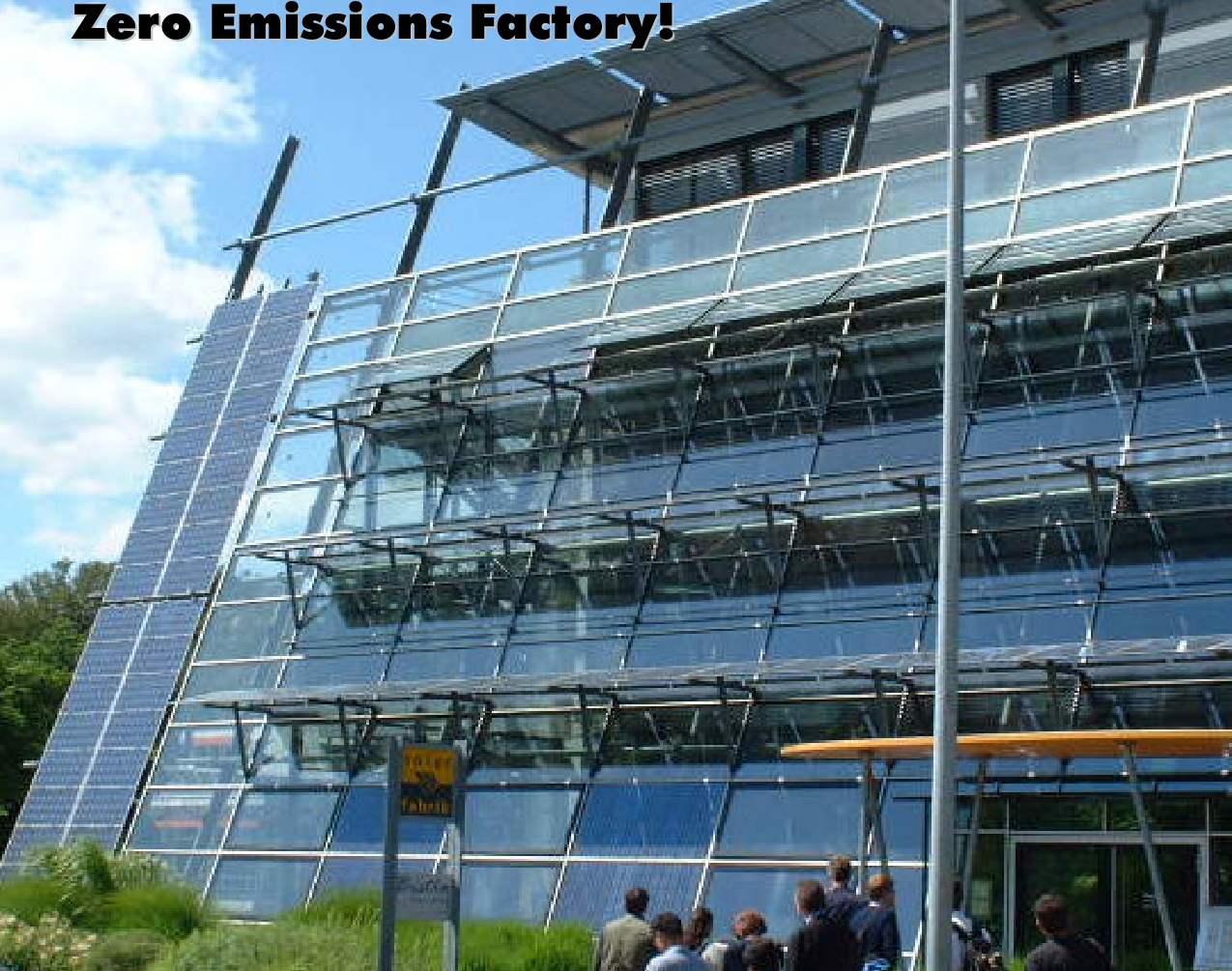
Zero Emissions Factory!
This is an industrial building and at the same time it is a solar architecture. The solar design and requirement for zero emissions meant combining new and old ideas, while abandoning some conventional assumptions. When you use solar in winter it is a powerful mechanism for heating, but in winter it can be a problem, as it may overheat the building. Solar shading must be calculated to prevent sunshine into the building on June 21 as the summer sun reaches its peak. Maximum sun is allowed to enter by December 21 when it is low in the sky. The primary purpose of solar panels thus becomes shading. Then, only secondarily, they are used for electricity production. Doubling up on the functionality reduces the overall return on investment. The combination of renewable energy concepts does not stop here however.
Earth collectors for getting air for cooling and heating surround the building underground. Earth temperature is 8 to 12 degrees celcius all year long. Cooling is therefore provided by the earth in the summer. In the winter, the air is much warmer than the temperature of outdoor air reducing the amount of heating required to boost the temperature inside the building. This building is one of the first that combines 100 percent glazing (windows on the south side) while not requiring mechanical air conditioning. With the earth cooling system vents are opened in the summer so that convection currents carry the warmer air out of the roof. This creates a natural lower energy air conditioning system.
Solar Fabrik started solar manufacturing twelve years ago. In that time they have become the number one provider of photovoltaic solar panels for the German market. Oil, coal and nuclear will be replaced by solar, wind, biomass and other renewables in the not too distant future. Proving that the factory system can be completely closed loop, this plant is the first zero emission factory in Europe for solar panels. Rapeseed is an additional biomass based system for generating heat energy in the winter. This biomass generating system is a cogeneration plant which only runs in winter to support heating requirements. The biomass system is CO2 neutral since as much is absorbed by the plants during growth as is given off when burning the biomass.
Solar Fabrik has a thriving business producing solar panels in Freiburg. Part of the reason is economic conditions in terms of subsidies that transfer income from conventional energy supplies to solar and wind. With a market system that more closely resembles full cost accounting, it is now possible for each person who, it has been calculated, would need 10 square meter of PV that produces of 1000 kwh to get a system that will provide a reasonable return on investment. The cost of this type of system in Germany has reduced the payback to eight to ten years (compared to up to 70 years in Canada for instance). The next twenty or thirty years of production are then pure profit. Things are getting to the point where more and more people can make this investment. In Germany these subsidies are applied equally to both big business and individual home owners.
Architecture must change to allow the new ecological models to take hold. Engineers and architects have to stop working against each other. In the case of the Solar Fabrik factory architects and engineers worked together from the start. This eliminated a design that might have required air conditioning to overcome the challenges of passive solar heating in the summer. The whole model is changing and needs to change. When an architect designs an efficient building we need to pay them more rather than the current model of paying a percentage of the overall cost of the building. We must consider the overall, beginning to end total cost of ownership. Lifetime energy costs must be reduced. Paying designers for this is what makes sense for creating a sustainable world.
Nuclear Protest
In 1975 a nuclear power plant was supposed to be built about 20 miles from town. People demonstrated against it. A retired police commissioner at the time recently recounted his feeling that he had two hearts. He worked for the police, but he also was in support of demonstrating for the changes. Normally he had to fight against demonstrators. Thousands of people occupied the land. This was the start of the ecological movement.
1986 was the year Chernobyl happened. This nuclear plant exploded, emitting a cloud that spread over much of Europe. Once again the determination to find alternatives was rekindled. Early ideas were primarily for energy savings, including cogeneration which means using technology more efficiently, and adding renewable energy. Cogeneration is something North America could use in order to stop wasting 70% of the current energy production as we've already seen. That this isn't the case currently points to a major flaw in the market system. It is essentially criminal given the known limits to fossil fuel reserves and the incredible value of this resource for so many other purposes. Most ecological design projects are from the bottom up. The political administration essentially followed the demands of grassroots organizations. Protest has proven effective and in fact critical to getting the government to change things.
People participation is critical. Getting this support can be a difficult task especially when economic times are tough. Putting sustainable development ideas in the spotlight, in very public areas of life can be very powerful. The roof of the soccer stadium in Freiburg is covered in photovoltaic solar panels. This project allowed people to buy a share of 5 square meters, and then the people became producers instead of consumers. Transforming consumers into producers is a very real change that will be required of all of us in order to become sustainable. Life systems must balance production with consumption in order to become sustainable.
Another major element of the sustainable community network is the energy distributor, Badanova, who players a major part working with groups to support the process. Badanova supports a number of different communities in the area. They built the local cogeneration district heating system in Vaubon. This a new cogeneration plant design that burns wood chips primarily. Electricity is generated as well as heat. The heat is distributed to the district supplying 5,500 residents with home heating.
Federal Law now says homes must use 7 litres of oil as a maximum for use of energy. 0.5 litres is now required for the new passive solar home standard.
Citizens of Freiburg lobbied the city for ecological ideas in order to create the sustainable communities that now exist. Citizens wanted an interesting new district and they wanted to participate in the design. Architects and citizens met in the mess hall of the old French military base, to have meetings to develop the design of the future community. This diverse group came up with many new ideas. Many different types of buildings, colors, and many different builders and groups had the opportunity to do different things within the requirements of a minimum sustainable standard. Instead of a developer, the group works with an architect that can develop a wood framed house, with very good insulation. This group of people can then reduce the cost of development by
eliminating marketing/sales costs and use this saved money to create higher quality as well as adding renewable energy systems. The cost of homes, when compared with developer built homes, is about the same. Life quality is especially highly valued in these new communities. These are the models for the solar village of the future. Speed for cars in these new communities is less than 5 kmh, which makes for an overall slowing down, that is a part of this new type of community. Nature is exposed and natural systems given a priority. Priority is also given to pedestrians and bicycles. New tramways are planned to travel directly into the community. Tramway pricing is made to be expensive for 1 way trips costing 2 euros. For a tourist, if you go the whole day, then you spend 6 euros for the whole day for as much travel as you want. 44 euros is the cost for travel throughout the whole region for the month. Anywhere within 50 kilometers is accessible. A single pass holder can take their whole family on weekends as a bonus incentive for the pass. You can become a member and also share cars for travel beyond the reaches of the transit system.
Fronhoffer institute now has over 450 experts on solar technology. Shading is a very important system that could be a major easy change to make especially in southern countries. Solar air conditioner designs have been developed that use a heat exchanger to produce cooling. This development, originally for large scale buildings, is now being designed to work on a small unit for individual home solar air conditioning. Another important center of expertise is the service centre for renewable energy which is home to more than 40 companies under one roof. Also, the solar infocentre retains an office in this building providing a high concentration of experts. This concept brings small consultants that were all over into one location increasing the speed of communication and development.
InterSolar 2005 is a large trade fair that will occur from June 23-25 this year. More than 16,000 people in three days are expected to attend this event.
Wind turbines cost about $2 million each. 6 wind turbines, were $13 million euros altogether fully installed. 4.6 million euros was paid by people who bought a share in these wind turbines. The basic investment amount is 3,000 euros that produces 1,200 kwhs. These large scale wind power projects run for 20 years 2003-2023 for instance. In the end the investment pays back 280% of money. During the first year you get 3%, then 5% and so on. The energy company, Badanova, operates the wind farm. The towers are 98 meters high. The generator weighs 100 tons. The towers in this case are made out of reinforced concrete because steel towers can't be brought up the steep hills of the mountain.
These 1.8 MW wind turbines use a new technology that is gearless improving reliability and efficiency. The blades turn 22 times per minute, generating DC, with a transformer that takes the electricity into the grid at 20,000 volts AC. Some areas that have good wind speeds may be difficult to add due to access to the grid.
95% of wind turbines are financed privately. People invest because it is good investment. Pricing scheme is key. Utility collects 1 cent/kwh on top of the actual normal rate. $2 billion euro is collected which is used as subsidy to solar and wind. Renewable energy gets paid an additional 3 cents/kwh for wind power.
Passive Solar Home
ANDREAS DELLESKE is a resident and member of a private group who built the Vaubon passive solar house together with 15 other people. Passive house means it uses only 1.5 litres of oil per square meter per year. Compared to conventional homes, Andreas has found that he pays up to tens times less. From an economic, sustainability and a comfort perspective, these residents have found a way to build a home that costs about the same as conventional construction, while using ten times less energy.
The idea to build this type of home started when an architect and biologist got together and said they wanted to see about building a sustainable home. The architect wanted to try out some of the new and old passive solar design ideas. The biologist wanted to integrate some new waste processing ideas. The house has been lived in now for six years.
The house is a co-owner apartment built with 40 units. The cost was 7% higher than conventional new built homes but saves so much money every year, and provides better indoor air quality making it a superior option. Surplus costs will pay off in 10-20 years. The air exchange system improves indoor air quality making it a better home to live in by making the indoor environment more comfortable. Each unit pays for only a very low amount of energy. Each unit that is about 90 square meters pay 140 euros (about $200) for their heating bill for an entire year. Often people pay 10 times this amount for heating in a conventional German home.
By building the home as a group of sixteen co-owners you save in costs on sales/marketing, but must be prepared to spend more time on discussion and trying to get agreement. The most important thing was that a clear set of guidelines were defined in which it was clear that this would be a "passive house" standard design. People believed in the concept. Cogeneration was going to be a part right from the start. It was found very helpful to start with a view of the direction that was very clear. Then more fruitless discussions can be avoided.
Unfortunately, the passive house is still not that common even in Germany. This was the first multi-family passive house in Germany. Most architects are just learning about these ideas. Architects have to work very closely with energy engineers to make this type of design work. This is done at university but people forget about their education. The passive house standards will require good orientation and access to the sun so it isn't for every location. Deciduous trees on the south side and shading are also important features to ensure that the building does not overheat.
All the windows are triple glazed which isn't common or standard in Germany yet. They are heavier, requiring better
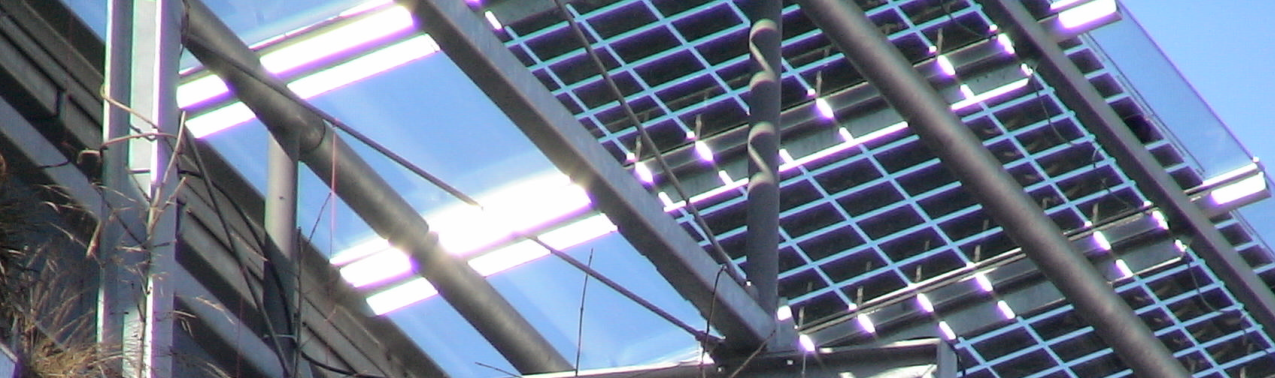
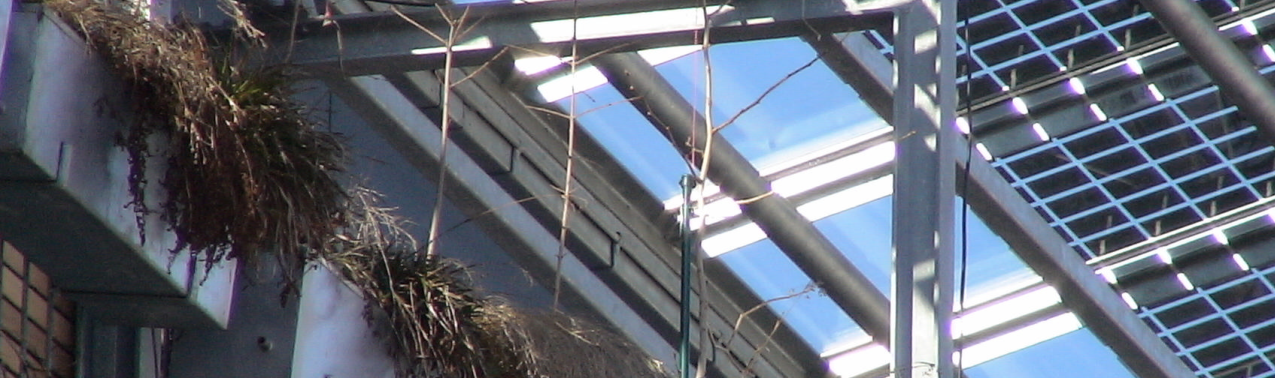
Solar PV installed on passive solar home.
support which can add to the cost. However, the long term savings make this investment worth it. In a passive house you have triple glazed windows with a mono-atomic layer of silver, sometimes called low-e, for keeping heat in. Between the panes of glass a gas such as krypton or argon is added to further increase the insulation values. The sun is the biggest, simplest, and least costly source of energy for a passive house.
Passive house standard requires a mechanical ventilation system, which is not so common in Germany. This mechanical system means adding a heat recovery ventilator. The level of insulation is conventional now with new building standards even on conventional homes.
The main features of a passive solar home standard in Germany includes the following five important elements:
-70% windows (glazing) on the south, combined with solid concrete floors to absorb the heat, and shading to prevent overheating in the summer
-High levels of isolation, 35-40 cm insulation, mineral wool in the case of this home, and styrafoam in others including the basement -Triple glazed windows and with heat reflection on windows, keeps heat inside -Air exchange system has 2 ventilators with a heat exchanger so that heat is not lost while ventilating fresh are from/to the outside -cooking and showering generates heat which contributes to overall heating system, called internal gains to the extent that twice the heating capability would be required if the building was empty Three more passive solar house ideas that were implemented on the house that Andreas and his group built include:
-Solar thermal collector 46 square meters which supplies 46% of hot water required
-3 kwh photo voltaic solar array on the roof that generates 10% of electricity needs, connected to the grid -Cogeneration heating plant in the basement, driven by natural gas, provides 60% of electricity and 100% of the remaining heating requirements An alternative sanitary concept uses a vacuum toilet, like in airplanes, in order to reduce the amount of water to less than 1 litre per flush. Combined with the local biogas plant this sewage waste is used to generate electricity while the heat from this process is also captured for heating. Using ultra-low flow toilets is required for the use of the sewage for generating energy in the biogas plant.
Most people know that we have an energy problem, but we also have a bigger problem in our limited resources. This requires that we close the loop. Platinum for instance used in a cars catalytic converter to reduce emission, creates a waste stream of platinum. This valuable resource is then very expensive to recover. We put this incredibly valuable substance into millions of cars and now we can't get the platinum back, so we are using it up and it can't be created at least not without a lot of energy. The waste streams need to be separated so that we don't raise entropy in our environment. Entropy is a measure of the chaos of materials. Platinum is also a critical component of hydrogen fuel cells which may be required as a storage system for renewables like solar, wind, biogas, and hydro. Resources will be as big of a challenges as the move towards renewable forms of energy in our solar villages.
The primary design of the passive house was carried out by an engineering office and an experienced architect, who had a lot of knowledge particularly with sustainable building concepts. Citizens wanted to participate in the design process. For ten years there was good dialogue and discussions, with some difficulties, but they solved problems well together. Now more that 5,500 people live in this district.
Passive Solar Condo
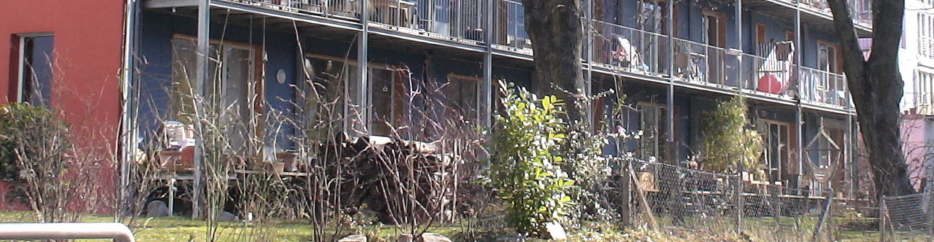
The walls are a wooden structure filled with insulation, a mineral wool. Up to 47cm of space in the walls is filled with mineral wool. A normal house only has 12-16 cm of insulation. This high level of insulation is one of the most important, practical and cost effective leaps forward. Insulation is a critical element to conservation and efficiency of the overall energy requirements of the home.
watts of energy in the heat they radiate while present in the building. People supply a great deal of energy, reducing heating needs by up to 50%. A relatively small cogenerator is in the basement that uses natural gas to create 5 kwh of electricity and 12 kwh of heat. An additional heat exchanger also collects the last 2 kwh of heat given off by the cogenerator to provide additional heating.
The main cooking appliances use natural gas which are much more efficient than electrical equivalents. Two thirds of energy is wasted with appliances that use electricity. Gas is essentially 100% efficient. Every appliance is very efficient. Water doesn't need to be heated by electricity for appliances further reducing the energy requirements.
Toilet and gray water is separated. Vacuum toilets only needs .5 to 1 litre of water per flush. This was required for the bioreactor system that is able to generate electricity from this "waste" material which is being turned into an energy supply.
The greenroof was important to avoid dumping rain water into the surrounding community. Only 10% of water ends up being drained away as the greenroof absorbs and allows evaporation to reduce this runoff. Crushed bricks provide the base for the greenroof. This crushed material was needed to collect water for the plants. Everything was naturally seeded over several years. No fertile earth was required keeping the costs down.
Vauban citizens installed a 30 kwh pv array on the shared community parking garage. This solar power plant now generates up to 27 MWh per year. Wood chips are used as a biofuel in a cogeneration plant used to generate steam for providing heat in the Vaubon district. The plant also generates electricity. This is a cogenerating plant. It combines electricity generation with heating
Internal gains also provide an important energy investment. Humans actually supply 180 so that very little energy is wasted. If we look at the typical North American model, the conventional nuclear, coal and oil based generators simply generate electricity and throw away the heat as waste. Cogenerators capture this heat for use in the local community. This improves efficiency of the plan by up to 40%. Local usage also minimizes losses that are typically in the 20% range for the large central systems established in North America.
Other supplemental renewable energy projects are widely supported. Most people like the wind turbines because they've come to understand that other fossil fuel or nuclear systems pose grave health and safety hazards. Most people like having renewable energy. If people like nuclear or coal then give them this waste and see how it compares to a beautiful clean wind generator or solar panel.
The maintenance of all these systems is quite simple although some techniques used are a little more complicated. The cogeneration plant is maintained on a contract so this appliance is not an issue. This home has had five years of operation without a problem. Simple operation can be seen from the fact that the whole system only has nine switches to control everything. All the radiators are pumped with one small pump. The radiant heating system even conserves energy by insulating the tubes that supply the heated water to reduce losses. The cogenerator produces 100% of the heat needed for the house which is a total of 1460 square meters of home heated. As we've already seen this system saves residents up to 10 times the conventional cost of heating.
The air system is centralized, with a large heat exchanger to reduce heat losses. 80% of heat should remain in the house based on the high level of insulation, high quality windows and efficient heat exchange units.
The sewage system biogas reactor housed below the ground is a cubic container. Farmers will come for this biowaste to use on the fields after it is processed to eliminate the pathogens and other elements that are not desired. Black water is separated from gray water. Gray water is processed with a membrane filter that is sucked through and cleaned. The processed gray water is clean enough to be drained into gardens and streams. Oxygen and air along with bacteria on the membrane combine to naturally clean the water aerobically.
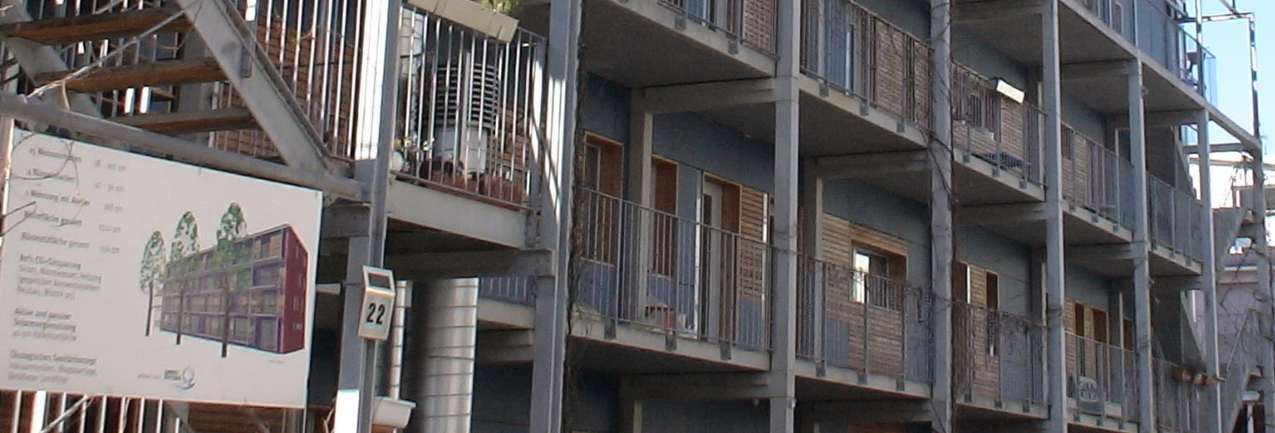
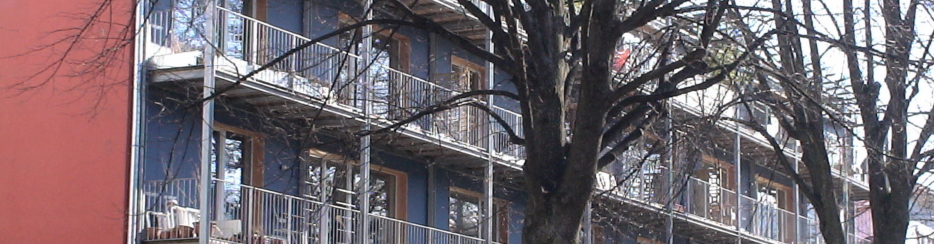
Many other details are important to the overall design integration. An example is the balconies on the south side which are separated from the building to ensure the thermal barrier is a perfect seal. The depth of these balconies is precisely the right width to prevent sun in the summer and allow maximum sun in the winter. Many other details ensure that the full life cycle costs, and total sustainability footprint through time are minimized. This community represents a working model upon which we can all build upon.
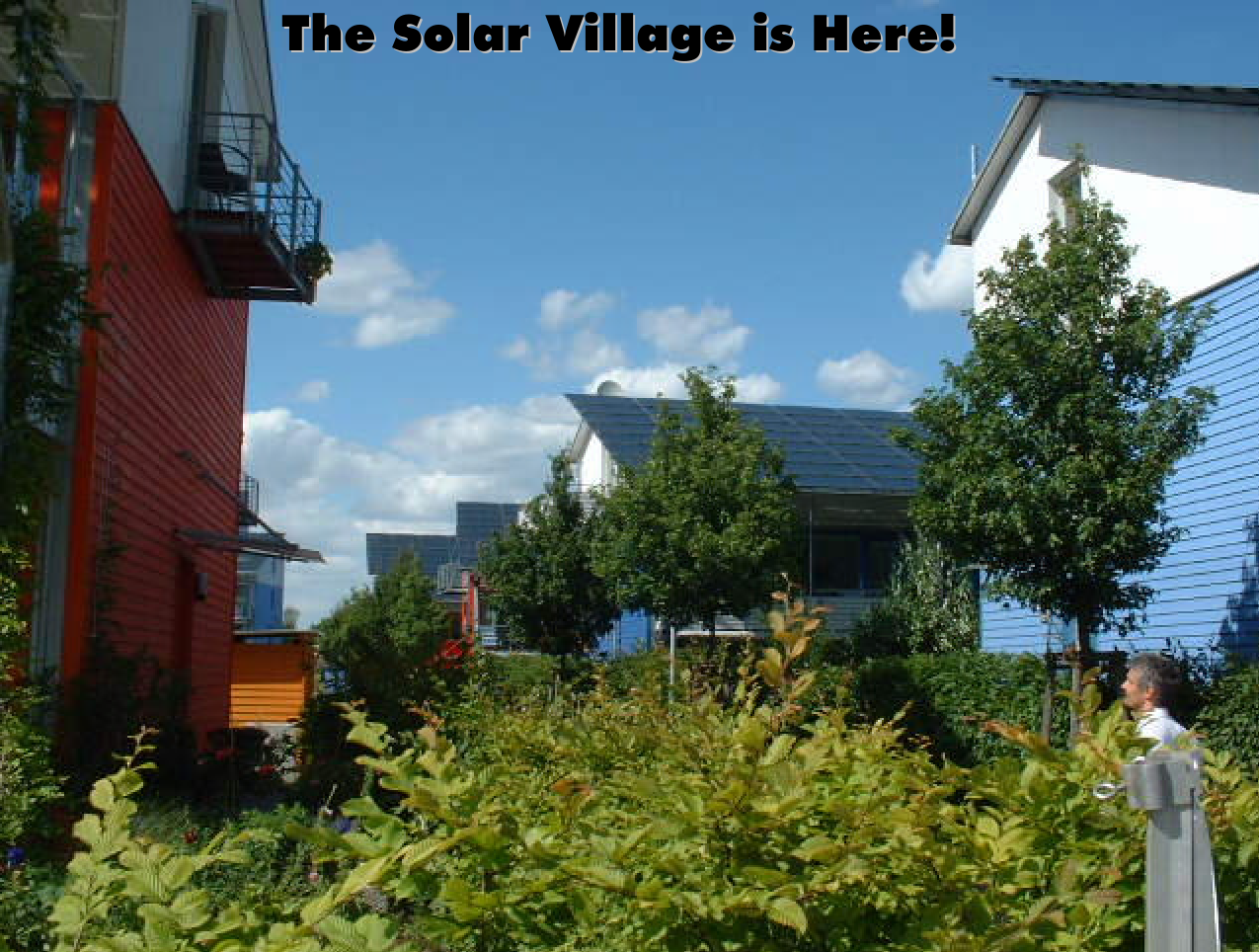
The Solar Village is Here!
The development of Vauban, the district where this passive solar home was built, was managed by a citizens group. This group, called Forum Vauban, contributed many ideas to keep things sensible. One suggestion was a new traffic concept. First, there is a car sharing organization. Then, there is a tramway line to be completed in 2006, that will stop in the centre of the community. This transit system will provide 5,500 people with access to the city centre in just eight minutes. Cars were banned in the housing district. Car free means that every person who buys a car must also buy a place in the central garage. This creates a good quality of living by eliminating cars from the shared community areas. Many families have been attracted. 40% of the residents are people below 18 years of age. The community has been so popular for families that the school has had to be enlarged twice. A local supermarket is built into some commercial space in the central parking garage structure. The parking garage has a 70 kwh peak solar array on the roof.
The history of Vaubon goes back well before the fall of the Berlin wall. However, at this moment it became clear the French military would leave this former military barracks. The students in Freiburg at the time needed an affordable type of housing, so the students wanted to take four of the old buildings for this purpose. This was an idea called SUZE, self organized settlement group, and the goal was to create a low cost housing option, without costing the city anything. The original prejudice and doubts were changed when after ten years these students were able to do things for such a reasonable costs. The SUZE project wanted to preserve a community centre and the result is the transformation of an old military barracks building as a shared community centre.
The central heating plant for Vauban is based on burning wooden chips to drive a steam turbine. Natural gas fires 20% while wood chips generate 80%. This system is not used for the passive house system since it has its own cogenerator in the basaement. The community wood chip generator supplies heat for 5,500 people in the community. This is an innovate new type of local plant. The steam motor is only one of five in existence. Cogeneration usually means natural gas. Forum Vauban citizens had the idea that wooden chips would be a better renewable solution and for this reason the plant gets paid at a higher rate. Renewables get subsidies that fossil fuels don't.
Energy injection laws in Germany guarantees a certain amount will be paid for renewable energy supplies including, 45 cents/kwh for solar photo voltaic, and 10 cents/kwh for others renewables. This pricing mechanism applied to all sectors is a critical factor to the solar village transform that was won through political activism and protest. It is a critical element since it points the economic drivers in favor renewables. Once the full costs are applied to fossil fuels and nuclear, the system suddenly makes renewables the true wise investment that they really are. For our children's future we must make these changes now!
-
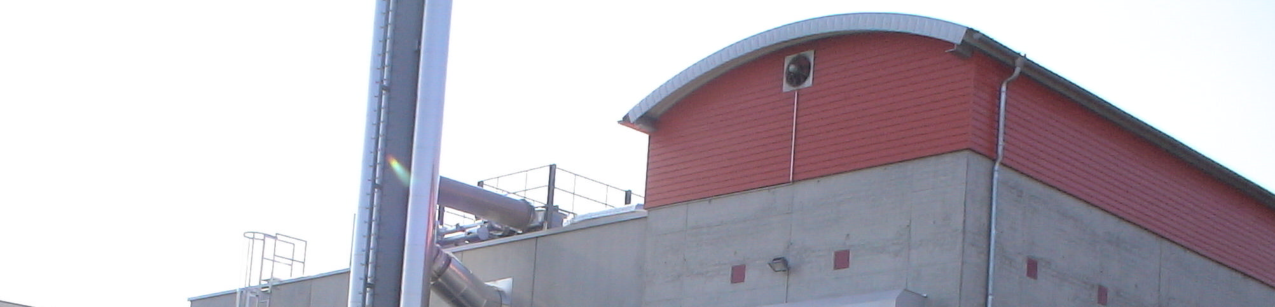
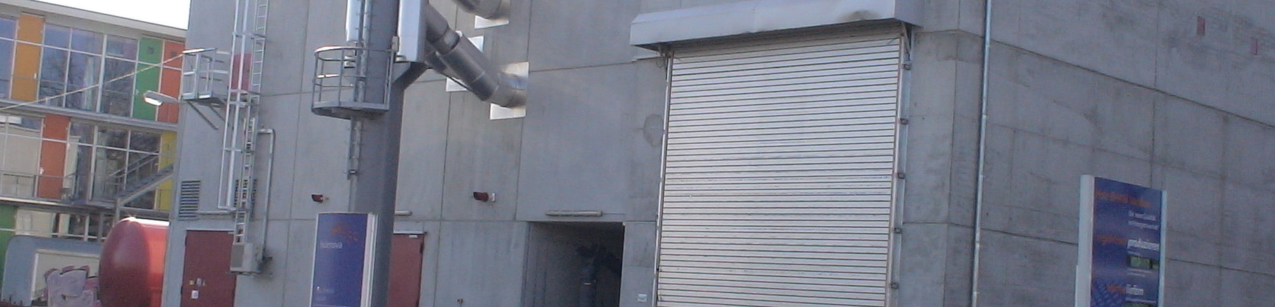
Wood chip community cogeneration plant. Heat and electricity generation.
Books About A New World Order
The biggest force slowing the broad based support for the changes required for sustainability are the "corporation" and the governments they control. How did we get to this point in such a brief time and how do we move towards a more equitable and sustainable future? Two books that bring home these important problems and how they can be overcome are The Corporation (also an award-winning documentary), and Alternatives to Economic Globalization. In terms of clarifying the problems and providing workable solutions, these two books provide invaluable information.
The Corporation: The Pathological Pursuit of Profit and Power by Joel Bakan
My main interest as a legal scholar is in how the law shapes and is shaped by social and economic forces. THE CORPORATION is a project that came out of this interest. In 1997 I published a book, JUST WORDS: CONSTITUTIONAL RIGHTS AND SOCIAL WRONGS, in which I argued that constitutional rights were becoming increasingly ineffective in protecting the ideals they embodied, such as freedom, equality and justice. One reason for this, I suggested, was that constitutions apply only to governments; they do not apply to the key institution of market capitalism-the corporation.
The problem was especially pressing because, with economic globalization in full swing, corporations were emerging as global governing institutions, dominating societies and governments throughout the world. At the same time, most people had, and have, very little understanding of their true institutional nature. So it made sense to ask-what is the nature of this new governing institution? And what are the consequences of its growing hold on society? I developed the idea that the corporation, deemed by the law to be a person, had a psychopathic personality, and that there was something quite bizarre, and dangerous, in such an institution wielding so much power.
Quotable
"Since Rachel Carson's Silent Spring began to expose the abuses of the modern industrial system, there has been a growing awareness that profit at the expense of Earth--of individuals, society, and the environment--is unsustainable. Joel Bakan has performed a valuable service to corporations everywhere by holding up a mirror for them to see their destructive selves as others see them. The clarion call for change is here for all who would listen." - Ray Anderson, CEO of Interface, a multi-billion dollar company
Alternatives to Economic Globalization: A Better World is Possible Editors John Cavanagh and Jerry Mander
After years of protest in opposition to corporate globalization, the International Forum on Globalization presents alternatives to corporate domination of the world economy more fully and thoughtfully than has ever been done before. This books includes some of the best of current thinking on alternatives for a sustainable future including:
Ten governing principles for a new social paradigm-one that will lead to truly democratic and sustainable societies that benefit the many rather than the few
Spell out alternatives to the World Bank, the IMF, and the WTO that advance democracy, basic rights, and ecological sustainability
Show how vital goods and services (such as water or genetic material) can be administered for the common good rather than privatized for profit
Offer alternative operating systems for energy, agriculture and food systems, transportation, and manufacturing
Provide examples of successful alternative policies and systems already in use by communities around the world today Written by a premier group of 21 thinkers from around the world, the second edition of Alternatives to Economic Globalization lays out democratic, ecologically sound, socially just alternatives to corporate globalization more fully, specifically, and thoughtfully than has ever been done before. Focusing on constructive, achievable goals, the authors present ten governing principles for establishing truly sustainable societies and describe alternatives to the World Bank, the IMF, and the WTO that would better serve the needs of the planet. They offer detailed proposals for protecting vital goods and services from corporate exploitation, limiting corporate privileges and power, rebuilding economies to make them more responsive to human needs, and more.
The definitive document of the anti-corporate globalization movement - the consensus report of an alliance of leading activists, scholars, economists, researchers, and writers. This book offers a constructive, coherent, positive alternative to globalization-the very thing that the anti-corporate globalization movement is always accused of not putting forward. The International Forum on Globalization consists of the leaders of over 60 organizations in 25 countries - including such prominent organizations as Friends of the Earth, the Third World Network, the Sierra Club, the Institute for Policy Studies, Public Citizen, Rainforest Action Network, and Food First.
Quotable
"Globalization is not inevitable. Fortunately, there are alternatives and presenting them is the achievement of this book. Read it and be motivated: A better world IS possible." - Dennis J. Kucinich, United States Congressman -
Books About Power
Two books that I've read recently have brought home to me how important dealing with our sustainable energy problems will continue to be. In fact, the more I think about it the more that I see how much ideas like population controls, conservation, efficiency, organic farming, permaculture, urban transit systems, and solar power, are so critical to evolving our society. As the oil runs out, and as these books so ably demonstrate, it may be sooner that we expect. It will be to these ideas of sustainability, of Natural Living, that we will be forced to survive. As our ecological footprint shows oil has allowed us to exceed the sustainable capabilities of natural systems. With growing population levels we have already exceed what may be sustainable without oil. If we have any chance of surviving the next fifty to one hundred years it will be because we address these issues. Coming to terms with their reality is critical. So read these books and start taking action today.
War. Big Oil, and the Fight for the Planet: It's the Crude, Dude by Linda McQuaig
Who stands to gain or lose the most from climate change? The oil companies, the largest industry on the planet. When you add up all the subsidies provided ANNUALLY to oil and nuclear energy, you can clearly see how big a lie it is to say that renewable energy systems aren't economical. Subsidies to oil and nuclear including the car and airline industry, amounts to significantly more than $200 billion per year and growing especially if you include the wars fought to protect these resources.
Let us say then that the subsidies to these industries reaches about $1 trillion over the last ten years, contributing massively, if not exclusively to climate change. Now, take away this $1 trillion in subsidies from the oil, nuclear, and transportation industries. Give the $1 trillion in subsidies to the conservation, efficiency, and sustainable renewable energy sector over the next ten years. Suddenly oil and nuclear look uneconomic, and the alternatives make perfect sense.
Quotable
"we've used up the earth's oil so rapidly and recklessly that we have not only jeopardized the viability of the planet (part one of the energy dilemma), but we have at the same time squandered much of this incredibly valuable on-time inheritance. This may sound like a contradiction. If oil is so bad for the earth's ecosystem, maybe we shouldn't care that it's running out. The problem is that we've built the modern world around it, relying on oil for transportation, industry, agriculture and just about every other thing we do, eat, wear, type, watch and move around in." - pg. 29, War, Big Oil and the Fight for the Planet: It's the Crude, Dude.
" annual subsidies to the industry amounted to $14 billion in the U.S., $5.9 billion in Canada and a total of $59 billion in all the industrialized nations that make up the OECD." "nuclear industry, received $12 billion in annual subsidies in OECD countries." "The fossil fuel industry is also aided greatly by massive subsidies to the car and airline sectors plus $135 billion a year in the U.S. -on the construction and maintenance of roads." - pg 299, War, Big Oil and the Fight for the Planet: It's the Crude, Dude.
Power Down: Options and Actions for a Post-Carbon World by Richard Heinberg
Rather than retaining any level of false optimism this book and the author take deadly aim at the priority issues we face and their terrible consequences.
Powerdown provides a visionary response to the coming energy famine, a clarion call to cooperative solutions based on the conviction that realism must trump self-delusion in matters of cultural survival. Ultimately there is hope if we are willing to look truth in the eye. If we have the strength to admit our problems we will find the solutions. Quotable
"Most of the wars of the twentieth century were fought over resources - in many cases, oil." Pg 21.
"The elites - corporate owners and managers, government officials, and military commanders - are people who have been selected for certain qualities: loyalty to the system, competitiveness, and hunger for power. Often they are literally bred for their roles. Like George W. Bush, they are people born to wealth and power, and raised to assume that privilege is their birthright. These are people who identify with the system and the status quo; they are constitutionally incapable of questioning assumptions.
Moreover, the elites are guided day-to-day by a set of incentives that are built into the system itself. Managers who pursue immediate gain get ahead, while those who make short-term sacrifices in order to preserve long-term stability are often at a disadvantage. Likewise, managers are rewarded who keep up appearances, who generate good news, and who exude confidence. Confessing errors accrues no benefit; instead, managers are encouraged to deny short-comings and to blame competitors and subordinates." Pg. 168.-
Reading
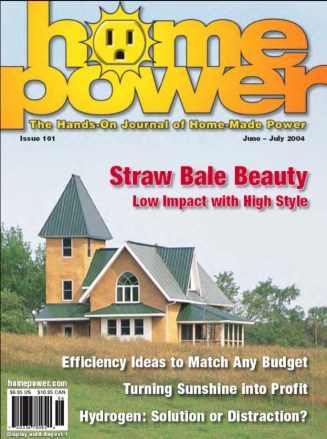
Home Power
For anyone who wants to get into the details of living with renewable energy this is the magazine for you. Each month this hands-on journal has off-the-grid and on-the-grid home owners tell their story in an easy to understand format. If you are interested in the technical details and comparing systems then this is the ultimate source of information. You can download a free copy off their web site each month in PDF format.
Web Site: www.homepower.com
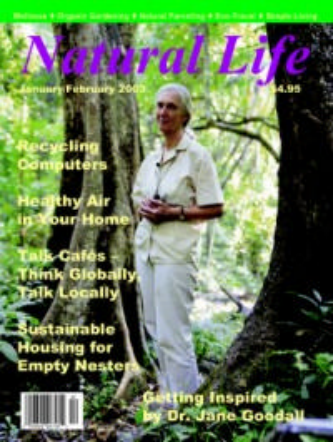
Natural Life
This simple magazine covers a wide range of sustainable living topics. For ideas that we can all start using today this is the place to start. Each issue reaches far and wide for interesting stories with lots of ideas for living a more natural life style.
Web Site: www.naturallifemagazine.com
Natural Home
Each month this magazine features new and renovated homes that are seriously sustainable. Like other popular home and design magazines, you also get coverage of life issues, food, travel and other related topics, all with a "green" twist of course. Other departments include Good to Know, Green Events, New & Noteworthy, Try This, Nuts and Bolts, and Earth Mover Awards. If you want to be inspired by high-end homes with tons of creativity, and features like solar panels, this is a great magazine.
Web Site: www.naturalhomemagazine.com

Dwell: At Home in the Modern World
Small Change is what it takes over a period of time to make the big changes. Dwell magazine may just be about affecting big change in the mainstream. This slick magazine has a real ecological design supported focus while also insisting on homes that look good. " Dwell has become proactive in its mission. The magazine isn't just writing about and showing photographs of the design of houses, she suggested, but is actually influencing the ways in which they are designed and built." The current issue takes aim at ideas such as smaller homes, prefab alternatives, and Dwell Home II, a sustainable house to be built in LA. Check out the amazing four-page pullout spread. The winning home includes passive solar, solar panels, and a green roof.
Web Site: www.dwellmag.com-
Join Us
Become a part of a community of people around the world dedicated to living in harmony with nature. We've created this network so that we can all share our ideas, experiences and knowledge. The changes we envision are revolutionary; however our goals are to make them the norm. The organization is about the practical, inspiring and real application of living gently on the earth so that our children may enjoy a clean, healthy and productive environment.
The simple point is that we all can "do" much more - and that means all of us or it won't work. For example:
§Choose or create a home/community that is powered by the sun; §Grow and eat organic food; §If you must travel select the most efficient means, walk, bicycle, tele-commute, travel by train, bus, ultra-efficient car, or fly; §If and when possible, work in nature - grow your own organic food, restore nature around you, put your investments to work for natural living. What will amaze you that everything we need to live this way exists. The cost over the longer term is less. The results are a happier more healthy self and family. Start learning how today. Member benefits:
Monthly Natural Living Journal full electronic edition.
E-Mail Question & Answer (3 per year, no more than 1 per month.)
Directory listing (optional) and Natural Directory.
Discounts on some products and services offered by Natural Life Network. Sign-up for membership at: www.NaturalLifeNetwork.com-
Next Issue
Ecovillages and the future of communities. For weekly updates, special offers, and additional products and services visit our web site: www.NaturalLifeNetwork.comHave a question? Ask us and we'll try and include a response in our next issue of the Natural Living Journal. Have an interesting story to tell that relates to natural living? Contact us any time with your questions, concerns or ideas at: john.wilson@naturallifenetwork.com-Order the Journal now! www.NaturalLifeNetwork.com