January 2006 — Ecological Design for Solar Villages
Publisher's Message
Ecological Design of Communities Purpose. What is the purpose of your life? What is the purpose of a community? In our world which isolates families and individuals, a community can become a closet into which we lock ourselves away from the outside. We feel powerless. Caught in the flow of society, we are carried downstream to the ocean of a conventional consumer lifestyle. We get educated so we can get a good job, buy a big house, and enjoy ourselves with entertainment in the evening and on weekends. Our children reflect our taste for consumption. If we've fail to consume as well as we've hoped, we try to ensure our children are “given every opportunity”. Happiness and comfort through consumption. Something is missing. Ecology tries to discover nature's broader purpose, our broader purpose. We do not live for ourselves. In nature, in reality, in the real world, we live for our children, our friends, to nurture earth's ecosystems. We search for the truth. We are always looking for the fabric in the universe that ties us all together. We must continuously search and evolve our understanding of these links and our part in them. In this we will find our purpose in life and to our community, the broader community of life. Getting our governments at all levels to reflect this becomes the next step. Changing our own lifestyle is possible despite the design of our communities and government that all too often work against ecological design. To get change to occur broadly we must use the levers of policy, taxes, regulation, subsidies, and many other tools. Currently these tools are directing the world towards cheaper fossil fuels that pollute. Large scale nuclear reactors pose grave dangers. We must change these economic and policy levers to create broad levels of sustained change. Commercial enterprise must also have the levers of economics adjusted. Where today more than 300 billion dollars subsidizes the fossil fuel industry, with ecological design in mind, these subsidies must now be redirected towards sustainable energy like wind, biomass, solar, geothermal and others. The roads that we build for our communities are a massive subsidy in favor of cars. Taking a longer term view we must transfer these transportation subsidies for mass transit systems and new clean hybrid, electric and possibly hydrogen fuel cell based alternatives. By acting now we will save ourselves unimaginable amounts of money in reduced long term operating costs, improved health, reduced healthcare costs, more jobs, greater stability in energy prices and much more. Ecological design is both economical and sustainable. It is the only path that makes sense for our children's future. We must make the jump in logic from individual and community in a country to individual and community within the ecosystem that sustains us. With this understanding we have the choice to adjust our societal levers to reflect the purpose of our lives and that of our community in favor of the natural world that sustains us. John Wilson, Founder of the Natural Life Network E-Mail: john.wilson@naturallifenetwork.com
Natural Living Journal John D. Wilson - Editor and Publisher Natural Living Journal Published by World Peace Communications Copyright © 2005 John D. Wilson Our Web Site: www.NaturalLivingNetwork.comE-Mail: john.wilson@naturallifenetwork.comPhone: (519) 942-3266 ADVERTISING SALES: Leigh Geraghty, Advertising Representative, (519) 942-3266, leigh.geraghty@sympatico.caCONTRIBUTE: We are always looking for new, interesting and inspiring stories, pictures, and poetry, about people who are achieving a natural lifestyle. If you would like to contribute an article or story then please send us a note with your idea. Contact John Wilson by email at john.wilson@naturallifenetwork.comAll contents of this issue of Natural Living Journal are copyrighted by John Wilson, World Peace Communications, 2005. All rights reserved. Printed in Canada.
SUBSCRIPTION SPECIAL OFFER
NAME
ADDRESS
CITY/STATE/PROVINCE ZIP/ POSTAL CODE COUNTRY
PHONEYES! Sign me up for Natural Living Journal. Orders must be prepaid. Here is my check/money order in U.S funds (Canadian orders in Canadian funds). Subscriptions/ membership includes shipping, handling and applicable taxes. $29 - Individual - 1-year subscription and membership, paperless Internet delivery, requires email (6 issues) $39 - Business - 1-year subscription and membership, paperless Internet delivery, requires email, and business directory listing with logo (6 issues) Membership includes answers to three questions (no more than one per month) through email for a year. To order online by credit card go to www.NaturalLifeNetwork.com. Send all subscriptions and renewals to payable to World Peace Communications. Mail to: World Peace Communications 248108 5th Side Rd., RR# 5 Orangeville, ON L9W 2Z2, Canada
Ecological Designfor Solar Villages
Now is the time to make a choice that will make your community a world-class centre of excellence for sustainable development. Using practices proven both locally and globally to be the best - working in partnership with organizations, local experts and companies - we can create a model of sustainable development that draws worldwide attention and notoriety. Your village can provide the model the world needs: an economically built community, with lower operating costs. Working with educational institutions, non-profits and developers, we have a unique opportunity to sow the seeds of change, preparing the next generation for the biggest opportunities of this century - a turning point in human history. Together we must seize this moment to become leaders in this inevitable transition.
Development Guidelines
The basis for these suggestions requires a reasonable up-front investment of less than 10% above conventional systems with a rapid payback based on energy and operating cost reductions of between 60-90%. Knowing that we can count on these savings and higher returns on this investment as energy costs continue to rise, there is an opportunity to cover this additional cost through private partnerships, federal funding support and other community funding potential. We must work with land owners, municipal government, surrounding communities, and local business, schools, and other groups to get the required funding to make these investments. We will find local private enterprise to support the development, and make connections with other groups. Together we can lay the foundation for a growing community that does not require additional polluting energy sources, municipal water supplies and waste water management systems. Creating new jobs, providing local businesses with long term opportunities for development, and making your village a model for community development simply makes economic and social sense. These recommendations have an over-arching vision that sees zero emissions, renewable energy, and efficient design, intelligently integrated into forms optimized to the site. Design must reflect the needs of our sustaining ecosystems and community development. No single technology, standard, or zoning criteria is the answer; instead a diversity of ideas, holistically applied with concepts that make sense on a particular site, must be taken into consideration.
We must ensure that community developers and municipal government look at sustainable objectives for development that may be required. It is critical that developers be guided to work within the natural bounds of place. In order to demonstrate that this is practical and beneficial this article reviews best practices from around the world, in combination with local expertise in applying these concepts, and suggests a holistic approach. The following is a summary of suggestions for zoning requirement for sustainable development. The remainder of this review provides further details to these summarized suggestions. With further community input and refinement we can establish development guidelines for a Solar Village that will make your community a centre of excellence for these ideas. Implementing these ideas in your community will create a beacon of hope for our children and their children to come.
Community Renewable Generation
Use a small portion of your site as a model community renewable power generation facility for electrical power that will provide a low-cost supply to the community. Through a partnership with local renewable energy cooperative groups and private enterprise your community can create a symbol visible for miles that will reduce electricity costs while providing an ongoing revenue stream through leased land and profit sharing. Many options exist for the construction and operation of this iconic renewable energy generating facility. This additional revenue stream will provide investment income for shareholders and potentially your communities electricity utility, making the community a symbol of sustainable technology. Some community renewable energy options include wind power, biomass such as wood chips, and solar thermal or photo voltaic arrays integrated into the building façade. Because this could be a community level development, it has all the necessary characteristics for a demonstration level investment. Power is being generated "behind the meter" so that the community could ensure a lower cost of electricity when compared to market rates. This source of "pre-grid" electricity supply would be highly useful to local electricity utilities for reducing peak demand, and help it to deliver low-cost power to local industrial customers at key time periods, at rates well below peak demand costs. As a visible demonstration facility with potential links to educational tours, this small scale local renewable energy generation plant could provide a model for further local development by private enterprise, local land owners and other local government entities.
Zero Emissions
It is now economical and practical to build zero-emissions factories and commercial buildings. Combining best practices make it possible and affordable for large-scale development of commercial enterprise infrastructure without the conventional requirements for large-scale infrastructure improvements. It is now economical to build zero-emissions industry through a combination of high efficiency, passive solar, active solar, wind power, innovative construction techniques, geo-thermal, cogeneration, new/old sustainable building materials and other sustainable design options. These buildings must incorporate state-of-the-art “zero emissions” building design, which points to the future of clean manufacturing and commercial building design. These buildings will lower long term operating costs, reduce long term business risks related to energy costs, and last longer. Zero Emissions Concept:
Solar panel integration, electricity generation and shading in the summer
Green roofing that reduces rainwater run-off while reducing summer heating by up to 30%
Super insulation concepts with potential for breathing wall design - for better indoor air quality and improved worker and employee performance and productivity
Geothermal earth-based heating and cooling systems that reduce the need for mechanical heating and cooling
Biowaste or agriculture product-based oil cogeneration facilities for carbon neutral heating that generates heat and electricity
LEED building standard potential Combined with potential private partnerships, such leading solar companies as ATS Automation, Solar Fabrik, Sanyo, Sharp, and others provide the opportunity to create an elegant means of integrating flexible solar modules into the cladding.
Art Gallery and Arts Centre Your village and surrounding communities may already be well known for their artisans, artists and arts festivals. If your community is looking to attract more residents and visitors, developing the arts community can provide many economic benefits to current residents. A solar village should provide a highly functional art gallery to showcase local talent as well as providing a place for young and old to see, learn and practice the arts. In general a place where the creative application of sustainable concepts are made visible while also providing the community with a gathering place for events, arts performance, and meetings. The arts supported by ecologically designed building facilities and art parks that are sustainable, present the concepts in a visible and appealing way that garners regular community involvement.
Art Gallery and Arts Centre:
Super-efficient building design using local building materials
Breathing walls for better indoor air quality
Natural fiber insulation for organic styling to walls
Green roofing for reduced rain water runoff, and cool comfortable environment without air conditioning in the summer
Surrounding park space to provide open-air creative space for art and artists
Sustainable techniques to be incorporated to eliminate the need for pesticides using permaculture techniques for surrounding art park
Straw bale wall construction for ideal acoustic conditions for performing arts
Improved indoor air quality for better health and enjoyment of facilities.
Retirement Living As the community broadly moves towards an aging population we must look to incorporate homes that reduce retiree's expenses while providing comfort and security. We can provide a leading-edge example of the potential for large-scale passive solar residential design that is both comfortable and economical. Passive Solar Residence super insulated with rock wool triple glazed windows
70% glazing on the south side
Hydronic in-floor heating system
Heat and power cogeneration system
90% reduction in ongoing energy costs
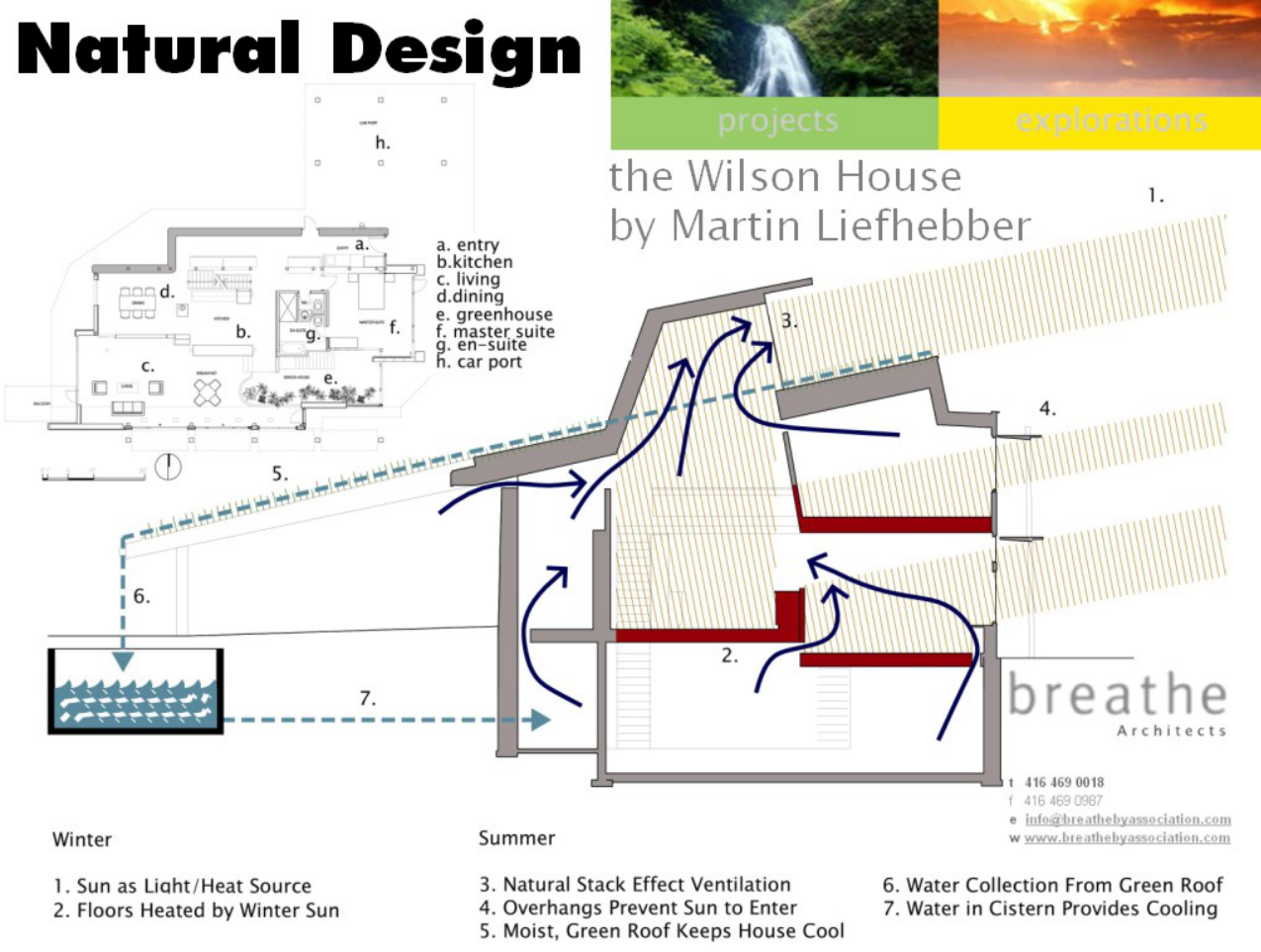
Ecologically Designed Homes We must take the lead from award-winning homes, like the Wilson Natural Home (www.naturallifenetwork.com) which shows how it can be done affordably. It starts with a few homes that demonstrate the improved comfort and long term savings. These homes must be built with the following criteria:
Local renewable building materials
Breathing walls for improved indoor air quality, minimum insulation levels of R50
Green roofing for the elimination of air conditioning and reduced rain water runoff
Passive solar design that reduces heating costs
Solar cooling systems (Sahara architecture concepts for cooling)
Solar panel integration as shading system that produces a portion of the homes electrical power requirements
Waste and Waste Water
Your village may be at capacity or reaching peak for what the existing waste water and other water system can handle. Issues and concerns are arising everywhere regarding the capacity of existing systems. By moving to a biogas processing facility, using green roofing systems and incorporating living machine waste processing onsite, waste water processing systems can be alleviated, minimized or eliminated. This area is a sensitive one with close ties to many groups with a focus on ensuring clean water supplies as more and more sources become contaminated. Water source protection is a key issue for community health while allowing a means for sustainable development is critical to our economic future. Living Machine waste processing, green roofing that minimizes rain-water runoff, rain water recovery, and biogas recovery from sewage waste all provide a mechanism for exciting and interesting sustainable facilities that would be ideal complements to sustainable community development.
Transportation
Limited transit systems development seems to be the norm in North America. More often than not buses are the primary public transit link to the surrounding large urban centers. Transit connections will be required. Links to local transit, inter community transit, and other bus/street car services are possible. There is a chance for the solar village to provide a demonstration hybrid bus or streetcar services linking the community transit system. Future opportunities may exist with rail links owned by the town that links with other tracks and other rail systems in the area. The community must provide an ecologically preserved and a naturalized setting with easy walking, biking, and other trails throughout the community that should link to the village, commercial districts and other local facilities. Making it easy, comfortable, safe and convenient to use alternative transportation is critical to finding a truly sustainable transportation mix. References Included:
The Solar Village DVD - examples for Zero Emissions facility and Passive Solar residence. www.thesolarvillage.com
Wilson Natural Home DVD - a tour of the award-winning Wilson Solar Home. www.naturallifenetwork.com
OBJECTIVE
Ecological design requirements that creates a sustainable communities centre of excellence
Goal
An extensive study and requirements review regarding sustainable design principles should be undertaken to minimize disruption of the local ecosystem, preserve views and provide the shelter and privacy that will be conducive to the sustainable community development objectives outlined here. Through this review a set of sustainable development guidelines should be created. These guidelines will then provide the criteria under which your solar village may be developed.
Values
In order to develop these guidelines and in order to envision the potential for your site it is important to understand the basis for sustainable design principles. One example is Ecological Design.
Ecological Design Principles Applied
Solutions Grow from Place = Local Engagement
Ecological Accounting Informs Design = Demand Driven
Design with Nature = Holistic Innovation
Everyone is a Designer = Community Ownership
Make Nature Visible = Natural Beauty
* Ecological Design by Sim Van Der Ryn
Proven Results The use of sustainable design principles has, almost without exception, provided greater value to land owners, developers, surrounding communities and future residents. The reasons are simple:
Lowers long term operating costs
Energy cost reductions up to 90%
Minimum impact of major redevelopment on infrastructure
Develop skill cluster to serve wider market, improving job opportunities
National/Global benchmark of excellence creates a centre of excellence
Model of innovative energy cost/availability
Scale model of urban energy standards
New market opportunities for construction industry
New manufacturing opportunities for materials
Sustainable development leadership
Energy/Water service provider
Scale project for new multi-utility business model
Higher than average return on assets/investments
Develop new skills with world leading expertise These criteria critical in a world facing major climate change, that is reaching ecological limits in terms of materials, energy sources and clean water. Before we review some ideas for what this new community could be, let us first take a look at some background information. Background
Future of Energy Use Globally Energy consumption is a massive issue globally. As limited remaining reserves are required by a developing world the demand is going to grow quickly in the coming decades. The use of conventional energy sources like coal, oil, and gas are the primary sources of global pollution problems including climate change. Our commitment to our children must be to find alternatives that are clean, safe, affordable and renewable.
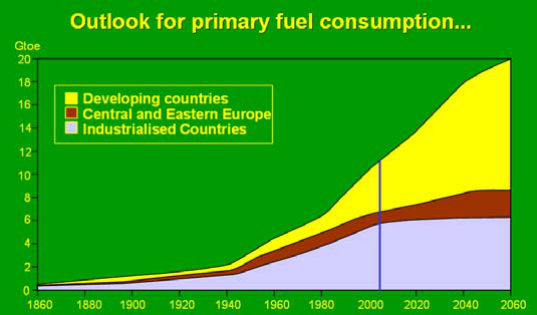
Figure 1 World demand growing rapidly. * Source: World Energy Council
Energy Use in Canada Given the implications of world demand for energy, how might our communities be affected? Certainly the cost of conventional sources of non-renewable energy can be expected to continue rising. Increasing demand with reduced sources of availability can only mean one thing, soaring energy costs. We must find clean, safe renewable source of energy for our major energy requirement. Major sectors including industry, homes, buildings and transportation will require products and services that incorporate design, technology and research revolving around this massive energy crunch. Key areas where energy efficiency, ecological design, renewable energy and research will be required (as indicated by consumption of overall energy supply):
Homes & Buildings 40%
Industry 35%
Transportation 25%
Where does it all go?
Most energy is lost in range of inefficiencies
Generation, transmission distribution of electricity contributes to 10-20% of the losses, that is why it makes more sense to generate locally if possible
Vast heat losses in electricity chain
Inefficient industrial processes, buildings, vehicles…
Energy prices globalizing, China competing for worlds remaining oil reserves
Only 5% to 15% used productively The bottom line is that it is going to make more and more sense to generate and supply energy from local sources. Efficiency and conservation are the most economical ways of achieving sustainability. From that point local sources of renewable energy are capable of providing a clean reliable and economical source.
North American Homes and Business Breaking down the usage of energy in our communities demonstrates that we can make significant improvements in our energy demand with a focus on residential and commercial buildings. Our homes, offices and commercial buildings are massive consumers of energy. This currently inefficient use of energy causes a large portion of our pollution problem. As energy prices steadily increase in the coming decades, how cost-effective and competitive will our communities be? As other communities come to realize that they too must change, it will be the leading examples that they turn to for help. We have the opportunity to make choices today that will alleviate many future problems.
Approximately 40% of energy end use
Residential Buildings
Commercial Buildings
Building use 65% of all electricity
Second-largest cause of greenhouse gases
Major cause of electricity peaks
High energy use compared to best-practice
High prices are changing perceptions around total energy cost
30% increase in heating energy costs expected this winter
Techniques are available now that can provide solutions that are cost effective
Proven Benefits of Integrated Energy Systems
Quality buildings
High resale/rental value
Low energy/other costs
Supply reliability
Tailored solution
Flattens electric peak
Optimized investment
Efficiency/Supply
Low energy footprint
At least one third emissions
Energy supply returns
Higher return on assets Sustainable Development Preliminary Master Planning
Creating a sustainable community make sense now and for the future. We suggest that guidelines for developing your community be developed by working with a few designated community members, members of renewable energy cooperatives, and other groups interested in sustainable site development, to facilitate and provide input into the development of a preliminary master plan. Study the following options in context with specific ideas outlined in the following sections.
Energy use profiles
Preliminary construction guidelines for super-efficient buildings
Evaluate energy/water supply options
Distributed co-generation
Natural gas/bio-fuel
Energy efficiency
Grid heat/electricity
Other renewable energy technology and choices
Fresh/rain/grey water systems
Home and Building interconnections
Financial and business models
Costs, revenues, returns, investments for utility and developer
Energy system ownership and operating structure
BUILDINGS
Infrastructure that inspires, reduce costs and educates
Zero Emissions Factories
Leading edge sustainable commercial building design will soar in demand through the coming decades as fossil fuel reserves dry up, new environmental protocols strengthen the financial benefits, and world-wide demand for these solutions continues to grow. Your village has the opportunity to lead the world. We can be the centre for a commercial sector that incorporates design required for future sustainable corporations. By demonstrating the design, research, and development of sustainable technologies, manufacturing processes, and work environments in a leading edge zero emissions manufacturing facility, the community will provide jobs and opportunities for this growing business sector. This is not pie in the sky. This is a real factory that works, provides jobs and produces zero emissions.
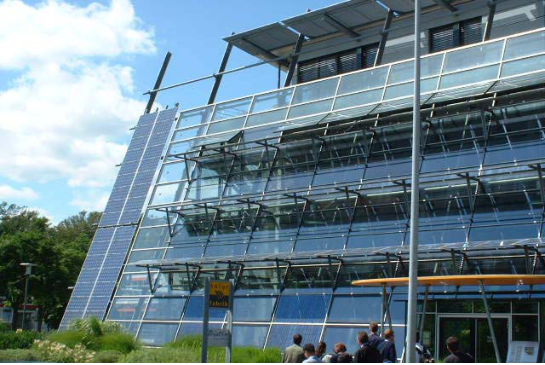
Figure 2 Zero emissions facility that can be built to cutting-edge standards with lower costs.
Zero emissions are achieved through a combination of proven economical systems all renewable solar based and including combined heat and power systems:
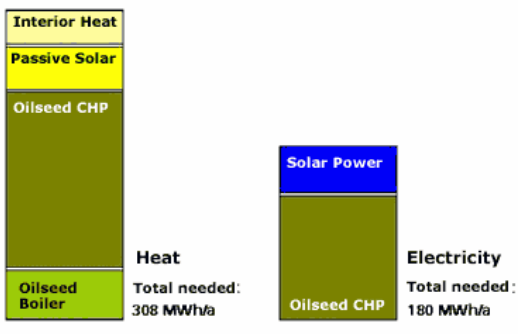
Figure 3 Example: Under the Solar-Fabrik energy concept, the factory's entire energy needs are met from renewable energy sources, making it Europe's first ever CO2-neutral production facility for solar modules. The diagram shows the energy balance of the Solar-Fabrik factory.
Ground source heating and cooling system.
Combined solar panel shading system perfectly integrated for optimal passive solar design for shading in summer and full solar access to thermal mass in the atrium in the winter.
Agricultural waste product or biofuels for carbon neutral supplement combined heat and power generation systems.
Supplemental large scale integration of campus shared wind power for electricity to power design and development facilities, research laboratories and prototype high efficiency manufacturing systems
Garner sponsorship, research, and equipment supply through a partnership with ATS Automation, for example, a leading Canadian supplier of automated manufacturing systems as well as solar photo voltaic panels and new low cost flexible solar photo voltaic systems
Add the concept of a large scale green roof to reduce rain water run-off, improve cooling in the summer by potentially 30%, reduce heating loss in the winter, and reduce maintenance costs
Consider re-use of stored and collected rain water for wash rooms, landscape watering, and other building features including potentially and indoor landscape that incorporates water features for improved indoor air quality especially in the winter.
Cost Benefits With corporate sponsorship potentially convention building costs, with up to 90% lower annual energy costs.
Art Gallery and Arts Centre
Example Building Description The Earth Rangers Centre in Woodbridge, Ontario is a 5,100 m2 wildlife rehabilitation and youth education centre not far from downtown Toronto. The concepts used in this working community service building provide similar attributes of a potential Art Gallery and Arts Centre for the community. Other opportunities include community centers, sports facilities and research centers.
In the Earth Rangers building example, major building areas include a veterinary hospital, wildlife rehabilitation rooms, seminar/demonstration rooms, feed preparation and service rooms, animal care facilities and educational areas. Enermodal provided sustainable and mechanical design services for the centre, which was built on a 31-acre property at the Kortright Centre for Conservation, in Woodbridge, Ontario. The Kortright Centre also incorporates a Living Machine for sewage processing and is an educational facility for all types of renewable energy.
Concrete ventilation tunnels and a double foundation plenum temper ventilation air through heat exchange with the ground, incorporating a simple ground source heating and cooling system. Ventilation heat recovery is part of all air handling systems, through either an enthalpy wheel or a glycol loop. Radiant heating and cooling are provided through tubing embedded in the concrete structural slabs. The radiant systems are fed by a high efficiency, condensing boiler and a small chiller using HFC refrigerant and a water-side economizer. The radiant system could be powered by biowaste or biomass based fuels or canola oil (as in the case of the zero emissions solar factory).
North facing skylights and enhanced daylighting design maximize natural lighting. Sixteen solar thermal panels are mounted on the south-facing surfaces of the building skylights. High efficiency lighting has reduced the lighting power density to 50% of national targets. Wastewater is treated on-site to tertiary quality with a bioreactor and ultra-filtration system. This water and roof rainwater is collected in a cistern to reduce potable water consumption by over 65%.
The building is estimated to achieve annual energy savings of 63% compared to the national reference sites. For more information see www.trca.on.ca .
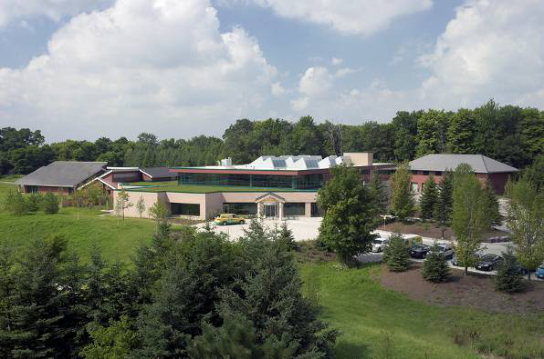
Cost Benefits Approximately twice conventional building costs with long term energy and resource savings a proven 60+%.
Retirement Living
Example Description Comfortable inspiring modern facilities that provide retirees with a world class condominium type residence that reduces on-going energy costs by 90%. Imagine the future of not just retirement living complexes but also condominiums in town that provide lower operating costs, improved indoor air quality, and eliminate the need for large scale sewage processing expansion. These suggestions have been proven to be cost effective at a construction cost of just 7% greater than conventional with long term energy savings.
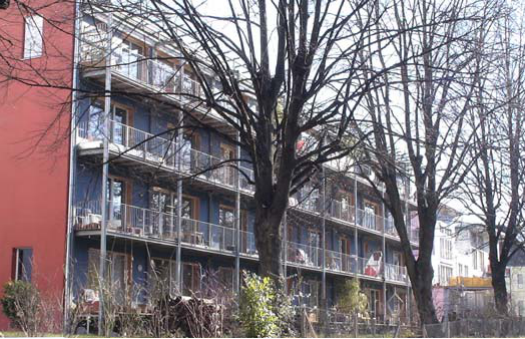
Figure 4 This 20 unit condominium incorporates passive solar design at a cost of only 7% more than conventional construction while providing energy savings that reduce demand by 90%.
Key features include:
Site orientation that takes advantage of solar access and shelter from trees and hills. Deciduous trees on the south provide shading in the summer for improved cooling while allowing sunlight to passively heat the building in the winter.
Conservation through high levels of natural renewable insulation and high quality sealing to minimize heating/cooling loss and gain. Breathing walls improve indoor air quality substantially without requiring a mechanical heat recovery ventilator.
70% glazing on the south side with minimal glazing on the north, east and west using triple pane windows with low-e coatings and inert gas fillings to increase insulation capabilities
Green roofing to improve cooling in the summer and reduce heating requirements in the winter. Green roofing lasts twice as long as conventional roofing and reduces rain water run-off substantially a critical concern for the already stressed Your village systems.
Biogas sewage waste reprocessing for electricity generation and heat recovery. This ability to process sewage on-site while generating electricity and heat further reduces the impact of the sewage and energy requirements from other sources. The biogas recovery system requires another efficiency measure in the use of modern vacuum toilets. Finally, the remaining material can be collected by farmers for further composting and use as a nutrient supplement.
Combined with these efficiency and conservation measures an integrated solar thermal and solar PV system provides more than fifty percent of the required hot water heating.
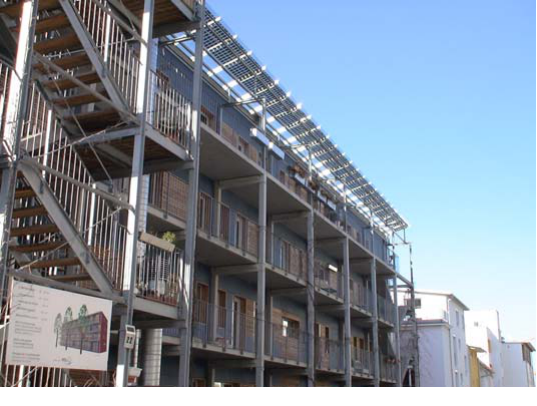
Cost Benefits Total 7% higher than convention costs, savings of up to 90% lower annual energy cost, potential for revenue generation on waste process biogas plant Ecologically Designed Homes
Home design can be accomplished now that is affordable and sustainable. By requiring that developers and builders incorporate ecological design techniques, sustainable homes can be built that cost about the same as conventional homes. However, over the long run the operating costs of these homes can be up to 90% less than conventional homes. Using ecological design techniques
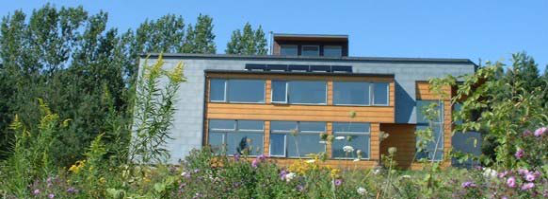
incorporated into the Wilson home for instance, it is possible to reduce energy demand by at least 50%. All of this can be accomplished while also supplying the home with building materials from local farm by-product that can be sustainably harvested each year.
Homes like the Wilson home demonstrate how it can be done affordably. We must require that homes be built with the following criteria:
Local renewable building materials
Breathing walls for improved indoor air quality, minimum insulation levels of R50
Green roofing for elimination air conditioning and reduced rain water runoff
Passive solar design that reduces heating costs
Solar cooling systems (Sahara architecture concepts for cooling)
Solar panel integration as shading system that produces a portion of the homes electrical power requirements
Cost Benefits
Same cost as conventional custom built homes (Reference is the Wilson Natural Home near the Hockley Valley).
No oil or gas bill for heating saves 50% on on-going heating and energy costs with percentage increasing as the cost of the non-renewables increase over time
Lower on-going maintenance costs with a green roof which also reduces rain water run-off issues
WATER AND WASTE WATER
Infrastructure that inspires, reduce costs and educates
Biogas Sewage Processing
Make the treatment of wastewater a profitable energy generation system. Collect remaining sewage waste for use, after composting, for farming. The City of Ottawa has constructed a co-generation facility at the Robert O. Pickard Environmental Centre to produce heat and
electricity from methane created during the treatment of wastewater. The methane, which is produced in the anaerobic digesters of the wastewater treatment process, was previously used to generate heat, but not electricity. The capital cost of the new cogeneration facility was $4.5 million. But because the new facility reduces the Centre's electricity demand by about 41%, the resulting savings amount to more than $870,000 a year - enough to pay off the capital investment in just over five years. In addition to reducing annual operating costs, the new plant will also reduce the total quantity of greenhouse gases emitted to the atmosphere by about 16 kilotonnes (kt) of CO2E (carbon dioxide equivalent) every year. The Robert O. Pickard Environmental Centre (ROPEC) is the home of one of Canada's largest wastewater treatment facilities, where approximately 450 million litres of water are treated each day. Wastewater from homes in the Ottawa area is sent to the centre to undergo primary and secondary treatment, which involves using clarifiers to remove solids from the water. After it has been treated, the water is released back into the Ottawa River, while the solids are retained and sent through an anaerobic digester. In this phase of treatment, the oxygen is removed from the waste, which is then processed by bacteria, to produce a mixture of methane and carbon dioxide gas. This gaseous mix., known as digester gas, has approximately 60% of the energy value of natural gas. Wastewater treatment facilities produce methane gas naturally as a by-product of the process of breaking down organic material. The methane, a greenhouse gas that is 21 times more powerful than carbon dioxide, is normally flared off into the atmosphere. Increasingly, however, landfills and wastewater treatment facilities are capturing methane and using it as a source of energy. By reusing the methane within the facility, a region can reduce the greenhouse gas emissions associated with purchased electricity, while also saving money on electricity costs. The Pickard Centre's cogeneration facility began operating in 1997. The digester gas is burned in three Caterpillar G3516 low-emission reciprocating engines, each rated at 810-kilowatts, which give the facility a total capacity of 2.43 megawatts (MW). That is enough electricity to power about 2000 homes for an entire year. The facility's three Caterpillar engines each turn a generator that converts about 35% of the energy in the digester gas to electricity. The remaining thermal energy, which accounts for approximately 60% of the energy from the digester gas, is also recovered from the engines in the form of hot water. The heat is collected in cooling jackets on the engines and then through a heat exchanger, transfers the energy to the plant's heating system. A similar process also removes the heat from the exhaust gas and transfers it to the heating system, after which the cooled exhaust gases are vented to the atmosphere. The hot water produced through the heat exchange process enters the plant's heating & process systems at between 85°C and 95°C. Overall, the system produces enough hot water for the plant's needs in the summertime. Any excess hot water is released into the sewer, to be re-used in the treatment process. In winter, conventional natural gas-fired boilers are used when necessary to supplement the biogas energy. The cogeneration system is also set-up to allow the engines to switch to natural gas during periods of low digester gas availability, enabling continued electricity and heat production.
Since the co-generation facility went into service, it has produced an average of approximately 17 million kWh of electricity per year, or roughly 41% of the plant's total electrical demand. Although the co-generation facility provides thermal energy for seven major industrial buildings and two km of tunnels that house piping, electrical conduits and pumping equipment, it has not reduced the plant's overall natural gas requirements. That is because the heat for these areas used to be generated from the digester gas. Natural gas is also used to meet the heating needs of three buildings that are not connected to the primary heating loop. Before construction of the co-generation facility, ROPEC burned its digester gas in a boiler that recovered the thermal energy and used it for space heating and process requirements. But the gas produced more heat than needed, so the remainder was used to heat effluent water that was later released in the sewers. The decision to build a co-generation facility was based on the availability of a significant amount of excess energy, as well as the fact that resolving the problems the Centre was having with its combustion equipment would have required a major investment. Although co-generation is often considered unattractive financially, because it generally involves payback periods of more than three years, ROPEC decided that the approach was their best option, based on both economic and environmental considerations. There was also strong support for the cogeneration facility at the political level. To date, the success of the facility is attributed to dedicated employee awareness as well as a comprehensive maintenance agreement with the local supplier Toromont-Cat. Financing for the facility was provided by the Regional Municipality of Ottawa-Carleton, through its sewer reserve fund.
Cost Benefits
Potential for revenues on energy generation from biowaste processing on-site or through the sale of material to a biowaste processor.
No need to expand the existing sewage processing plants. Living Machines
Description A central highlight of the community might also include a Living Machine that processes sewage into clean water. Background:
More that 30 systems in production world-wide
Living Machine® systems are biologically diverse, making them resistant to problems resulting from “shock loads” in the incoming waste stream.
Living Machine® systems allow their owners to minimize or even eliminate environmental impact and the liability related to environmental impact.
Living Machine® systems are aesthetically pleasant and do not promote strong, unpleasant odors, making them much better neighbors than many conventional wastewater treatment facilities.
Through the incorporation of green principals and the promotion of sustainability, coupled with high treatment standards and the opportunity for reuse of treated wastewater, Living Machine® systems are widely accepted by the public and regulators alike.
Living Machine® systems - good for your project, good for you. For the Community:
Living Machine® systems are simple to operate, cost effective and aesthetically pleasant wastewater treatment systems which work hard to clean wastewater to reuse standards without posing undue harm on the surrounding environment.
Living Machine® systems provide an enjoyable space where people can gather.
Living Machine® systems can provide a community with independence from a municipal wastewater treatment facility and promote smart growth.
Living Machine® systems can be designed and expanded in a modular fashion so that wastewater treatment is consistent with the needs of a growing community.
Living Machine® systems users experience reduced costs relating to wastewater surcharges, water purchases, sludge disposal and chemical treatment, storage and record keeping.
Living Machine® systems work largely without the addition of dangerous chemicals. Fewer chemicals stored and used in a community means a lower potential for an adverse impact and less liability overall for the community.
Living Machine® systems offer significant educational opportunities and resources for school age children, university students and adults alike.
Living Machine® systems provide communities with an opportunity to enhance public awareness for sustainability and the promotion of green principals
Living Machine® systems are designed to conserve water through the reuse of treated wastewater; they save potable water, money and resources.
Living Machine® systems - good for your community, good for you. For the Planet:
Living Machine® systems are simple to operate, cost effective and aesthetically pleasant wastewater treatment systems which work hard to clean wastewater to reuse standards without posing undue harm on the surrounding environment.
Living Machine® systems can achieve tertiary treatment of wastewater to consistently meet tough discharge requirements.
Living Machine® systems can provide a cost effective and smart growth alternative to extending existing municipal sewer lines.
Incorporated into the design of each Living Machine® system are the principals of efficiency, sustainability and ecological engineering.
Living Machine® systems - good for the planet, good for you.
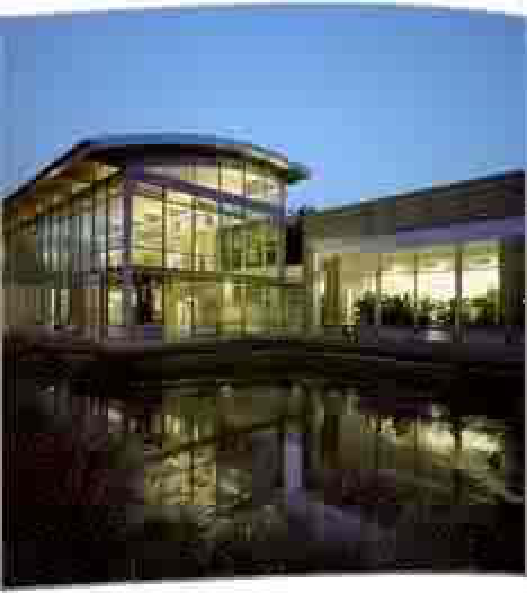
Figure 5 Stunning example of a community Living Machine waste water treatment facility.
Cost Benefits
Comparable costs to conventional systems.
No need to expand existing systems.
Fits in with Headwaters requirements for reduced impact on natural water systems.
TRANSPORTATION
Vehicles of the Future Linked to Your village Transit
Transit Links
Limited transit systems exist for the area. Buses are often the primary public transit link to the surrounding large urban centers. Solar village transit connections will be required. Light rail transit or street cars can provide an efficient community transportation system. Links to local transit, inter-regional transit, and other services are possible with a simple single addition streetcar or bus service to this new community from the closest commuter train or bus station. There is a chance for the solar village to provide a demonstration hybrid bus service or new high efficiency street car technology linking various transit systems. Obviously the community must provide an ecologically preserved and a naturalized setting with easy walking, biking, and other trails throughout the community that should link to the village, commercial districts and other areas including parks. In order to encourage people to use bicycles means providing bicycle racks in sufficient quantities around every community facility.
Making walking, skateboarding, and rollerblading safe requires a new set of trails. Slowing down traffic or eliminating vehicular traffic may be necessary to make pedestrians feel safe. All the facilities described ought to be accessible by walking or biking paths. Linking the existing community to a new Art Gallery and Arts Centre are critical elements to encompassing this new development into the village. Providing local commercial enterprise, retail facilities and zero emissions industrial work are critical to potentially reducing the need for cars by residents. By planning these transportation links well in advance of the actual development of homes, commercial buildings, and services, residents, business owners and service operations will be able to plan for low impact transportation. The only way to make sure the community is not a conventional car based suburb is by providing the necessary transportation options. These must be guaranteed up front, before the majority of development takes place. New technologies for transportation are evolving. The hybrid cars and trucks are leading the charge for main stream manufacturers. Planning communities with walking, biking and transit links is becoming standard practice. These services require each citizen to look for these opportunities and ensure that our elected representatives and corporate business owners comply with our need for a safe, clean, and sustainable community. '
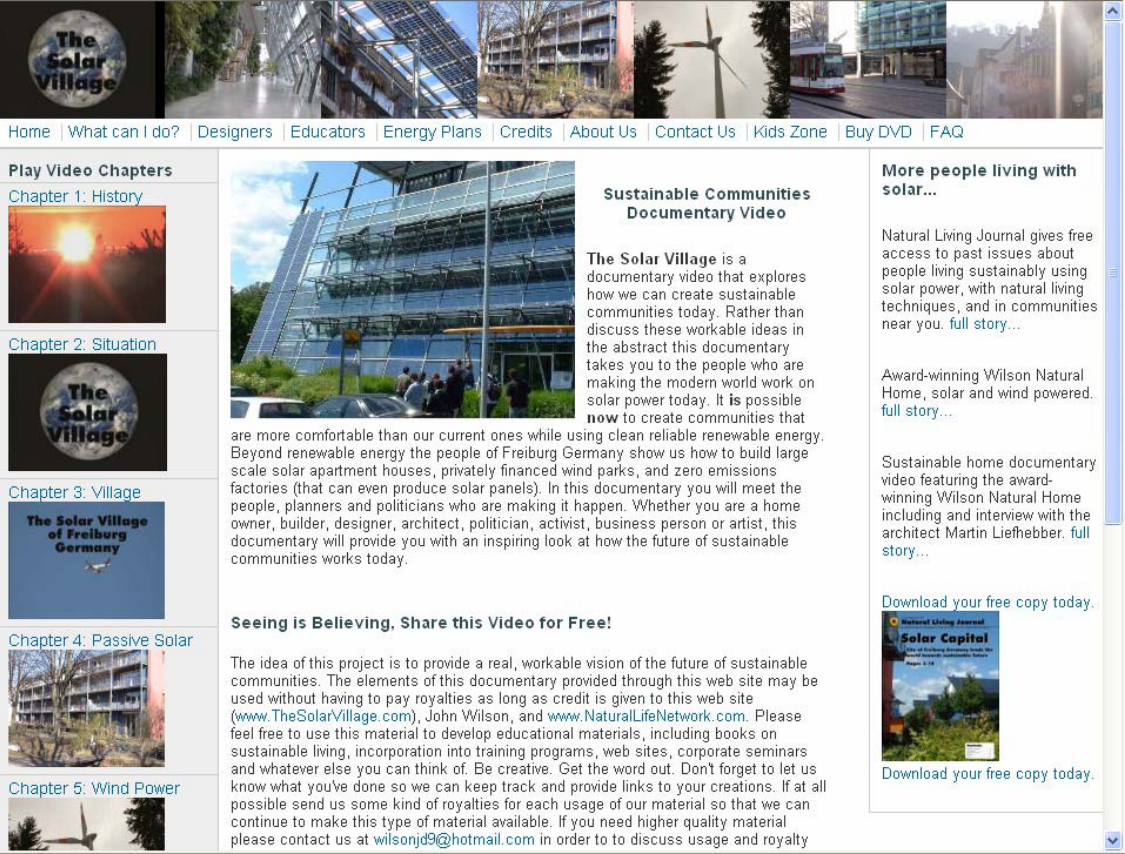
The Solar Village Documentary Video
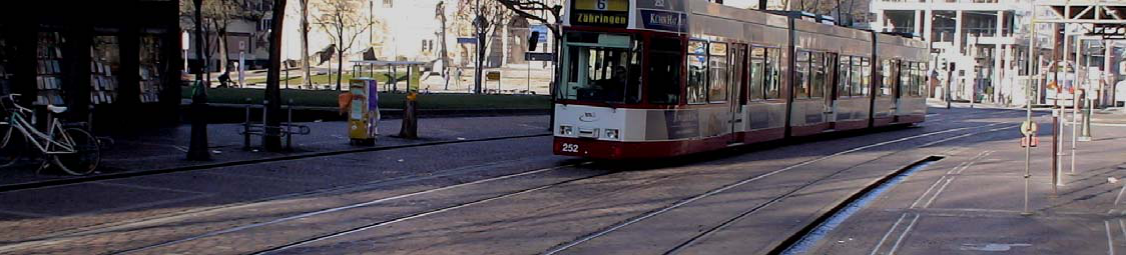
We could be creating solar villages everywhere in the world today. It is possible to power our modern civilization on solar energy. Do you find that hard to believe? If so, then visit Freiburg Germany, the Solar Capital of Europe. In this unique video, now available for free on the web, you will meet some of the people in a working solar village that explain how we all could be doing the same sorts of things. A community powered by solar energy doesn't look much different than any other on the surface. However, in the background you may notice wind turbines in the hills. You will see streetcars built before the houses so that transportation is possible in new communities. Large apartment blocks with more than twenty unit, surrounded by beautiful deciduous trees on the south side, may look normal but also include passive solar (triple glazed windows, with low-e coatings), green roofing, solar thermal water heating, and solar photo voltaic panels that double as a shading structure. Right in the community you will also see how zero emissions factories can produce the appliances, generators, products and goods we'll need to live quite comfortably in our solar villages. Creating solar powered zero emission factories turns out to be a huge employee and community motivator. Supplying the community with local wind produced electricity allows most of the community to invest in their future with superior returns. Learn how groups of people come together to build homes, apartments, communities, wind turbines and much more in this inspiring look at a working solar village. You'll meet Andreas Delleske, a resident of the twenty unit solar powered passive solar apartment building. He'll explain the benefits of ultra-low flush vacuum toilets, high levels of insulation, and even the benefits of “internal gains”. Also featured are a political leader, city planner and the CE0 of Solar Fabrik. You'll see how, through a combination of scientific research, political leadership and most importantly, grassroots activism have transformed medieval Freiburg into the most inspiring solar village in the world. Now, this wonderful experience is available to all. Tune in to this free documentary video on the internet at www.TheSolarVillage.com . Not only is this detailed look at a working solar village free but the elements of the documentary can be used for educational purposes. Find out more by logging on to the web site and viewing each chapter of this documentary. Tell as many people as you can about the secrets of solar communities so that these ideas can be used in your local community. It has all been done before and now the ideas can be shared and used easily through this new video web site. '
Books About A New World Order
The biggest force slowing the broad based support for the changes required for sustainability are the “corporation” and the governments they control. How did we get to this point in such a brief time and how do we move towards a more equitable and sustainable future? Two books that bring home these important problems and how they can be overcome are The Corporation (also an award-winning documentary), and Alternatives to Economic Globalization. In terms of clarifying the problems and providing workable solutions, these two books provide invaluable information.
The Solar Economy: Renewable Energy for a Sustainable Global Future by Hermann ScheerThe global economy and our way of life are based on the exploitation of fossil fuels, which not only threaten massive environmental and social disruption through global warming but, at present rates of consumption, will run out within decades, causing huge industrial dislocation and economic collapse. Even before then, the conflicts it causes in the Middle East and elsewhere will be frighteningly exacerbated. The alternative exists: renewable energy from renewable sources - above all, solar. Substituting renewable for fossil resources will take a new industrial revolution to avert the worst of the damage and establish a new international order. It can be done, and it can be done in time. The Solar Economy, by one of the world's most effective analysts and advocates, lays out the blueprints, showing how the political, economic and technological challenges can be met using indigenous, renewable and universally available resources, and the enormous opportunities and benefits that will flow from doing so. Quotable “The Solar Economy offers and an alternative program to the Kyoto Protocol. It details the links between energy resources and economic structures that have given rise to the fossil energy economy, and maps the dynamic road towards renewable energy that will lead to a new and sustainable global economy. Fossil resources brought the industrialized countries their prosperity. Yet now that their cost outweighs their benefits, fossil resources may bring those self-same countries to their knees. It is the principal thesis of this book that renewable energy, by contrast, brings greater social benefits the more widely it is used, to the point where it fully replaces all fossil energy. There can be no sound reason for making this revolution of our resource base contingent on obligations agreed under international treaties.” - Hermann Scheer
Alternatives to Economic Globalization: A Better World is Possible Editors John Cavanagh and Jerry ManderAfter years of protest in opposition to corporate globalization, the International Forum on Globalization presents alternatives to corporate domination of the world economy more fully and thoughtfully than has ever been done before. This books includes some of the best of current thinking on alternatives for a sustainable future including:
Ten governing principles for a new social paradigm-one that will lead to truly democratic and sustainable societies that benefit the many rather than the few
Spell out alternatives to the World Bank, the IMF, and the WTO that advance democracy, basic rights, and ecological sustainability
Show how vital goods and services (such as water or genetic material) can be administered for the common good rather than privatized for profit
Offer alternative operating systems for energy, agriculture and food systems, transportation, and manufacturing
Provide examples of successful alternative policies and systems already in use by communities around the world today Written by a premier group of 21 thinkers from around the world, the second edition of Alternatives to Economic Globalization lays out democratic, ecologically sound, socially just alternatives to corporate globalization more fully, specifically, and thoughtfully than has ever been done before. Focusing on constructive, achievable goals, the authors present ten governing principles for establishing truly sustainable societies and describe alternatives to the World Bank, the IMF, and the WTO that would better serve the needs of the planet. They offer detailed proposals for protecting vital goods and services from corporate exploitation, limiting corporate privileges and power, rebuilding economies to make them more responsive to human needs, and more. The definitive document of the anti-corporate globalization movement - the consensus report of an alliance of leading activists, scholars, economists, researchers, and writers. This book offers a constructive, coherent, positive alternative to globalization-the very thing that the anti-corporate globalization movement is always accused of not putting forward. The International Forum on Globalization consists of the leaders of over 60 organizations in 25 countries - including such prominent organizations as Friends of the Earth, the Third World Network, the Sierra Club, the Institute for Policy Studies, Public Citizen, Rainforest Action Network, and Food First. Quotable “Globalization is not inevitable. Fortunately, there are alternatives and presenting them is the achievement of this book. Read it and be motivated: A better world IS possible.” - Dennis J. Kucinich, United States Congressman '
Books About Power
Two books that I've read recently have brought home to me how important dealing with our sustainable energy problems will continue to be. In fact, the more I think about it the more that I see how much ideas like population controls, conservation, efficiency, organic farming, permaculture, urban transit systems, and solar power, are so critical to evolving our society. As the oil runs out, and as these books so ably demonstrate, it may be sooner that we expect. It will be to these ideas of sustainability, of Natural Living, that we will be forced to survive. As our ecological footprint shows oil has allowed us to exceed the sustainable capabilities of natural systems. With growing population levels we have already exceed what may be sustainable without oil. If we have any chance of surviving the next fifty to one hundred years it will be because we address these issues. Coming to terms with their reality is critical. So read these books and start taking action today.
War. Big Oil, and the Fight for the Planet: It's the Crude, Dude by Linda McQuaigWho stands to gain or lose the most from climate change? The oil companies, the largest industry on the planet. When you add up all the subsidies provided ANNUALLY to oil and nuclear energy, you can clearly see how big a lie it is to say that renewable energy systems aren't economical. Subsidies to oil and nuclear including the car and airline industry, amounts to significantly more than $200 billion per year…and growing especially if you include the wars fought to protect these resources. Let us say then that the subsidies to these industries reaches about $1 trillion over the last ten years, contributing massively, if not exclusively to climate change. Now, take away this $1 trillion in subsidies from the oil, nuclear, and transportation industries. Give the $1 trillion in subsidies to the conservation, efficiency, and sustainable renewable energy sector over the next ten years. Suddenly oil and nuclear look uneconomic, and the alternatives make perfect sense. Quotable “we've used up the earth's oil so rapidly and recklessly that we have not only jeopardized the viability of the planet (part one of the energy dilemma), but we have at the same time squandered much of this incredibly valuable on-time inheritance. This may sound like a contradiction. If oil is so bad for the earth's ecosystem, maybe we shouldn't care that it's running out. The problem is that we've built the modern world around it, relying on oil for transportation, industry, agriculture and just about every other thing we do, eat, wear, type, watch and move around in.” - pg. 29, War, Big Oil and the Fight for the Planet: It's the Crude, Dude. “…annual subsidies to the industry amounted to $14 billion in the U.S., $5.9 billion in Canada and a total of $59 billion in all the industrialized nations that make up the OECD.” “nuclear industry, received $12 billion in annual subsidies in OECD countries.” “The fossil fuel industry is also aided greatly by massive subsidies to the car and airline sectors …plus $135 billion a year in the U.S.-on the construction and maintenance of roads.” - pg 299, War, Big Oil and the Fight for the Planet: It's the Crude, Dude.
Power Down: Options and Actions for a Post-Carbon World by Richard HeinbergRather than retaining any level of false optimism this book and the author take deadly aim at the priority issues we face and their terrible consequences. Powerdown provides a visionary response to the coming energy famine, a clarion call to cooperative solutions based on the conviction that realism must trump self-delusion in matters of cultural survival. Ultimately there is hope if we are willing to look truth in the eye. If we have the strength to admit our problems we will find the solutions. Quotable “Most of the wars of the twentieth century were fought over resources - in many cases, oil.” Pg 21. “The elites - corporate owners and managers, government officials, and military commanders - are people who have been selected for certain qualities: loyalty to the system, competitiveness, and hunger for power. Often they are literally bred for their roles. Like George W. Bush, they are people born to wealth and power, and raised to assume that privilege is their birthright. These are people who identify with the system and the status quo; they are constitutionally incapable of questioning assumptions. Moreover, the elites are guided day-to-day by a set of incentives that are built into the system itself. Managers who pursue immediate gain get ahead, while those who make short-term sacrifices in order to preserve long-term stability are often at a disadvantage. Likewise, managers are rewarded who keep up appearances, who generate good news, and who exude confidence. Confessing errors accrues no benefit; instead, managers are encouraged to deny short-comings and to blame competitors and subordinates.” Pg. 168.'
Reading
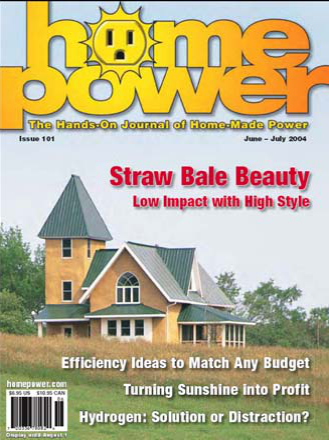
Home Power For anyone who wants to get into the details of living with renewable energy this is the magazine for you. Each month this hands-on journal has off-the-grid and on-the-grid home owners tell their story in an easy to understand format. If you are interested in the technical details and comparing systems then this is the ultimate source of information. You can download a free copy off their web site each month in PDF format. Web Site: www.homepower.com
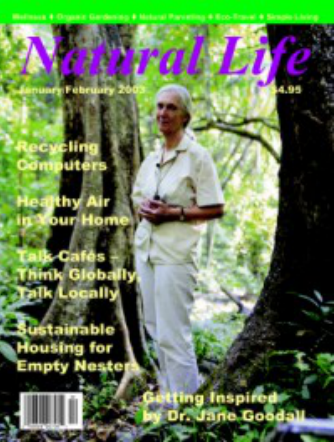
Natural Life This simple magazine covers a wide range of sustainable living topics. For ideas that we can all start using today this is the place to start. Each issue reaches far and wide for interesting stories with lots of ideas for living a more natural life style. Web Site: www.naturallifemagazine.com
Natural Home Each month this magazine features new and renovated homes that are seriously sustainable. Like other popular home and design magazines, you also get coverage of life issues, food, travel and other related topics, all with a “green” twist of course. Other departments include Good to Know, Green Events, New & Noteworthy, Try This, Nuts and Bolts, and Earth Mover Awards. If you want to be inspired by high-end homes with tons of creativity, and features like solar panels, this is a great magazine. Web Site: www.naturalhomemagazine.com

Dwell: At Home in the Modern World Small Change is what it takes over a period of time to make the big changes. Dwell magazine may just be about affecting big change in the mainstream. This slick magazine has a real ecological design supported focus while also insisting on homes that look good. “…Dwell has become proactive in its mission. The magazine isn't just writing about and showing photographs of the design of houses, she suggested, but is actually influencing the ways in which they are designed and built.” The current issue takes aim at ideas such as smaller homes, prefab alternatives, and Dwell Home II, a sustainable house to be built in LA. Check out the amazing four-page pullout spread. The winning home includes passive solar, solar panels, and a green roof. Web Site: www.dwellmag.com'
Join Us
Become a part of a community of people around the world dedicated to living in harmony with nature. We've created this network so that we can all share our ideas, experiences and knowledge. The changes we envision are revolutionary; however our goals are to make them the norm. The organization is about the practical, inspiring and real application of living gently on the earth so that our children may enjoy a clean, healthy and productive environment. The simple point is that we all can "do" much more - and that means all of us or it won't work. For example: Choose or create a home/community that is powered by the sun; Grow and eat organic food; If you must travel select the most efficient means, walk, bicycle, tele-commute, travel by train, bus, ultra-efficient car, or fly; If and when possible, work in nature - grow your own organic food, restore nature around you, put your investments to work for natural living. What will amaze you that everything we need to live this way exists. The cost over the longer term is less. The results are a happier more healthy self and family. Start learning how today. Member benefits:
Monthly Natural Living Journal full electronic edition.
E-Mail Question & Answer (3 per year, no more than 1 per month.)
Directory listing (optional) and Natural Directory.
Discounts on some products and services offered by Natural Life Network. Sign-up for membership at: www.NaturalLifeNetwork.com'
Next Issue…
Solar Village design detail For weekly updates, special offers, and additional products and services visit our web site: www.NaturalLifeNetwork.comHave a question? Ask us and we'll try and include a response in our next issue of the Natural Living Journal. Have an interesting story to tell that relates to natural living? Contact us any time with your questions, concerns or ideas at: john.wilson@naturallifenetwork.com'
Order the Journal now! www.NaturalLifeNetwork.com