August 2004 — Freedom Off-the-grid
Publisher's Message
Freedom The idea of freedom and independence, not to mention the elimination of a large part of your complicity in pollution, make living off-the-grid something to consider. While planning our own straw bale, solar/wind powered home we grappled with the various pros and cons. Although we chose to go grid connected, the simplicity and awareness required for off-the-grid are appealing. Freedom from utility bills is possible today.
In this issue we learn from Leonard Allen and his family that you can be very comfortable off-the-grid. Amazingly it doesn't take any extra maintenance and once installed is quite easy to operate. The "new way of thinking" required means becoming aware of every last bit of energy load. Everything you use from dishwasher to toaster, and even your television and computers have to be reviewed in terms of the energy loads they place on the solar and battery storage systems. On top of that you have to eliminate all sources of "phantom" loads. That means looking at televisions, DVD players, Internet modems, computers and so on for the potential "leaks". In fact by using a simple "Kill O Watt" device that Leonard was kind enough to give me you can find out exactly how much each device is trickling away. I was amazed to find that our old microwave oven, even when "not in use", still uses a couple of watts of electricity just for the digital clock. So we've unplugged it!
Something that surprised me was how similar living off-the-grid is to being connected. Although your awareness of the load is much greater, you still can expect to have all of the conveniences of any other modern home. The other interesting element was the difficulty imposed by the large variation in energy usage between winter and summer as well as the difference in ability to generate with solar power.
The future appears to include better storage systems for solar powered homes. Given the wide variation in solar energy available this far north, the advent of the fuel cell for energy storage, will usher in a better future for this technology. For off-the-grid, a fuel cell generator will allow all of the excess energy generated in the summer to be stored for use in the winter. This eliminates the need for the gas powered generators required today.
Leonard has proven to me that off-the-grid works well in Canada, and is a worthwhile option for anybody who may find it expensive to access the electricity grid. The increased level of awareness about energy consumption makes this type of lifestyle an excellent educational experience for anyone trying to get a feel for what energy hogs we are here in North America.
The technology has come a long way. These systems can be configured to run themselves essentially automatically. A charge regulator, which is able to increase generation by as much as 25-30%, can compensate for problems like the increased voltage produced by solar panels in the cold winter temperatures. We've come a long way towards making things easy. Just imagine how smart things will be in a few years as we learn to integrate computer monitoring systems more completely into our homes. Soon we'll have these systems automatically optimizing the usage of each system much like today's amazing Hybrid cars. We'll take a closer look at these in a future issue.
John Wilson, Founder of the Natural Life Network E-Mail: john.wilson@naturallifenetwork.com
Natural Living Journal John D. Wilson - Editor Natural Living Journal Published by World Peace Communications Copyright ã 2004 John D. Wilson Our Web Site: www.NaturalLivingNetwork.comE-Mail: john.wilson@naturallifenetwork.comPhone: (519) 942-3266 ADVERTISING SALES: Leigh Geraghty, Advertising Representative, (519) 942-3266, leigh.geraghty@sympatico.caCONTRIBUTE: We are always looking for new, interesting and inspiring stories, pictures, and poetry, about people who are achieving a natural lifestyle. If you would like to contribute an article or story then please send us a note with your idea. Contact John Wilson by email at john.wilson@naturallifenetwork.comAll contents of this issue of Natural Living Journal are copyrighted by John Wilson, World Peace Communications, 2004. All rights reserved. Printed in Canada.
Join us!
NAME
ADDRESS
CITY/STATE/PROVINCE ZIP/ POSTAL CODE COUNTRY
PHONE
YES! Sign me up for Natural Living Journal. Orders must be prepaid. Here is my check/money order in U.S funds (Canadian orders in Canadian funds). Subscriptions/ membership includes shipping, handling and applicable taxes. $29 - Individual - 1-year subscription and membership, paperless Internet delivery, requires email (12 issues) $59 - Business - 1-year subscription and membership, paperless Internet delivery, requires email, and business directory listing with logo (12 issues) Membership includes answers to three questions (no more than one per month) through email for a year. To order online by credit card go to www.NaturalLifeNetwork.com. Send all subscriptions and renewals to payable to World Peace Communications. Mail to:
World Peace Communications
248108 5th Side Rd., RR# 5 Orangeville, ON L9W 2Z2, Canada
Freedom Off-the-grid
Gaining your freedom off-the-grid takes a new kind of thinking. Leonard Allen lives and breathes that kind of thinking every day. Off-the-grid means generating your own electricity, storing it for usage during peak demand, and eliminating your electricity bills. Leonard is one of the few "solar" power people who "walks the talk." His company, Phantom Electron Corporation, is one of the most innovative renewable energy systems providers in Canada.
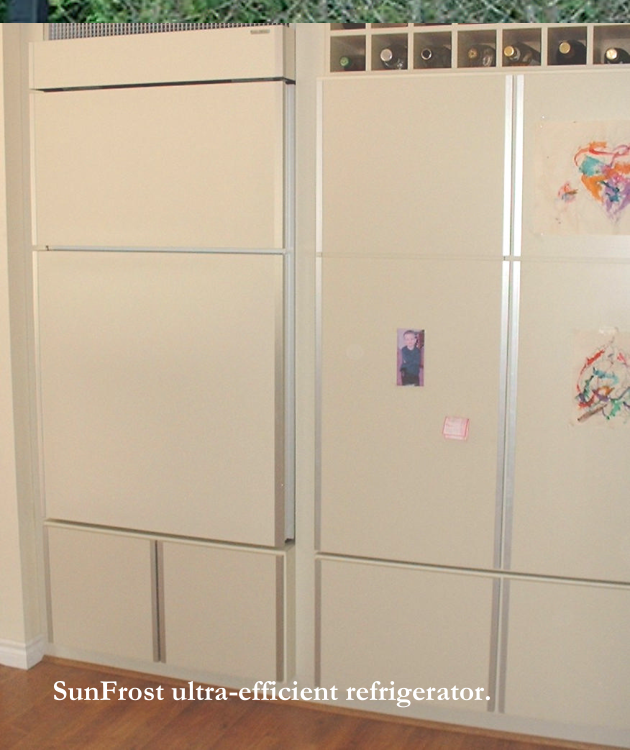
Living off-the-grid does not require any radical lifestyle adjustments. The Allen family including Leonard, his wife Jolanda, their three year old son Weston, and dog Duke, live very comfortably in their large modern home. Like most families they enjoy the modern conveniences of a dishwasher, and clothes washer and dryer. Their computers access the Internet through a high-speed satellite link. Their large screen television, stereo and electric guitar (Leonard plays in a band), all make everything appear quite remarkably the same as those living on-the-grid. Take a closer look, however, and there are some underlying differences that create the magic of freedom from utility bills. Out behind the house, mounted on a thirty plus foot steel pole are an array of photovoltaic solar panels that generate electricity. This solar array is actually mounted on an automatic "tracking" system that directs the panels as close to directly at the sun as possible all day. In the morning the panels point east, by mid-day they are pointed almost straight up into the sky, and finally by evening they end up facing west, constantly optimizing their transformation of sunlight into electricity. Beyond these solar panels you would never know that this family lives off-the-grid. There are no other unusual features of the actual home, garden, or windows that would indicate that this home works a little differently. To be sure the house is wonderfully bright with light because of the many windows. If you look closely the fridge, elegantly designed into the beautiful kitchen, is a SunFrost (reportedly the most efficient fridge in the world). If you look a
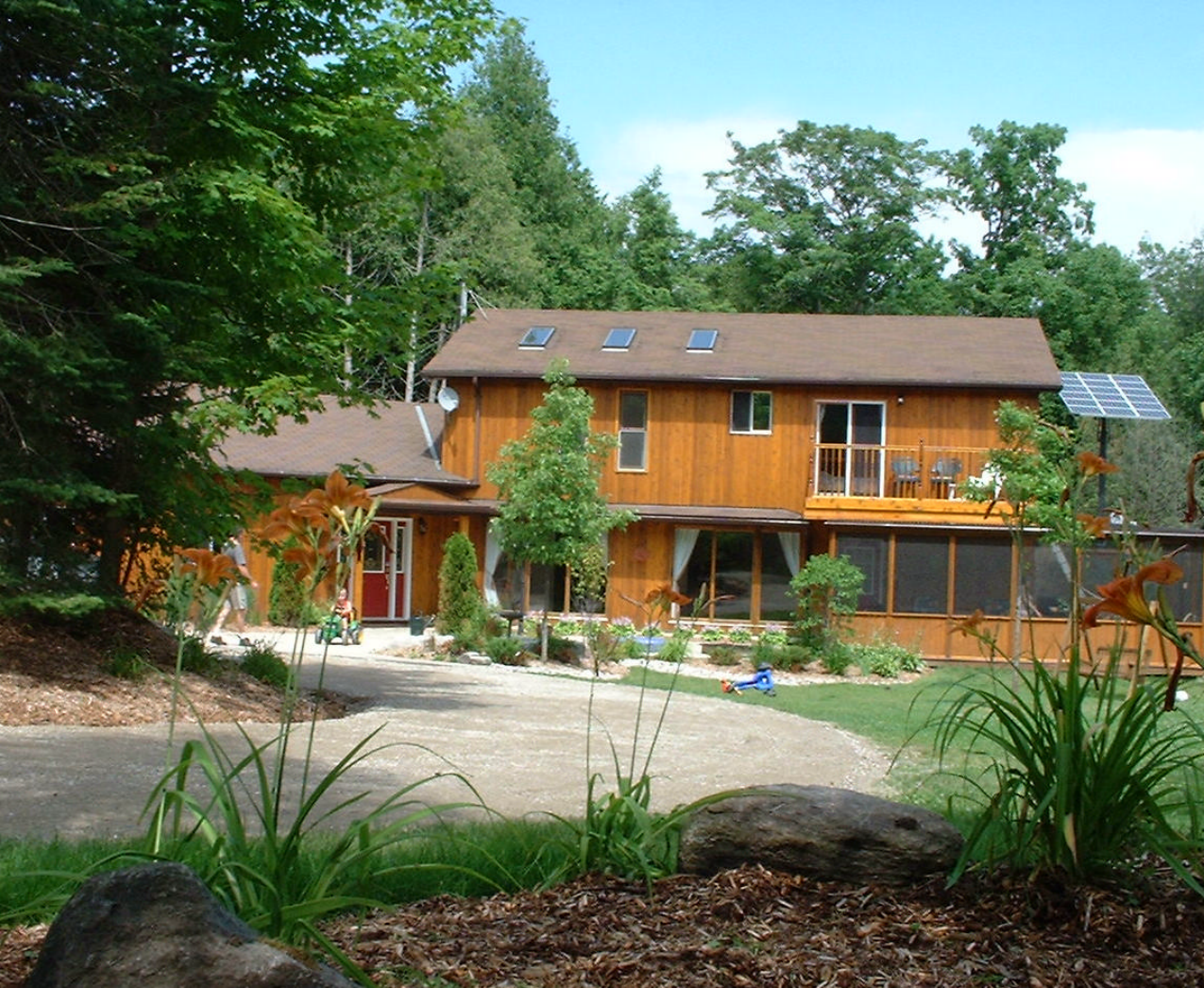
This solar photovoltaic array sits on a tower tracker system. The array includes 18 modules each rated at 85 watts. The tracking system is able to point the array directly at the sun, adjust the angle and position optimally all year round for maximum generating capacity.
little closer you'll also notice that the lights are all compact florescent of a wide variety of shapes, sizes and types. Leonard bought the property in 1987 before having a family. He made a decision not to get electricity from the grid during initial construction. He was able to run many small power tools for construction using an initial set of four solar photovoltaic panels, an inverter to convert the DC current to AC, and a small set of batteries to store excess power. The SunFrost refrigerator was ordered early on as the only means of significantly reducing the load typically required by a fridge. It was touted to be the most efficient in the world at the time. Since Leonard was the only one living in the house he was able to limit his use to 400 watts of solar power generation. Everything worked well. The garage was added and since it faced south he put an additional 300 watts of solar panels on the roof. The security systems business Leonard ran moved towards more and more solar powered systems and in fact has turned into primarily a renewable energy systems provider today. The original system was fine for about five years. The battery storage system has been expanded several times in order to allow the home to operate for longer periods of time without as much sunlight. This is especially important during the winter. The original 900 watt solar system, including the original battery system was then sold. That old system is still operating well for the people that Leonard sold the system to. He had no trouble selling
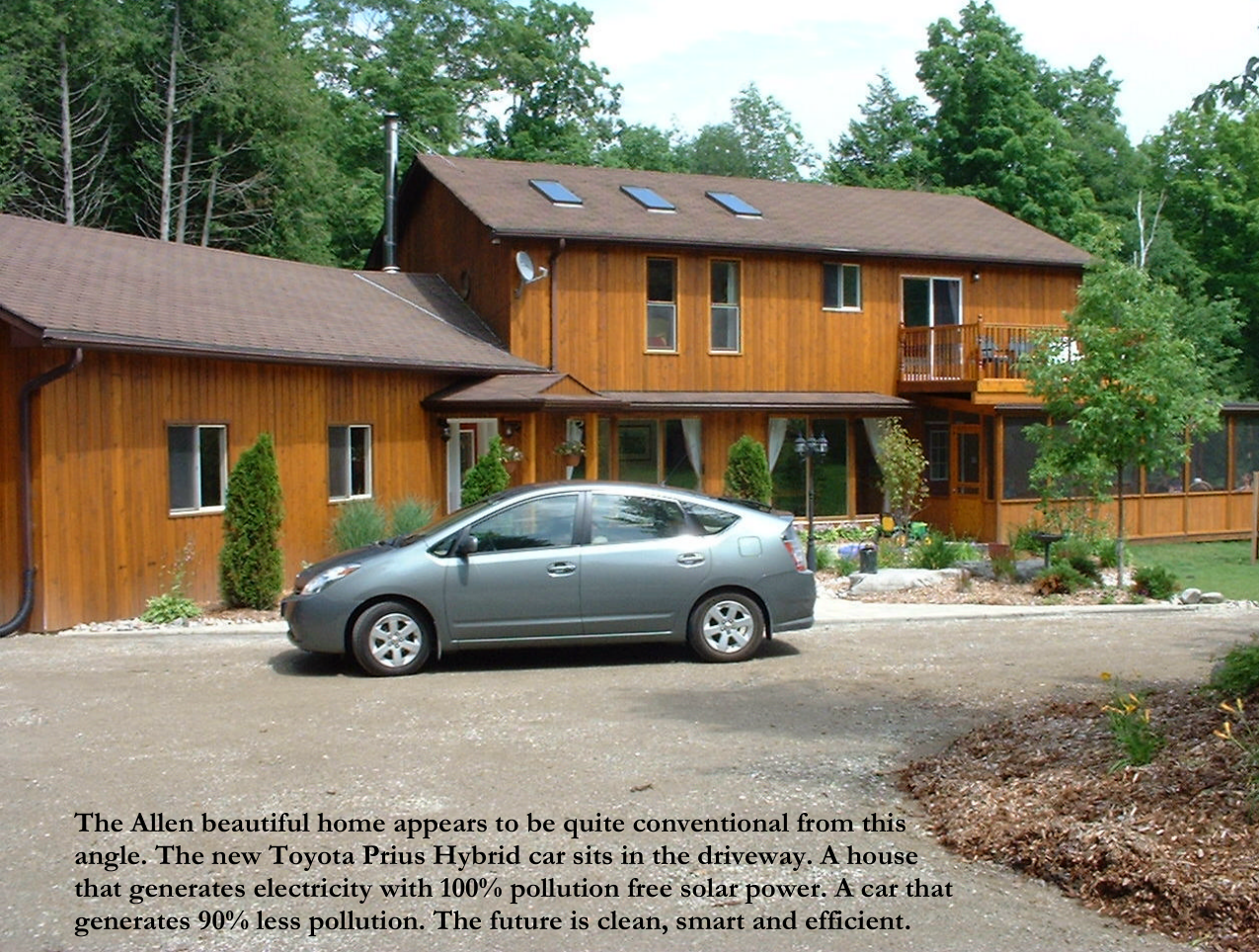
The Allen beautiful home appears to be quite conventional from this angle. The new Toyota Prius Hybrid car sits in the driveway. A house that generates electricity with 100% pollution free solar power. A car that generates 90% less pollution. The future is clean, smart and efficient.
the system as demand for solar is high. The battery system was expanded to three times the original size and is now able to store 50-60 Kilowatt-hours of electricity. This is enough to supply the home for the darker periods in the winter. There is a backup generator in case this is not enough. With the larger solar array and battery system a larger inverter was required. The new solar panels were put on a tower and tracker system, and mounted on a pole. The tracker automatically adjusts for variations in the sun's position during summer and winter, as well as throughout each day. The steep angle of the panels in the winter ensures that the snow does not accumulate on the panels (a problem when the panels were fix mounted on the garage). The current battery system is about ten years old. It should last another three years. The array is now up to 1500 watts and is on a higher pole than in the early days. The shading from trees required that they get it up even higher. They have more power than they need in the summer and the charger shuts down sometimes. There is still a deficiency in the winter. November in southern Ontario has many fewer daylight hours and may have no direct sun for days on end. The solar array could be bigger to make up the difference in the winter. In fact, engine-driven generators have been the biggest problem. They have been unreliable in general. They are strictly for backup power and aren't designed for long term usage.
The generator runs about 150 hours a year. The cost for gas on this is about $150. This is a stop gap for now, says Leonard. Eventually he is hoping to store the summer excess power for later usage in the winter. Eventually he hopes to run on a fuel cell energy storage system when these units come down in price. This should be in two to three years. Leonard expects to be one of the first off-the-grid users of fuel cells in the country. The fuel cell unit would then be sized to store the annual requirement for kilowatts needed. The array would probably need to be about 20% greater than expected requirement, and then the fuel cells could be used to store excess for use during the winter. The home has lots of natural daylight so that electric lights don't need to be turned on during the day. During the recent renovations the changes to the overhangs on windows have significantly improved cooling in the summer. The home was originally a forced air gas furnace. During the most recent renovation an in-floor hydronic heating system was put in on the 1200 sq.ft ground floor. Now no blowers, which were gobbling up lots of power with the old system, are required. The in-floor heating system is supplied with hot water by a propane in-line water heater. This same unit supplies all of the in-floor and domestic hot water required. By turning up the hot water temperature while the dish washer runs Leonard is able to ensure that the electric water heater in the dish
Leonard Allen and his wife Jolanda explain the amazing features of their very comfortable, modern home. Despite being off-the-grid, the Allens have all of the modern conveniences.
washer doesn't turn on, significantly reducing the load on the electrical energy systems. The dishwasher needs to see at least 140°C to not need the energy boost. Before, the dishwasher was using about 1000 watts of power. Propane is used for water heating, cooking and the clothes dryer. They get a 1000 liter propane tank filled three times a year. They spend about $1,200 per year on propane. To some extent the extensive windows require this high level of heating. The wood stove also is used to supply an additional 20% of heating and only when it is especially cold outside. The cost of wood is about $300 per year. Triple glazed windows are something Leonard would do next time. Another idea Leonard has is using the wood stove for heating water used in the in-floor system. Being off-the-grid you must be cognizant of your energy usage. You may undergo an adjustment period initially. People are, in general, unconscious of their energy usage. When it is finite, in off-the-gird homes, it may take a few months, if not a year or two, to become familiar with how efficient and careful you can be with this resource. Despite this, there is zero maintenance on the system now that everything has been optimized and tuned. There are some monitors for viewing the percentage of power available on the batteries. This becomes useful for unusual events more than day-to-day operations. For something like parties where additional power will be required it is possible to generate supplemental power with the generator. Basically, after the first year you understand what each system will provide. Each year will be about the same once the system has been tuned. For Leonard the system has been working well as is for a few years now. Each solar panel is 85 watts and costs about $600. He has 18 panels on the tracker. The skylights also provide lots of good day lighting. The garage has skylights for additional light. The solar array is about 75 feet from the house with an underground cable in PVC pipe. There are six pairs of conductors. The six pairs of wires come into a 60 amp circuit breaker and then into a charge regulator. The charge regulator is able to take the increased voltage that solar panels generate in the winter and improve charging current by 25%-30%. The charge regulator also displays a great deal of useful information about the amount of energy being generated. The power flows into a 250 amp breaker that is connected to the battery bank. The warmer the batteries are kept the better their capacity. So maintaining them in a warmer environment is better. The second breaker protects the DC systems from the AC inverter. There is a meter that monitors the level of charge in the batteries. The sine wave inverter converts the DC current generated by the solar panels to clean sine-wave AC for conventional appliances. The inverter is sized to convert 120 V AC sufficient for having all of the loads including all lights being turned on - 40 amps AC - 5,000-6,000 watts. It takes a few days of sunny weather to charge the batteries to capacity again. However, with a properly designed system, the batteries should never get to the point of being totally depleted. It takes about a day and a half of sunny weather to charge the batteries to capacity again. For 240 volt appliances an additional inverter can be included. The Allen's 240 volt inverter unit is no longer used. Amazingly, since the recent renovations and system expansions, the generator hasn't been used since March and won't go on again until November. The water system starts with a 13 year old 1/3 horsepower pump. It is sized to be just enough for what they need. An ultra-violet sterilizer cleans the water and is DC based using less power than other units. The SunFrost fridge and water cleaner run on DC (12-48 volts) rather than AC. The preheat tank will eventually be fed by a solar thermal heating array (panels). Currently the Rinnai Model 2532 Continuum in-line water heater provides all the hot water required for both in-floor and domestic needs. The unit is efficient at adjusting the flame to optimize for high and low BTU usage. Small pumps push warmed water through the floors for heating. The four small pumps are 12 volt DC circulation pumps each drawing just 3.1 watts as compared to 40-60 watt AC pumps used normally. Again, the off-the-grid aspect dictates ultra-efficiency wherever possible. The whole system only uses as much as a 60 watt light bulb, which is uncommonly low. The old forced air furnace was a major electricity load that drained the batteries. The in-floor or radiator based systems are the "only way to go" according to Leonard when compared to big fans blowing hot air around. The appliances, washer and dryer are very efficient. The dryer is propane to reduce loads on the electrical systems. The washing machine has a high capacity for double loads. The theme of maximum efficiency, wherever possible, is the key. Other appliances are standard. The stove is propane. Leonard gave us a Kill A WattÔ device that lets you measure the electricity usage characteristics. This device showed Leonard that his satellite Internet connection and television system combined were constantly draining 60 watts even while turned off. By adding a power bar to these systems Leonard has been able to shut off this constant drain on his system. Killing all the phantom loads is essential when you live off-the-grid. Leonard Allen is the President of Phantom Electron Corporation, a major supplier of solar and renewable energy systems in Ontario. For more information about renewable energy systems products, installation and operation see www.phantomelectron.com . -
Reading
Home Power
For anyone who wants to get into the details of living with renewable energy this is the magazine for you. Each month this hands-on journal has off-the-grid and on-the-grid home owners tell their story in an easy to understand format. If you are into all of the technical details and comparing systems then this is the ultimate source of information. You can download a free copy off their web site each month in PDF format.
Web Site: www.homepower.com

Natural Life
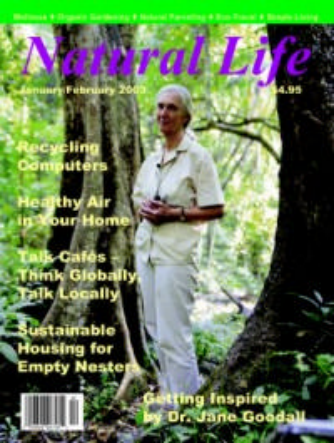
This simple magazine covers a wide range of sustainable living topics. For ideas that we can all start using today this is the place to start. Each issue reaches far and wide for interesting stories with lots of ideas for living a more natural life style.
Web Site: http://www.naturallifemagazine.com/
Private Power
As the cost of electricity goes up this new magazine has been of great interest to the people in rural areas of Ontario. Capitalizing on the recent high profile initiatives announced by the government this magazine shows many different ways that Canadians can start to generate their own clean green renewable energy today.
If you can get your hands on back issues look for the wonderful article by Peter Forint on our SunFest 2003. In it Peter describes the event in some detail for those who want to know what it is all about.
This magazine has provided plenty of food for thought for those living in rural areas. The need for energy on farms can be quite high. With recent increases in the cost of this resource, farms have been looking for a publication like this which explains in simple terms how they can start to reduce their demand and even generate their own "Private Power" today. Beyond the magazine the people behind Private Power have offered conferences on topics such as Wind and Solar Power. Their recent trade show and conference attracted more than 3000 people. The complete set of videos from the conference teaching sessions is available from Private Power. In addition, the Canadian RE Handbook, by Bill Kemp is also being offered with special pricing on combination orders.
Web Site: www.privatepower.ca-

Workshops
Everdale Hands-on Learning
Wind Power Generation II (Wind Turbine Installation) FEE: $85 July 17: with John Hogg of Free Breeze Energy Systems This is the second part of a two part workshop. Mostly hands on with a bit of theory. See a turbine in action and learn all about the nuts and bolts involved in installing a wind turbine. Solar Hot Water Systems FEE: $85 July 18: with Michael Holm of SOLARCO Learn to select and install a system, which will heat your water with the suns rays. Hands-on and educational. Home Alive! In Depth. FEE: $50 August 8: Lead by one of Home Alive's knowledgeable builders. Learn in detail how this house "Thinks, Drinks and Breathes" while seeing how energy and heat are produced and trying the alternative wastewater, solid waste and drinking water systems for yourself. Elements of the permaculture ecological landscape, house design, construction materials, energy production, appliance selection and more will be discussed with a descriptive tour, active demonstrations and lots of opportunity for your questions. Everdale Music FESTIVAL August 14: On Saturday, August 14, from noon till midnight, we're hosting a day of music and entertainment at Everdale for you and your family. As well as music on the main stage (mainly folk and blues), we'll have live entertainment for the kids and events that will bring out the kid in all of us. Meals will be provided at a reasonable price - delicious organic food from Everdale and other organic farms in our co-op network. Tickets will be available by the end of April. Stay tuned for developing details on our website: Tuning into Plant vibrations. FEE: $50 August 15: With Janice Canning a registered herbalist with the Ontario Herbalists Association. Exploring the vibrational energy of the plant world. By connecting with the sprit and essence of medicinal plants we can find our balance.
Safe and Simple Canning Techniques FEE: $50 August 28: with Cathy Hansen and Ginny Pearce These prize winning canners will walk you through some safe and simple techniques to preserve the summers harvest for winter enjoyment. Tomatoes, pickles, pesto and more Home Alive! In Depth. FEE: $50 September 5: See August 8 description. Autumn Harvest Picnic September 11: 1pm-6pm. Take a tour of the organic farm, try your luck at the harvest games, and check out the solar and wind power systems. Fun for the whole family. Bring a picnic dinner we'll supply the corn roast. No need to register in advance. Just come out and enjoy the day. Intro to Sustainable Living. FEE: $85 John Wilson presents the essentials of sustainable living. Organic Gardening: Seed Saving FEE: $50 September 25: with Bob Wildfong president of Seeds of Diversity Canada. Learn how to collect and save your own veggie seeds to plant next year. Grey Water Systems FEE: $85 October 2: with Doug Joy is a professor of water resource engineering at the University of Guelph and the general manager of the Ontario Rural Wastewater Centre. Details on the various types in use; what works, what doesn't and the laws governing these systems. Medicinal Herbs, Identification and Preparation FEE: $50 October 17: see May 30th workshop for details Building Design-getting your ideas on paper FEE $85 October 23: with Larry Benville, 25 year design professional with a background in sustainable construction. Working through design sketches, we will get real about budgets, design realities, and most aspects of the construction process. For more information on attending: Web Site: www.everdale.orgPhone: 519-855-4859 E-Mail: info@everdale.org-
Events
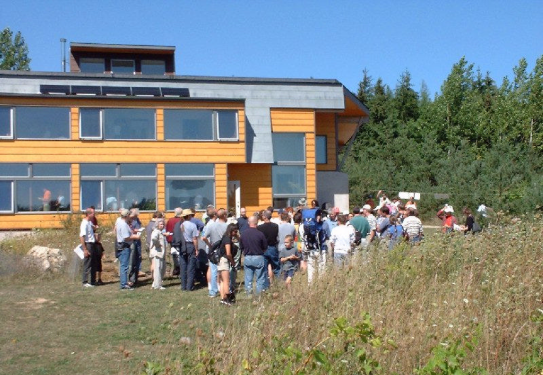
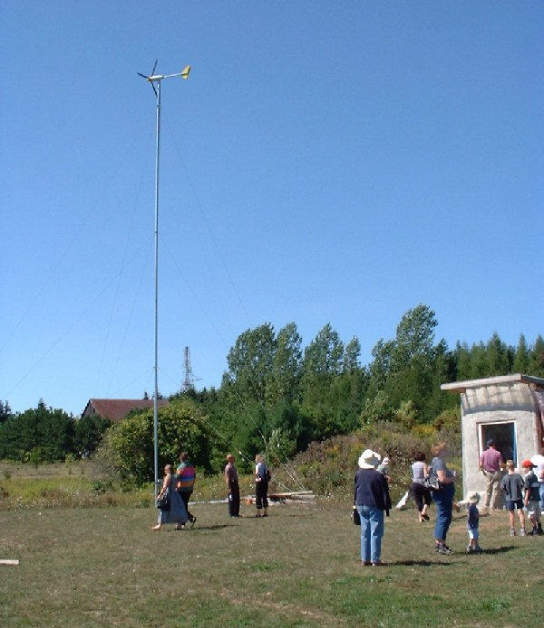
August 28, 2004: SunFest 2004 Tour a working solar/wind powered home. See the awarding winning Wilson Natural Home. John Wilson will be giving tours. Learn about the amazing green roof, straw bale walls, and passive solar design features. Talk to the experts to find out how you too could be running your meter backwards.
For more information on attending or exhibiting: Web Site: www.NaturalLifeNetwork.com/sunfest2004/Phone: 519-942-3266 E-Mail: john.wilson@naturallifenetwork.com-
Join Us
Become a part of a community of people around the world dedicated to living in harmony with nature. We've created this network so that we can all share our ideas, experiences and knowledge. The changes we envision are revolutionary; however our goals are to make them the norm. The organization is about the practical, inspiring and real application of living gently on the earth so that our children may enjoy a clean, healthy and productive environment.
The simple point is that we all can "do" much more - and that means all of us or it won't work. For example:
§ Choose or create a home/community that is powered by the sun; § Grow and eat organic food; § If you must travel select the most efficient means, walk, bicycle, tele-commute, travel by train, bus, ultra-efficient car, or fly; § If and when possible, work in nature - grow your own
organic food, restore nature around you, put your investments to work for natural living. What will amaze you that everything we need to live this way exists. The cost over the longer term is less. The results are a happier more healthy self and family. Start learning how today. Member benefits:
Monthly Natural Living Journal full electronic edition.
E-Mail Question & Answer (3 per year, no more than 1 per month.)
Directory listing (optional) and Natural Directory.
Discounts on some products and services offered by Natural Life Network. Sign-up for membership at: www.NaturalLifeNetwork.com-
Next Issue
Ecovillages and the future of communities. For weekly updates, special offers, and additional products and services visit our web site: www.NaturalLifeNetwork.comHave a question? Ask us and we'll try and include a response in our next issue of the Natural Living Journal. Have an interesting story to tell that relates to natural living? Contact us any time with your questions, concerns or ideas at: john.wilson@naturallifenetwork.com-