March 2004 — Natural Living: Overcoming Common Obstacles
Publisher's Message
It is not about the money or is it? Why aren't more people moving towards a sustainable lifestyle? There is this number that I've read that says that 90% of people when asked say that they want to do something about environmental problems. I've never read a number on the percentage of people who have actually seriously done something significant about these problems. From what I see all around me it looks like less than 1%. Why this massive gulf between this desire to do something and actually doing something significant?
These questions are important because if we can overcome this hurdle the sea of change would be unstoppable. If we got these ready and supposedly willing 90% of just say North Americans the impacts globally would be essentially unstoppable since by far the largest part of the impact is created here.
There appears to me to be many layers to this problem. These layers of problem are given different priorities by each individual so that solutions for one may not be for another. The large number of layers makes solving the problem more than simply removing one layer. So what are say the top three priority problem layers? Here is what I sense. What do you think?
#1 Social/Culture: The fabric of society manifest through culture is the most powerful undercurrent of the way things are. Things are as we think they ought to be. They are also limited by this, our imagination and drive. When challenged to survive, people can manifest society and culture in the form of something new and sustainable. I put this number one because in my own case the biggest barrier was going from a position of one where what I wanted to do with efficiency, solar and wind power, and straw bale insulation went from being "crazy" to maybe this is possible. The transformation required is one of "crazy" for doing these things to "crazy" if you don't.
#2 Economics/Money: Despite appearance and press that might suggest that society is driven by economics I believe that culture predominates. Still, it is perhaps the second most powerful driving force. We have convinced ourselves that we can buy happiness, culture, friends and more. We can't. Money has been transformed into the latest tool of "power". Money supposedly confers power given the way the world works today. In reality this power is fleeting. However, the power of money does support itself through the corruption of financial systems managed by elites, marketing programs that brainwash consumers, and ill gotten gains used by elites to maintain privilege and power by bribing society/culture and politics/government.
#3 Politics/Government: In both economics and politics the games is one of risk management. Maintaining the status quo for the elites and the wealthy few, means keeping the masses under control. The conscience of society has become the lackey of economics. Cut spending, subsidize the largest and most profitable corporations, reduce taxes, and minimize change. Make busy but don't actually do anything since that could get you fired, in the press, or worse, labeled a creative rebel who doesn't get it.
Have you noticed that one of our strongest survival traits appears to be habit? We do things as we've always done them so that we don't have to think about it. Living naturally is smart. People, when they see and feel a natural home can go from thinking it is crazy to, wow, this makes a lot of sense.
John Wilson, Founder of the Natural Life Network
Natural Living Journal John D. Wilson - Editor Natural Living Journal Published by World Peace Communications Copyright ã 2004 John D. Wilson Our Web Site: www.NaturalLivingNetwork.comE-Mail: john.wilson@naturallifenetwork.comPhone: (519) 942-3266 ADVERTISING SALES: Leigh Geraghty, Advertising Representative, (519) 942-3266, leigh.geraghty@sympatico.caCONTRIBUTE: We are always looking for new, interesting and inspiring stories, pictures, and poetry, about people who are achieving a natural lifestyle. If you would like to contribute an article or story then please send us a note with your idea. Contact John Wilson by email at john.wilson@naturallifenetwork.comAll contents of this issue of Natural Living Journal are copyrighted by John Wilson, World Peace Communications, 2004. All rights reserved. Printed in Canada.
Join us!
NAME
ADDRESS
CITY/STATE/PROVINCE ZIP/ POSTAL CODE COUNTRY
PHONE
YES! Sign me up for Natural Living Journal. Orders must be prepaid. Here is my check/money order in U.S funds (Canadian orders in Canadian funds). Subscriptions/ membership includes shipping, handling and applicable taxes. $29 - Individual - 1-year subscription and membership, paperless Internet delivery, requires email (12 issues) $59 - Business - 1-year subscription and membership, paperless internet delivery, requires email, and business directory listing with logo (12 issues) Membership includes answers to three questions (no more than one per month) through email for a year. To order online by credit card go to www.NaturalLifeNetwork.com. Send all subscriptions and renewals to payable to World Peace Communications. Mail to:
World Peace Communications
248108 5th Side Rd., RR# 5 Orangeville, ON L9W 2Z2, Canada
Natural Living: Overcoming Common Obstacles
How do you start?
Think of your children. Do you remember the day that they were born? They are created out of you. They are your future. It is about creating a better world for them or at least trying to. Meaning in life comes when we serve others. Serve those that you love. Challenge yourself every day to make the world a better place so that one day they come to you and say, Dad, Mom, wow, thank you, I understand now what was going on, and thank you for trying to make a difference.
Start with the basics. Improve your health by trying to eat more local vegetables. Get creative with your pasta tonight. Chop up so organic tomatoes, add some fresh basil, and try out the organic past noodles. Organically grown food tastes better and supports a sustainable form of agriculture. You and your children will be healthier for the value of which is inestimable.
Turn down your thermostats. While you are at it take the time to jot down some notes. What can you do to reduce your energy requirements? Some ideas include:
Turn off the lights when you leave a room.
Make your baby food from organic vegetables.
Switch to organic fair trade coffee beans.
Use recycled paper at work and home.
Use a re-usable coffee mug at work.
Replace burnt out light bulbs with compact. fluorescents
Try out a solar powered motion detection light for your doorways.
Can it be done?
Yes, it has all been done before. Read lots of books about natural living, solar energy, solar power, and natural homes. Keep reading our newsletter. The more you become familiar with all of the inspiring stories of others the more ideas you will get and the more comfortable you will feel. Then go tour a home. Volunteer at a straw bale construction site (check out www.strawhouse.ca or the straw bale builders association near you). There are thousands of homes and commercial buildings that prove that you can build a sustainable building. Most sustainable building practices can also be incorporated into a renovation project. Challenge yourself to think of creative ways that you could improve the insulation levels of your home, reduce leaks, or install a solar panel on your roof.
The list of things you should consider doing in priority (in terms of effectives) are:
1. Efficiency - not needing energy or materials in the first place, by insulating, sealing cracks and improving windows 2. Free Natural Resources - make use of site specific features or create them in the form of trees to block cold wind in the winter, additional windows for natural light and heating, and by increasing windows with shading where the sun enters the home, while shading in the summer, or use straw bales for the insulation of an addition or for the entire new home or commercial building (thousands have been built around the world) 3. Passive Solar Heating - create or modify the structure of your home or commercial building so that windows allow sunlight in and create "mass" in the form of concrete flooring, brick walls and so on to hold the heat 4. Natural Cooling - eliminate the need for air conditioning in the summer by employing a "cooling" tower that takes cool air from the basement or ground floor level and combined with natural ventilation sucks the warm air up a centrally located venting tower that has an operating window (see the picture) 5. Solar Water Heating - wherever you live one of the most ancient and proven technologies that exists is solar water heating panels and insulated water storage tanks for domestic water usage, as well as the potential to circulate the warm water within hydronic tubing in the floors, and yes these systems can work in both warm and colder climates (including Canada where I live) 6. Solar Photo Voltaic - get three quotes from your local solar photo voltaic system suppliers and start running your existing electrical meter backwards (these systems work in both cold and warmer climates and surprisingly the solar cells improve in efficiency of conversion of sunlight to electricity the colder they get so that there is a level of compensation for the reduced sunlight in colder climates) 7. Wind Turbine - get three quotes from your local wind turbine suppliers and again start running your electrical
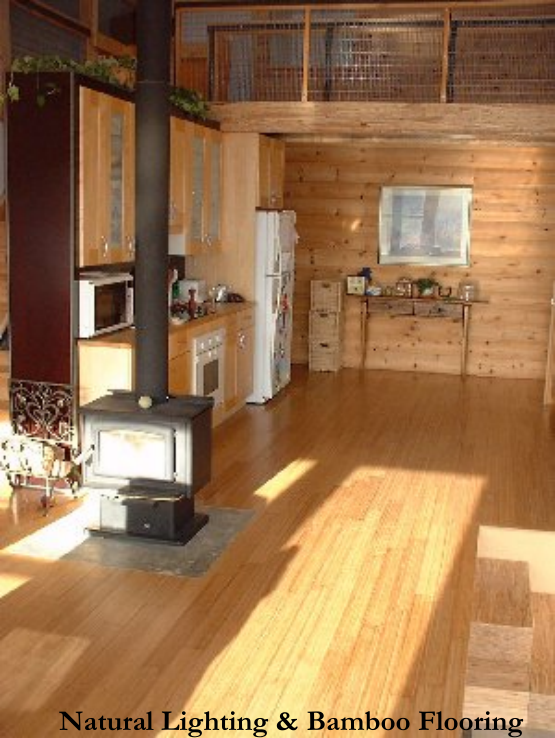
Natural Lighting & Bamboo Flooring
meter backwards, your suppliers should be able to help you determine all of the costs including any related to regulations in your particular region These ideas are for the most part hundreds if not thousands of years old. Efficiency is as old as time. Nature is efficient to the level of perfect harmony and symbiosis. Using free natural resources of the local site for lighting, water collection, drainage, protection from winds, and ventilation are ancient design concepts. Passive solar heating can be found in all parts of the world in some cases in structures that are hundreds and even thousands of years old.
Solar and Wind Power in the Great White North
In the case of more "active" systems like solar photo voltaic and wind turbine systems these have been well proven out over the past thirty to fifty years. As with all products and services the key is doing your homework to make sure you find suppliers that are knowledgeable, trustworthy (get references), and have competitive pricing.
All of these ideas are being used today in every part of the world. Amazing examples of ecologically sensible homes, communities, office buildings and industrial buildings that use all of these concepts do exist. They exist in North America, Europe, Asia, Australia, Africa and South America. You may need to find these examples in your area so that you can learn from these modern pioneers. Find out how things work in your area but also be prepared to just do it! Know that these things are as old and sensible as the ages.
Where do you find the money?
Planning ahead is where it starts for most of us. This means that, like a car, at the very least you should save enough to save for a significant down payment on what you are considering purchasing. Whether it is a efficiency upgrade on your home (average improvement costs to seal leaks and improve insulation levels are in the area of $2,000 - $4,000). More significant improvements such as solar water heaters and solar panels will likely be in the range of $4,000 - $10,000 to start with. If you are thinking of completely gutting and renovating your home or building a new home, the costs will be in the range of $150,000 - $500,000. Start saving your money by down-sizing in the case of these major projects. Think in terms of five years down the road so that you have enough cash to cover expenses right through approximately a quarter of the cost. Remember that these projects are notoriously hard to estimate in terms of cost. Try to determine a reasonable budget for your lifestyle and stick to it. Keep it small as every square foot costs more. Make a plan to do something significant, a significant investment, in the next five years.
When you pay for something like extra insulation or a solar panel, you are in effect investing rather than just spending money.
One of the difficulties with investing in renewable energy, conservation, or improved insulation is that the payback is long term. You end up having to pay for the value up front while the value lasts for twenty to fifty years. Spreading out the payment schedule in the form of a long-term loan or mortgage may be your only option. Although you will pay more in interest, the opportunity to start investing sooner may be opened up to you. At this stage in the change process it is critical that we get as many people as possible setting an example so this investment pays in many more ways than just the bottom line.
Several other important financing issues to keep in mind are as follows:
Retails sales tax rebates or other incentive programs may exist in your area. Check out local city, municipal, or state/provincial web sites for information on these programs. Talk to your local builder or supplier to see what they know about these programs.
It may be that certain taxes apply depending on the value of the work you decide to undertake. In some cases when you build, for instance, to a value of greater than $400,000, certain tax exemptions may not apply.
Some states or provinces offer rebates on investments in renewable energy, home efficiency upgrades, high efficiency appliances (with the Energy Star rate) and even some low emissions vehicles. Again, check out local utility or state/provincial web sites for information. Also, you local retailers should be informed as this lowers the cost of their products although don't rely on them to know about all programs.
How do you figure everything out?
Get the help of respected advisors. The value of good advice and services is inestimable. Read up on the ideas you decide to invest in. Get a couple of books on efficiency, natural home construction, and sustainable living. Talk to people who have done these things in your area. Attend local workshops on topics such as wind power, solar panels and so on so that even if you plan on purchasing, you know what to ask
What about regulations and approvals?
Since it has all been done before all of it go in with the attitude of simply doing it. Get your suppliers to help you. -
Payback: Looking at the Numbers
Comparing numbers is nearly impossible but we all want to do it. The difficulty is that too many of the numbers are hidden or unknown. Think about nuclear energy. How much did it cost to build that nuclear plant nearby? Is that cost included in the energy you pay on your monthly bill? What about all the problems with nuclear reactors that are causing billions of dollars a year to be spent on repairs or refurbishment only to find that these older reactors still can't be started up safely. Then, how can we include the long term costs of storing the nuclear fuels waste and the thousands of years it will take for decommissioned reactors to become safe again. On top of these numbers are the complex layers of subsidies, taxes, distribution costs, distribution losses and distribution channel markup costs. On top of all of that, we still have not, nor is any accounting made, for the terrible cost to the natural world of pollution, and the long term clean-up costs the tax payers are being burdened with. Another number we avoid including is the cost of the risk related to the unthinkable, that a terrorist or malfunction might cause a nuclear melt down. And yet, these unthinkable events are essentially inevitable. At a high level, clearly, we do not know what the real numbers are.
Cost
LEGEND
RenewableFossil Fuels & Nuclear
Time
Some numbers that exist for the region of Ontario, Canada so that you might get a sense for the scale of the problem (imagine if you multiplied these numbers to reflect world-wide levels and then also projected them over the next forty years as fossil fuel supplies dwindle to essentially nothing):
$40 billion (Canadian) in dept from nuclear power plant construction
$5 billion in cost over-runs over the last several years related to nuclear power plants refurbishment programs that have essentially entirely failed
$2 billion/year in subsidies to the energy sector of which approximately 97% goes to nuclear and fossil-fuel based energy systems compared to just 7% for clean renewable energy systems.
1900/year premature deaths in Ontario caused by air pollution related in large part to the dirty coal energy plants, cost being inestimable on a human life. Health costs are the number one budget problem of the Ontario and the federal Canadian government and yet the root causes are not addressed causing twice the cost burden, health costs and energy production costs.
$ billions in losses due to power blackout in 2003 caused by overloaded system with too many large scale central generators and too few smaller scale independent system to say nothing of the 30% waste energy that became visible as consumers and business found ways to reduce energy consumption by this amount in the days and weeks after the blackout (that
has sadly faded from memory causing usage pattern to return to the old wasteful levels)
#1 - Canada energy use per capita (30 million people)
#1 - Canada C02 emissions per capita (30 million people)
1 billion - the population of China rapidly approaching the energy usage patterns of Canadians So what are the costs of renewable energy systems and what are the payback numbers that we know. First, renewable energy systems essentially are burdened with their true cost of production, unlike nuclear and fossil fuels. So, the numbers that follow are "real" unlike those for nuclear and fossil fuel. Does enough renewable energy exist to supply the world-wide demand? Yes, in
perpetuity. Will fossil fuel energy supplies run out? Yes, in about forty years the most readily available supplies will all be gone. The relationship between renewable energy systems un-ending supply and the dwindling reserves of fossil fuels means that the cost comparison over the next forty years will change completely over the next forty years. Fossil fuel energy supplies will continually increase in cost over the next forty years reaching a point where that cost will be greater than the value of extracting it in the first place. The current unfair comparison that burdens renewable energy with the true cost while hiding large portions of the cost of fossil/nuclear power suggests that renewable energy sources are the only sensible choice even today. Wind energy for instance is cost competitive in many areas where wind resources are available (which is just about everywhere). This actually means that when you remove all of the hidden costs of fossil/nuclear wind energy may be several times more cost effective. Basic ideas such as efficiency, passive solar design and solar water heating are in fact likely better investments than any mutual fund. Again, given all of the hidden costs of fossil/nuclear, it is likely that even expensive solar photo voltaic systems are viable.
Energy Investment Comparison
PV
Wind
So how much does renewable energy really cost:
$1,250/year (solar/wind power system for a well designed sustainable natural home in Ontario Canada) today for a system that would supply renewable energy independently or on the grid for the next forty years (assumes a solar/wind power system that costs $50,000)
$2 million for a 1MW wind turbine that can provide renewable energy for about 300 conventional homes for about twenty years
$40 billion (the current dept load from building nuclear power plants in Ontario) could be used to build 20,000 MW of wind power generation that could supply 6 million conventional homes powered by renewable for the next twenty years (about 12 million natural homes like the Wilson Natural Home) The "Energy Investment Comparison" provides a visual idea of what the numbers mean over time. Clearly renewable energy is a good investment. Even better are investments in efficiency. -
What's Happening?
The last couple of months have been very busy for us here a Natural Life Network central. Some great events we've either hosted or attended are summarized in the following section.
Natural Living Seminar and Home Tour January 24, 2004 (next one is April 17, 2004 - see http://www.NaturalLifeNetwork.com/learning/ for more information)
Summary: We here at the Natural Life Network hosted eight people for a full day seminar and natural home tour. Leigh Geraghty and John Wilson presented the essentials of creating a sustainable lifestyle. It was a perfect day as the temperature outside was -20C, bitterly cold, while inside the sunshine warmed the home to comfortable temperatures. The wind turbine was operating about at about fifty percent capacity. Combined there was enough renewable energy being produced to make all attendees comfortable while being able to run the electrical meter backwards. Several attendees commented that the "down-to-earth" and real-life stories presented were very effective and appealing.
Seminar Topics included: 1. Introduction
What is sustainable living?
Objectives 2. Our Journey
Where did it all begin?
Seeing is believing!
Getting help from experts 3. Key Concepts
Ecological Design
Renewable Energy Systems
Water and Waste Management 4. Natural Living: The Wilson Natural Home
25 minute documentary video presentation
Questions and discussion 5. Hands-on Tour
Straw bale walls
Solar and wind power
Water and sewage systems
Interior design, appliances, and heating/cooling systems
Green roof
Composting
Organic vegetable garden 6. Planning and Financing
Finding the land
Choosing your team
Design the project
Getting the money
Tips and lessons learned Tour highlights included:
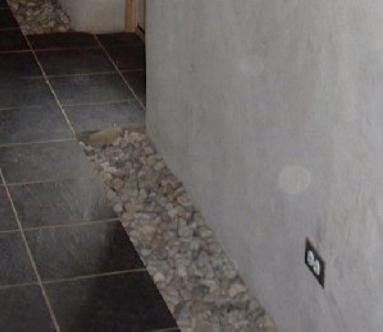
natural stone pebbles in hallway (see picture)
straw bale natural insulation in walls on north side
parallam post and beam construction
inspiring open concept design
bamboo flooring
no conventional fossil fuel furnace
working wind turbine
solar photo voltaic panels integration
electrical grid inter-tie, meter runs backwards
hydronic in-floor heating system, in-line electric water heater
EPA rated wood stove
Sahara architecture natural cooling system
green roof
Renewable Energy for College Kids February 26, 2004 Summary: Glendon, a campus of York University in Toronto, hosted John Wilson, from the Natural Life Network, for a one-hour presentation on the highlights of renewable energy. The course is an introduction to cultural and physical geography for students who hope to work internationally (and a few future teachers). Their professor is a strong advocate of both international and local environmental issues. Students were particularly interested in applying renewable energy systems in an urban environment as several of them had assignments specifically related to this topic.
Energy Systems for Grade Five February 27, 2004 Summary: Leigh Geraghty from Natural Life Network presented energy systems for an enthusiastic class of twenty grade five students at an Oakville, Ontario public school. These lively kids could easily understand that the straw bale material that Leigh shared with them would make a good natural insulation material. The documentary video (Natural Living: The Wilson Natural Home) got lots of giggles when the large wooden mallet was used to smooth out the straw bale wall. Claire Wilson and Ian Wilson also got a few laughs as they explained their new connections to nature helps them understand that potato plants are supposed to die and that the potatoes we eat are in the earth, not something that grows on the plant.
Sustainable Urban Park Project February 23, 2004 Summary: The Natural Life Network and partners presented to
Parc Downsview Park the idea of doing an "Ecological Design" review for the planned community elements of the park. This six hundred acre urban park, the first national urban park in Canada, has a strong emphasis on sustainability. The recently released "Tree City" design vision for the park is inspiring in terms of the ideas and values being put forward as the guiding principles for the park.
Parc Downsview Park core values are:
Design the Maintenance = Sustainability
Design the Educational
Check out the Power Up! Renewable Energy Co-Operative Web Site:
www.powerupenergy.ca
Effect = Stewardship
Redefine Leisure = Play
Build a Living Database = Legacy
Design the Icon = Beauty The principles of ecological design, as formulated by Sim Van Der Ryn and Stuart Cowan, in the book Ecological Design include:
Solutions Grow from Place
Ecological Accounting Informs Design
Design with Nature
Everyone Is a Designer
Make Nature Visible For more information see the Parc Downsview Park web site at: http://www.pdp.ca/
Power Up! Renewable Energy COOP February 28, 2004 Summary: Power Up Renewable Energy Co-Operative (PURE) is a grassroots cooperative that is committed to bringing renewable energy back to Dufferin County and the Headwaters area. Their motto is "Be Green, Be Conserving, Be PURE". At this, the inaugural meeting of the newly incorporated cooperative organization, we learned that the goals of the cooperative are as follows:
Contribute to the development of Dufferin Country and surrounding areas as a sustainable society and economy through the development of community-based renewable energy projects.
Promote energy conservation and renewable energy projects through education, advocacy and project development.
Develop a framework with the government and energy utilities where efforts to reduce energy consumption and increase renewable energy are measured and rewarded.
Identify and develop local energy resources (such as wind, solar and mico-hydro) in Dufferin County and the surrounding areas in cooperation and collaboration with the community.
Enable individuals and businesses to invest in sustainable energy projects that yield a stable and reasonable economic return.
Advocate market and legislative changes that will facilitate the implementation of our objectives.
Promote local energy solutions that are consistent with the environmental standards recognized by the Co-op and which bring economic benefit to the community. The PURE Co-operative had its genesis at a general meeting convened by OSEA in Shelburne in April of 2003. OSEA (Ontario Sustainable Energy Association) ignited the growing interest of local residents of Dufferin County and the Headwaters region, to explore and perhaps develop renewable energy alternatives for our community. These passionate individuals have invested many hours of work to bring to life a working viable cooperative for the Dufferin County area. In this process, we learn from the successful model of other Ontario co-operatives such as WindShare and its Toronto-waterfront wind turbines, Positive Power, and others.
Some facts provided by PURE about the current energy situation in Ontario Canada:
Canada uses more energy per capita than all other G8 countries including the US
Canada's wind energy production is only 2% of the wind energy currently generated in Germany
Time to market for wind is much shorter than either coal or nuclear energy
Renewable energy will help reduce smog-related illness
o Help us meet our Kyoto targets o Will increase the security of our energy supply o Sustainable energy supply leads to long term
price stability
Coal Power is directly responsible for approximately ¼ of Ontario's greenhouse, mercury and acid rain emissions (in 2000, approximately 1900 premature deaths were attributed to air pollution)
Nuclear Power has an extremely high cost of operation and their exists a perpetual problem of disposing of nuclear waste For more information about PURE or to become a member: Web Site: www.powerupenergy.caEmail: info@powerupenergy.caPhone: 519-925-1710-
Events
Canadian Geographic Kids - Wilson Natural Home featured
Some time between February and March 2004 the series will feature an episode on the Wilson Natural Home. Hear what the Wilson kids have to say about living solar.
April 3, 2004 Halton EcoFest Drop by our booth to catch up with us on the latest publications, books and videos. For more information: Web Site: www.haltonecofest.ca
April 17, 2004: Natural Home Tour and Seminar Held on location at the Wilson Natural Home, you get a full tour of this amazing, inspiring home, that incorporates straw bale natural insulation, passive solar design, solar & wind power, natural construction materials, no fossil fuel based furnace, and a green roof. For more information on attending: Web Site: www.NaturalLifeNetwork.com/learning/Phone: 519-942-3266 E-Mail: john.wilson@naturallifenetwork.com
April 22, 2004 Earth Day Look for local festivals and activities in your area. Renew your commitment to the earth. For more information: Web Site: www.earthday.net
August 28, 2004: SunFest 2004 Tour a working solar/wind powered home. See the awarding winning Wilson Natural Home. John Wilson will be giving tours. Learn about the amazing green roof, straw bale walls, and passive solar design features. Talk to the experts to find out how you too could be running your meter backwards. For more information on attending or exhibiting: Web Site: www.NaturalLifeNetwork.com/sunfest2004/Phone: 519-942-3266 E-Mail: john.wilson@naturallifenetwork.com-
Join Us
Become a part of a community of people around the world dedicated to living in harmony with nature. We've created this network so that we can all share our ideas, experiences and knowledge. The changes we envision are revolutionary; however our goals are to make them the norm. The organization is about the practical, inspiring and real application of living gently on the earth so that our children may enjoy a clean, healthy and productive environment.
The dream, the visions, are the same and yet perhaps broader. Yes, we want happiness, freedom, truth and beauty in our lives but more than that, we want this for our children and their children.
Quality of life matters, so above cost comes quality. It means understanding that less can be more and that doing nothing can do more.
The simple point is that we all can "do" much more - and that means all of us or it won't work. For example:
§ Choose or create a home/community that is powered by the sun; § Grow and eat organic food; § If you must travel select the most efficient means, walk, bicycle, tele-commute, travel by train, bus, ultra-efficient car, or fly; § If and when possible, work in nature - grow your own
organic food, restore nature around you, put your investments to work for natural living. What amazes me is that everything we need to live this way exists. The cost over the longer term is less. The results are a happier more healthy self and family. Member benefits:
Monthly Natural Living Journal full electronic edition.
E-Mail Question & Answer (3 per year, no more than 1 per month.)
Directory listing (optional) and Natural Directory.
Discounts on some products and services offered by Natural Life Network. Sign-up at: www.NaturalLifeNetwork.com-
Next Issue
Natural Living in the Dominican Republic
EcoTourism: Try Before You Buy For weekly updates, special offers, and additional products and services visit our web site: www.NaturalLifeNetwork.comHave a question? Ask us and we'll try and include a response in our next issue of the Natural Living Journal. Have an interesting story to tell that relates to natural living? Contact us any time with your questions, concerns or ideas at: john.wilson@naturallifenetwork.com-