January 2005 — Living Spaces
Publisher's Message
Creative Answers Exist In this issue we review the Living Spaces exhibit produced by the Cambridge Galleries. This exhibit shows how the design world in Canada is starting to move towards an ecological design paradigm while creating contemporary homes that fit the northern climate of Canada. Get inspired by the ideas presented in these model homes that have been built by their owners.
If you've been wondering, as I have, whether we are moving in the right direction, or moving at all, then start reading. The books and magazines featured in this issue prove that we are making good solid strides. The majority of people around the world are looking for equitable and sustainable answers to the problems created by corporations. Read the book The Corporation or see the award-winning documentary to find out how the most powerful institution on earth works. Knowing how corporations work provides many answers to the changes that will be required. For more ideas about a new world order that provides some of the answers check out Alternatives to Economic Globalization.
Some good signs of change recently to usher in 2005:
Russia has agreed to sign the Kyoto Protocol on Climate Change. With Russia this international agreement is now a legally binding force for a large number of countries around the world. Although the United States has broken its promise and commitment to this agreement, some States are making progressive strides towards compliance, and in fact world leadership.
Energy prices have remained high throughout the world forcing governments and corporations to look for alternatives.
Major car companies have won "best" awards for their hybrid offerings bringing these vehicles to the mainstream. The Toyota Prius was car of the year. Incredibly it reduces pollution by 90% compared to conventional cars and reduces fuel consumption by about 50%, saving thousands of dollars.
Politicians at all levels of government are announcing real sustainable renewable energy projects. See the Premier's letter on our website.
Clarity regarding the imbalance in funding between oil/nuclear and renewables is reaching the public. The fact that about $60 billion subsidizes the oil industry ANNUALLY is being clearly and convincingly discussed, although changes have not yet started to equalize the situation. The day when the lies regarding the "uneconomical" nature of renewables may soon be upon us, Let us hope it is this year.
John Wilson, Founder of the Natural Life Network E-Mail: john.wilson@naturallifenetwork.com
Contents:
Publisher's Message...................................................................................... 2 Subscriptions.................................................................................................. 2 Books .............................................................................................................. 9 Reading .........................................................................................................11 Join us ...........................................................................................................12
Natural Living Journal John D. Wilson - Editor and Publisher Natural Living Journal Published by World Peace Communications Copyright ã 2004 John D. Wilson Our Web Site: www.NaturalLivingNetwork.comE-Mail: john.wilson@naturallifenetwork.comPhone: (519) 942-3266 ADVERTISING SALES: Leigh Geraghty, Advertising Representative, (519) 942-3266, leigh.geraghty@sympatico.caCONTRIBUTE: We are always looking for new, interesting and inspiring stories, pictures, and poetry, about people who are achieving a natural lifestyle. If you would like to contribute an article or story then please send us a note with your idea. Contact John Wilson by email at john.wilson@naturallifenetwork.comAll contents of this issue of Natural Living Journal are copyrighted by John Wilson, World Peace Communications, 2004. All rights reserved. Printed in Canada.
Join us!
NAME
ADDRESS
CITY/STATE/PROVINCE ZIP/ POSTAL CODE COUNTRY
PHONE
YES! Sign me up for Natural Living Journal. Orders must be prepaid. Here is my check/money order in U.S funds (Canadian orders in Canadian funds). Subscriptions/ membership includes shipping, handling and applicable taxes. $29 - Individual - 1-year subscription and membership, paperless Internet delivery, requires email (12 issues) $59 - Business - 1-year subscription and membership, paperless Internet delivery, requires email, and business directory listing with logo (12 issues) Membership includes answers to three questions (no more than one per month) through email for a year. To order online by credit card go to www.NaturalLifeNetwork.com. Send all subscriptions and renewals to payable to World Peace Communications. Mail to:
World Peace Communications
248108 5th Side Rd., RR# 5 Orangeville, ON L9W 2Z2, Canada
Living Spaces
21 Contemporary Canadian Homes
Cambridge Galleries, Exhibit Info: www.cambridgegalleries.caThis exhibition, which will travel to galleries across Canada in 2005, examines the regional, historical and societal influences of 21 of the nation's most beautiful homes designed by some of Canada's renowned architects. Most of these modern homes incorporate some level of sustainable design. By harnessing the power of the wind and collecting the sun's energy, sustainability is achievable even in the cold northern climate of Canada.
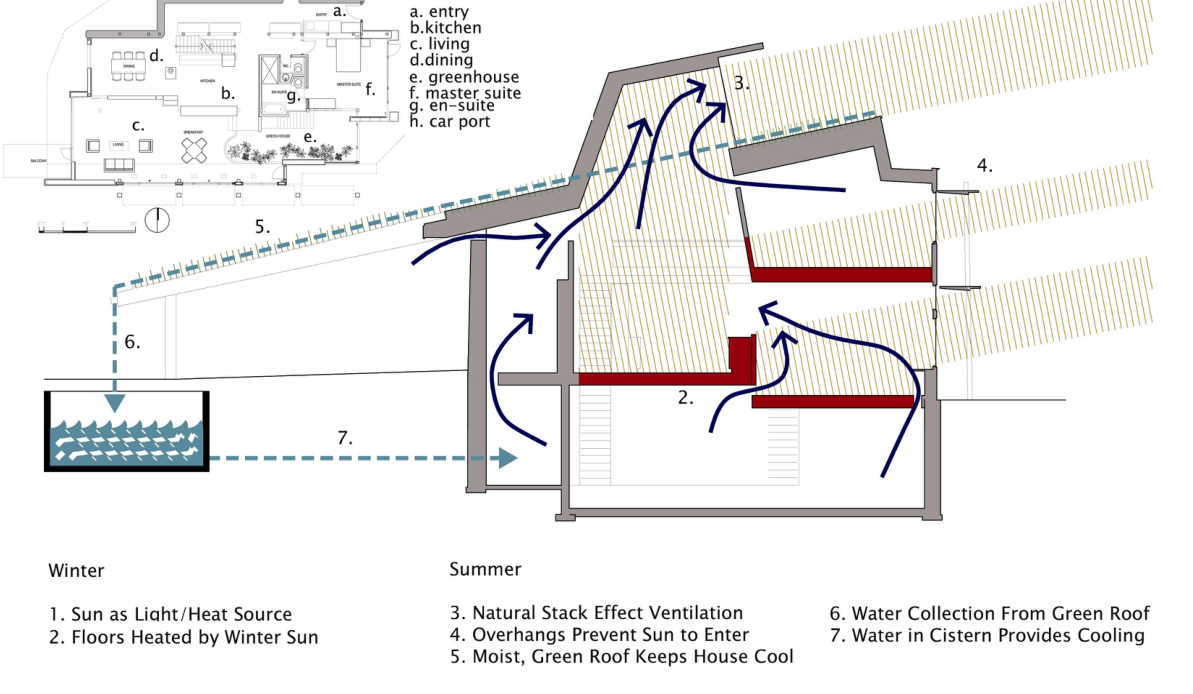
Wilson Natural Home - Situated near the top of a hill, facing due south, this passive solar house uses concrete flooring to collect heat from the sun without the need for a furnace. Massive straw bale walls insulate the home to retain heat in the winter and coolness in the summer. A large skylight in the center of the home creates a natural air conditioner that takes advantage of convection currents in the summer to cool the entire home, while providing day lighting year round. All the materials used in the construction are chemical and toxin free. This modern home combines comfort year round, energy sustainability, occupant health, and the inspiration of a natural setting.
Natural Ecological Design
What is so special about the sustainable design award-winning Wilson Natural Home included in this collection? Many elements combine to create a solution that costs less while minimizing impact on nature. At the same time the lifestyle provided is more healthy and comfortable. Finally, the esthetic is beautiful, in that it fits in with the natural environment while minimizing the impact on it. Key features include no conventional heating/cooling; instead, the elimination of fossil fuel based heating systems, elimination of hydro-based cooling systems means no pollution. The heating effects of the sun provide an alternative heating system, smart windows and the floor construction combine to produce and deliver heat. It's called 'passive solar heating' - the ultimate furnace!
Ideas used for millennia in the Sahara are used to create natural air-conditioning using a stack effect for cooling in the summer. The home's central 'solar chimney' uses a method perfected in the Middle East for cooling dwellings even during hot summer weather. The design draws naturally cooled basement air up into the solar chimney. The ambient hot air is washed out with it, thereby cooling naturally. Combined with a green roof that adds up to 30-40 percent cooling effect, the comfort is efficient, effective and natural. This design effectively combines ancient ideas for cooling. Both chimney effects and green roofs have proven effective for thousands of years.
Wind power combines with passive and active solar design techniques to create a comfortable and inspiring natural home that blends with the landscape. Copyright 2004 John Wilson
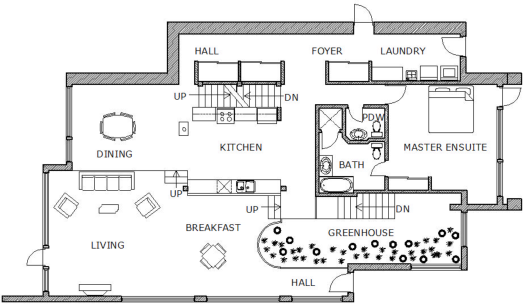
Ground floor of the sustainable design award-winning Wilson Natural Home. Straw bale walls and utility room/hallway protect the house on the north side. Living space is mainly on the sunny south side.
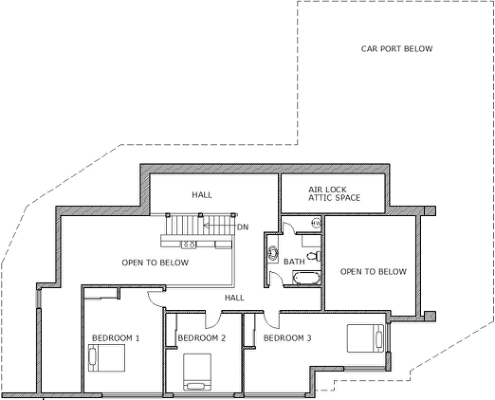
On the 2nd floor each bedroom can be heated separately with individual thermostats installed that control the in-floor heating system. Significant roof overhang protects straw bale walls on the north side. Washrooms are stacked in order to allow for a central composting toilet system.
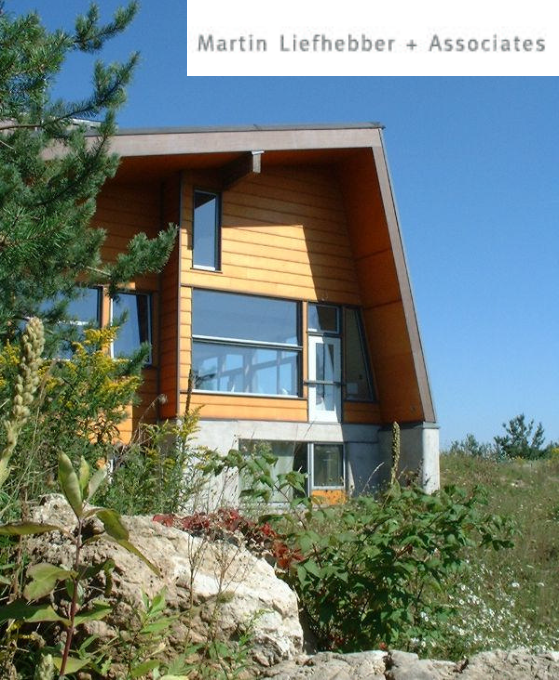
The natural landscape sets the tone for the lines and angles that perfectly collect energy from the sun just like the surrounding wild flowers.
WATER The green roof is shaped to catch and funnel all precipitation to a 30,000 liter cistern, providing water for the garden and some interior uses, even during a 3 month draught.
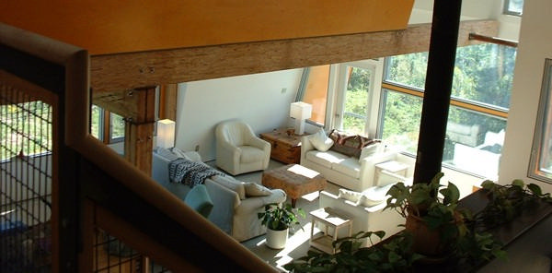
Natural lighting warms the cozy living room from morning until dusk. Sunsets set off the large natural views to the south and west.
BUILDING MATERIALS No conventional suburban construction practices were used so that 'stinky', toxic materials (PVC's, MDF's, Vinyls) could be eliminated. Reliance on a post and beam structure, using laminated strand lumber, a natural, renewable building resources, including straw bale insulation for the walls, to create a 'breathing' building envelope combine to create a comfortable healthy indoor environment. A simple and easy to construct post and beam method was used. The traditional concepts of combining community volunteer help reduced the construction costs, especially when it came to the straw bale walls and green roofing. These techniques can easily be used to reduce the cost of home construction.
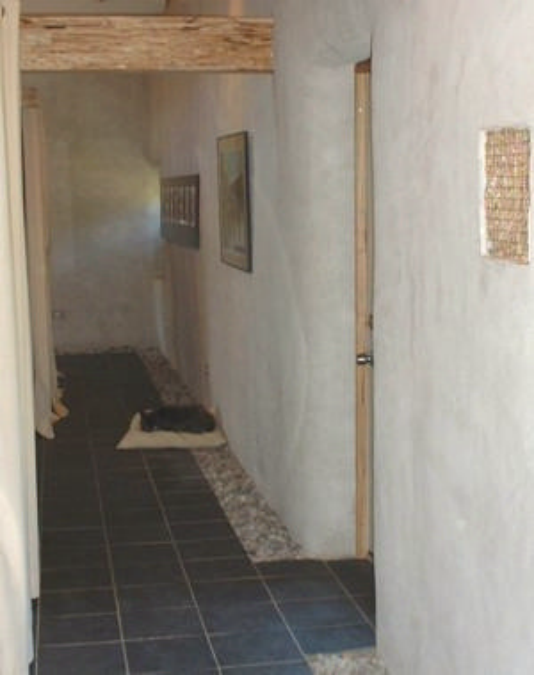
Straw bale walls provide R50-R60 insulation levels on the north wall. Truth window (upper right) exposes the straw bale near the entranceway. Minimal windows and doors reduce heating loss in the winter. Gravel hides vents to the basement for improved stack effect cooling in the summer. The stone also ‘naturalizes' the internal space providing one of the most effective esthetic features. Natural cotton curtains replace synthetic sliding doors for cupboards on the left.
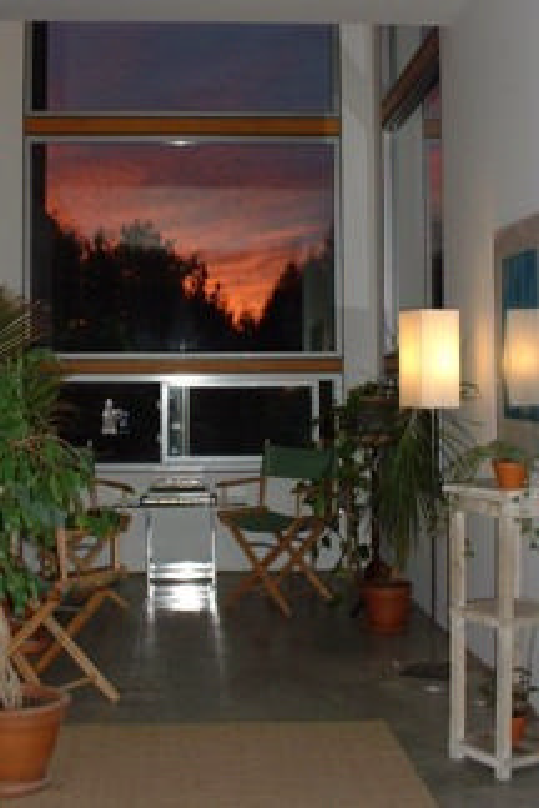
Green house exposes plants to light from early sunrise to sunset all year round.
Clean Green Renewable Power
Grid tied solar photovoltaics and a wind turbine for electricity have proven to be very viable as an alternative energy source. Even on a small scale the system provides reasonable payback of less than twenty years. With future subsidies removed from oil/nuclear and provided for renewable sources, payback may be reduced quickly to less than five to ten years. The best solar orientation and solar design principles need to be used. The house combines straw bale insulation with passive solar design techniques and high quality fiberglass windows from Inline Fibreglass Inc. Supplemental heat is supplied by a radiant floor heating system, and a small wood stove centrally located.
Energy System Configuration
Installed by Phantom Electron Corp. Web: www.phantomelectron.com
1 kWh Bergery XL wind turbine on a 60 foot tower
10 x Siemens 40 Wh solar photovoltaic panels
Xantrex/Trace inverter rated at 2.5 kWh
4 batteries as a buffer for wind turbine
Grid tied (the meter runs backwards most days!)
Cost Canadian $20,000
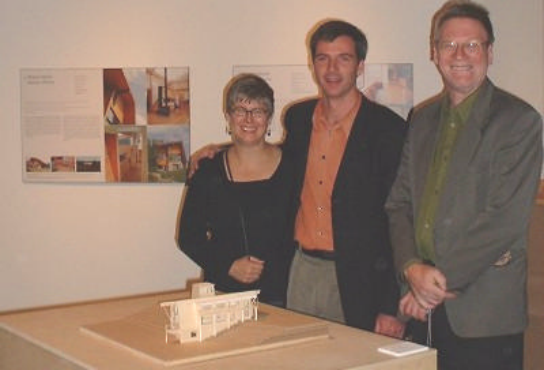
Wilson Natural Home, designed by Martin Liefhebber, is featured at the Living Spaces exhibit. Leigh Geraghty and John Wilson (left), owners of the home are photographed here with architect Martin Liefhebber (right).
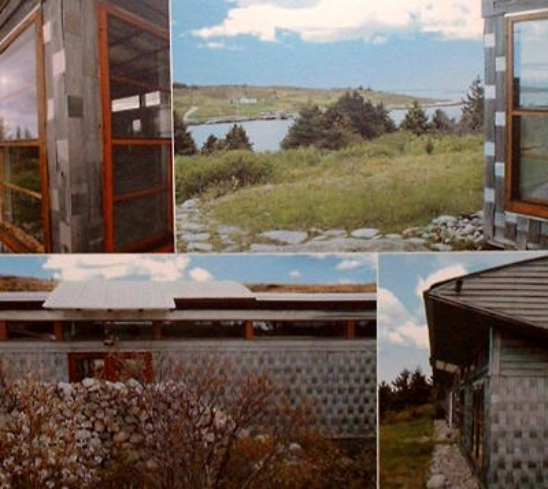
Inspired thinking by architect/owner Richard Kroeker makes this House in Long Cove a wonderful interpretation of natural forms. Putting earth on the roof provides ballast, protects the roof membrane, provides natural habitat, holds water and is relatively easy to accomplish. Local plants thrive in the "living roof" system providing for low maintenance and naturally fitting into the local terrain.
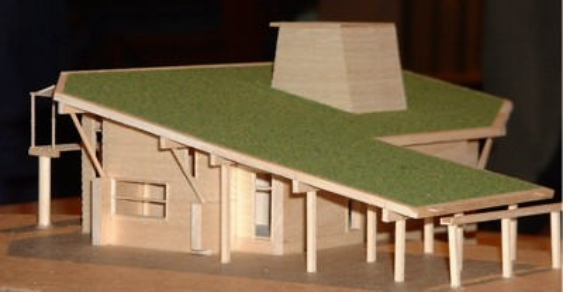
Wilson Natural Home model showing the extensive green roof that reduces heating in the summer by 30-40% and improves insulation for the winter. Green roofing also reduces impact on the local environment.
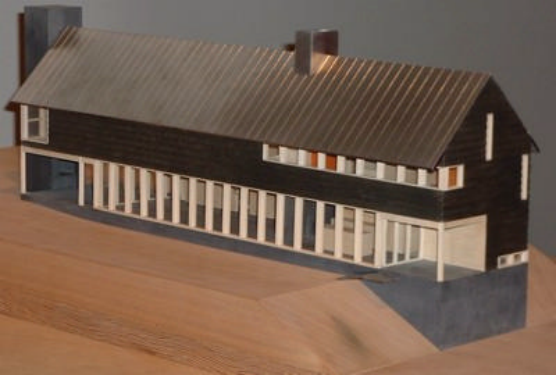
Simplicity of design inspires this country cottage north of Montreal. The Maison Goulet was designed by Saia Barberese Topouzanov Architectes.
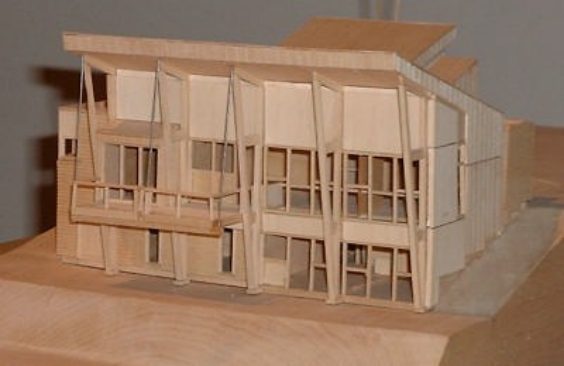
The Salyzyn residence uses parallam posts and beams to expose windows to the incredible views offered by the east coast of Canada.
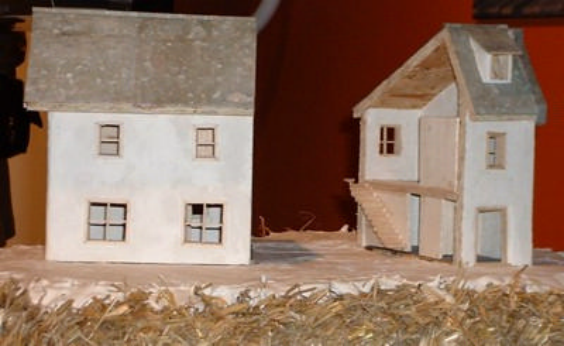
R-40 straw bale house built in a downtown location on an in-fill lot in Montreal. The architect/client is Julia Bourke who neatly combines the concepts of sustainability, affordability, and urban in-fill.
Living Spaces: 21 Contemporary Canadian Homes was undertaken by Cambridge Galleries. Lead curator, John Ota and regional curators, Christine Macy, Marco Polo and David Theodore present the work of some of the Canada's most distinguished and innovative architects. The exhibition also features the homeowners' views, ideas and quotes. The focus was on changing lifestyles, complicated sites, modest budgets and concern for the environment.
Martin Liefhebber + Associates
Who is the architect behind the Wilson Natural home? Martin and his associates are creating a new way of building homes suited to the needs of sustainable design. The practice is a think tank that allows clients and associates to answers the questions required to create a comfortable 'way of life'.
BUILDING AS PROCESS RATHER THAN PRODUCT Clients that hire Breathe Architects are able to reinvent themselves, as their research and design insight combine to provide answers that result in buildings that are used as instruments of change:
This innovative practice speaks for itself as clients go on to demonstrate the worthiness of the innovative ideas, communicate it on their websites and, in doing so, generate additional prospective clients. As a result, clients become part of the 'Breathe by Association' team.
Purpose and Goals: Breathe Architects anticipate the visions of their residential clients to become more and more relevant to commercial and institutional organizations. The practice's transformation from Martin Liefhebber Architect Inc. into Breathe Architects enables them to respond to larger scale building programs. They see the relative smallness of the residential work completed thus far to be an essential part of this process. The innovation has to come from the small into the big in order to provide evidence of effective alternatives, reinforce client ambitions, and in order to create a sustainable business model - for their clients, themselves and the ongoing relevance of architecture.
Innovative Technique: Their unique approach sets Building Code precedents and enables clients to express themselves through their product, be it intellectually, spiritually or monetarily.
Background to the Transformative Model: They see, as a logical extension, the need to promote more environmentally sensitive living on a larger scale. Up until a few years ago the practice has been a Sole Proprietor. By embracing the Integrated Design Process they have further expanded the team and skill set necessary for the manifestation of an ecological practice. This inspires their clients to be more open-minded, accept ecological principles into their lives, and to communicate these to the broader community.
Implementation: As a team - client, builder and architect - they challenge conventions by proving that alternatives are ready for implementation. A good example is the ruling of the Ontario Building Code Commission that strawbale construction, a 'breathing' wall assembly, is superior to conventional 'sealed' construction.
Demonstration Results: By producing hundreds of articles, documentaries and interviews on their projects throughout the years, the media has shown that the way Breathe practices architecture is relevant to the general public. The architectural practice is indeed relevant to a wider audience by addressing environmental concerns.
Cost/ Benefits: In addition to their low annual operation costs, Breathe clients benefit from the health and wellbeing of living in the dwellings they design. Further, there is a reduction in costs to the community and environment, which are usually externalized in conventional cost/benefit considerations. They eliminate reliance on fossil fuels, seek to use renewable resources, and source manufacturers whose products do not reduce the value of the environment or negatively affect a client's health. They encourage 'life-cycle' thinking and like to embody 'waste' and 'recyclable' products as building materials.
More Information
To contact John Wilson about the Wilson Natural home or about the Solar Village development being planned please send an email to john.wilson@naturallifenetwork.com . More Information on the Web on how you too can take advantage of solar, wind, straw bale, green roofing and to learn much more about the construction of the Wilson home see: http://www.NaturalLifeNetwork.com/wilson . Breathe Architects / Martin LiefhebberThe firm is the award-winning architect for the Wilson House. Breathe Architects is an unique design firm with leading edge expertise in ecological and renewable energy systems. The firm combines a variety of interrelated disciplines to develop affordable and environmentally adept housing. Web: www.breathebyassociation.comEMail: info@breathebyassociation.comPhone: 416-469-0018 Kolapore Construction Inc. (formerly C & R Construction) / Colin Richards Kolapore Construction is in the custom home construction business with a distinct view to the integration of natural, ecologically friendly, and renewable energy resources. Email: gregory.richards@sympatico.caPhone: 905-880-2732 Phantom Electron Corporation / Leonard AllenWe are innovators, committed to a leadership role in the development and utilization of solar electric technologies in mainstream applications. Our team is building a unique company that is powered by vision... a vision that sees our products providing an avenue for transparent integration of renewable energy into everyday markets. Web: www.phantomelectron.comEMail: sales@phantomelectron.comPhone: 905-430-6512
-
Books About A New World Order
The biggest force slowing the broad based support for the changes required for sustainability are the "corporation" and the governments they control. How did we get to this point in such a brief time and how do we move towards a more equitable and sustainable future? Two books that bring home these important problems and how they can be overcome are The Corporation (also an award-winning documentary), and Alternatives to Economic Globalization. In terms of clarifying the problems and providing workable solutions, these two books provide invaluable information.
The Corporation: The Pathological Pursuit of Profit and Power by Joel Bakan
My main interest as a legal scholar is in how the law shapes and is shaped by social and economic forces. THE CORPORATION is a project that came out of this interest. In 1997 I published a book, JUST WORDS: CONSTITUTIONAL RIGHTS AND SOCIAL WRONGS, in which I argued that constitutional rights were becoming increasingly ineffective in protecting the ideals they embodied, such as freedom, equality and justice. One reason for this, I suggested, was that constitutions apply only to governments; they do not apply to the key institution of market capitalism-the corporation.
The problem was especially pressing because, with economic globalization in full swing, corporations were emerging as global governing institutions, dominating societies and governments throughout the world. At the same time, most people had, and have, very little understanding of their true institutional nature. So it made sense to ask-what is the nature of this new governing institution? And what are the consequences of its growing hold on society? I developed the idea that the corporation, deemed by the law to be a person, had a psychopathic personality, and that there was something quite bizarre, and dangerous, in such an institution wielding so much power.
Quotable
"Since Rachel Carson's Silent Spring began to expose the abuses of the modern industrial system, there has been a growing awareness that profit at the expense of Earth--of individuals, society, and the environment--is unsustainable. Joel Bakan has performed a valuable service to corporations everywhere by holding up a mirror for them to see their destructive selves as others see them. The clarion call for change is here for all who would listen." - Ray Anderson, CEO of Interface, a multi-billion dollar company
Alternatives to Economic Globalization: A Better World is Possible Editors John Cavanagh and Jerry Mander
After years of protest in opposition to corporate globalization, the International Forum on Globalization presents alternatives to corporate domination of the world economy more fully and thoughtfully than has ever been done before. This books includes some of the best of current thinking on alternatives for a sustainable future including:
Ten governing principles for a new social paradigm-one that will lead to truly democratic and sustainable societies that benefit the many rather than the few
Spell out alternatives to the World Bank, the IMF, and the WTO that advance democracy, basic rights, and ecological sustainability
Show how vital goods and services (such as water or genetic material) can be administered for the common good rather than privatized for profit
Offer alternative operating systems for energy, agriculture and food systems, transportation, and manufacturing
Provide examples of successful alternative policies and systems already in use by communities around the world today Written by a premier group of 21 thinkers from around the world, the second edition of Alternatives to Economic Globalization lays out democratic, ecologically sound, socially just alternatives to corporate globalization more fully, specifically, and thoughtfully than has ever been done before. Focusing on constructive, achievable goals, the authors present ten governing principles for establishing truly sustainable societies and describe alternatives to the World Bank, the IMF, and the WTO that would better serve the needs of the planet. They offer detailed proposals for protecting vital goods and services from corporate exploitation, limiting corporate privileges and power, rebuilding economies to make them more responsive to human needs, and more.
The definitive document of the anti-corporate globalization movement - the consensus report of an alliance of leading activists, scholars, economists, researchers, and writers. This book offers a constructive, coherent, positive alternative to globalization-the very thing that the anti-corporate globalization movement is always accused of not putting forward. The International Forum on Globalization consists of the leaders of over 60 organizations in 25 countries - including such prominent organizations as Friends of the Earth, the Third World Network, the Sierra Club, the Institute for Policy Studies, Public Citizen, Rainforest Action Network, and Food First.
Quotable
"Globalization is not inevitable. Fortunately, there are alternatives and presenting them is the achievement of this book. Read it and be motivated: A better world IS possible." - Dennis J. Kucinich, United States Congressman -
Books About Power
Two books that I've read recently have brought home to me how important dealing with our sustainable energy problems will continue to be. In fact, the more I think about it the more that I see how much ideas like population controls, conservation, efficiency, organic farming, permaculture, urban transit systems, and solar power, are so critical to evolving our society. As the oil runs out, and as these books so ably demonstrate, it may be sooner that we expect. It will be to these ideas of sustainability, of Natural Living, that we will be forced to survive. As our ecological footprint shows oil has allowed us to exceed the sustainable capabilities of natural systems. With growing population levels we have already exceed what may be sustainable without oil. If we have any chance of surviving the next fifty to one hundred years it will be because we address these issues. Coming to terms with their reality is critical. So read these books and start taking action today.
War. Big Oil, and the Fight for the Planet: It's the Crude, Dude by Linda McQuaig
Who stands to gain or lose the most from climate change? The oil companies, the largest industry on the planet. When you add up all the subsidies provided ANNUALLY to oil and nuclear energy, you can clearly see how big a lie it is to say that renewable energy systems aren't economical. Subsidies to oil and nuclear including the car and airline industry, amounts to significantly more than $200 billion per year and growing especially if you include the wars fought to protect these resources.
Let us say then that the subsidies to these industries reaches about $1 trillion over the last ten years, contributing massively, if not exclusively to climate change. Now, take away this $1 trillion in subsidies from the oil, nuclear, and transportation industries. Give the $1 trillion in subsidies to the conservation, efficiency, and sustainable renewable energy sector over the next ten years. Suddenly oil and nuclear look uneconomic, and the alternatives make perfect sense.
Quotable
"we've used up the earth's oil so rapidly and recklessly that we have not only jeopardized the viability of the planet (part one of the energy dilemma), but we have at the same time squandered much of this incredibly valuable on-time inheritance. This may sound like a contradiction. If oil is so bad for the earth's ecosystem, maybe we shouldn't care that it's running out. The problem is that we've built the modern world around it, relying on oil for transportation, industry, agriculture and just about every other thing we do, eat, wear, type, watch and move around in." - pg. 29, War, Big Oil and the Fight for the Planet: It's the Crude, Dude.
" annual subsidies to the industry amounted to $14 billion in the U.S., $5.9 billion in Canada and a total of $59 billion in all the industrialized nations that make up the OECD." "nuclear industry, received $12 billion in annual subsidies in OECD countries." "The fossil fuel industry is also aided greatly by massive subsidies to the car and airline sectors plus $135 billion a year in the U.S.-on the construction and maintenance of roads." - pg 299, War, Big Oil and the Fight for the Planet: It's the Crude, Dude.
Power Down: Options and Actions for a Post-Carbon World by Richard Heinberg
Rather than retaining any level of false optimism this book and the author take deadly aim at the priority issues we face and their terrible consequences.
Powerdown provides a visionary response to the coming energy famine, a clarion call to cooperative solutions based on the conviction that realism must trump self-delusion in matters of cultural survival. Ultimately there is hope if we are willing to look truth in the eye. If we have the strength to admit our problems we will find the solutions. Quotable
"Most of the wars of the twentieth century were fought over resources - in many cases, oil." Pg 21.
"The elites - corporate owners and managers, government officials, and military commanders - are people who have been selected for certain qualities: loyalty to the system, competitiveness, and hunger for power. Often they are literally bred for their roles. Like George W. Bush, they are people born to wealth and power, and raised to assume that privilege is their birthright. These are people who identify with the system and the status quo; they are constitutionally incapable of questioning assumptions.
Moreover, the elites are guided day-to-day by a set of incentives that are built into the system itself. Managers who pursue immediate gain get ahead, while those who make short-term sacrifices in order to preserve long-term stability are often at a disadvantage. Likewise, managers are rewarded who keep up appearances, who generate good news, and who exude confidence. Confessing errors accrues no benefit; instead, managers are encouraged to deny short-comings and to blame competitors and subordinates." Pg. 168.-
Reading
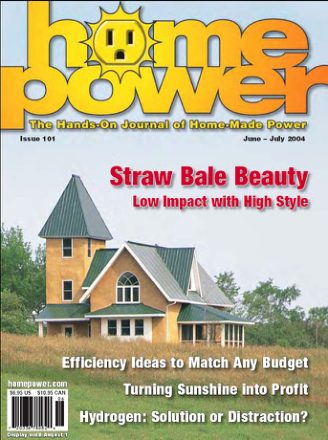
Home Power
For anyone who wants to get into the details of living with renewable energy this is the magazine for you. Each month this hands-on journal has off-the-grid and on-the-grid home owners tell their story in an easy to understand format. If you are interested in the technical details and comparing systems then this is the ultimate source of information. You can download a free copy off their web site each month in PDF format.
Web Site: www.homepower.com
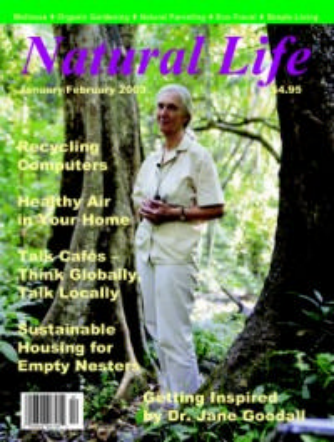
Natural Life
This simple magazine covers a wide range of sustainable living topics. For ideas that we can all start using today this is the place to start. Each issue reaches far and wide for interesting stories with lots of ideas for living a more natural life style.
Web Site: www.naturallifemagazine.com
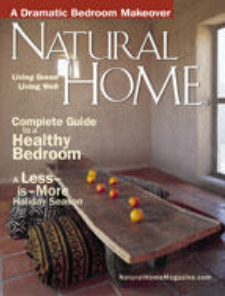
Natural Home
Each month this magazine features new and renovated homes that are seriously sustainable. Like other popular home and design magazines, you also get coverage of life issues, food, travel and other related topics, all with a "green" twist of course. Other departments include Good to Know, Green Events, New & Noteworthy, Try This, Nuts and Bolts, and Earth Mover Awards. If you want to be inspired by high-end homes with tons of creativity, and features like solar panels, this is a great magazine.
Web Site: www.naturalhomemagazine.com
Dwell: At Home in the Modern World
Small Change is what it takes over a period of time to make the big changes. Dwell magazine may just be about affecting big change in the mainstream. This slick magazine has a real ecological design supported focus while also insisting on homes that look good. " Dwell has become proactive in its mission. The magazine isn't just writing about and showing photographs of the design of houses, she suggested, but is actually influencing the ways in which they are designed and built." The current issue takes aim at ideas such as smaller homes, prefab alternatives, and Dwell Home II, a sustainable house to be built in LA. Check out the amazing four-page pullout spread. The winning home includes passive solar, solar panels, and a green roof.
Web Site: www.dwellmag.com-
Join Us
Become a part of a community of people around the world dedicated to living in harmony with nature. We've created this network so that we can all share our ideas, experiences and knowledge. The changes we envision are revolutionary; however our goals are to make them the norm. The organization is about the practical, inspiring and real application of living gently on the earth so that our children may enjoy a clean, healthy and productive environment.
The simple point is that we all can "do" much more - and that means all of us or it won't work. For example:
§ Choose or create a home/community that is powered by the sun; § Grow and eat organic food; § If you must travel select the most efficient means, walk, bicycle, tele-commute, travel by train, bus, ultra-efficient car, or fly; § If and when possible, work in nature - grow your own
organic food, restore nature around you, put your investments to work for natural living. What will amaze you that everything we need to live this way exists. The cost over the longer term is less. The results are a happier more healthy self and family. Start learning how today. Member benefits:
Monthly Natural Living Journal full electronic edition.
E-Mail Question & Answer (3 per year, no more than 1 per month.)
Directory listing (optional) and Natural Directory.
Discounts on some products and services offered by Natural Life Network. Sign-up for membership at: www.NaturalLifeNetwork.com-
Next Issue
Ecovillages and the future of communities. For weekly updates, special offers, and additional products and services visit our web site: www.NaturalLifeNetwork.comHave a question? Ask us and we'll try and include a response in our next issue of the Natural Living Journal. Have an interesting story to tell that relates to natural living? Contact us any time with your questions, concerns or ideas at: john.wilson@naturallifenetwork.com-
Order the Journal now! www.NaturalLifeNetwork.com